eBook - ePub
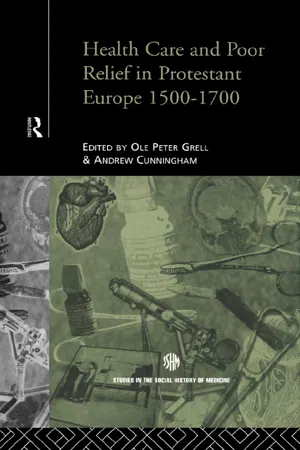
Health Care and Poor Relief in Protestant Europe 1500-1700
- 272 pages
- English
- ePUB (mobile friendly)
- Available on iOS & Android
eBook - ePub
Health Care and Poor Relief in Protestant Europe 1500-1700
About this book
The problem of the poor grew in the early modern period as populations rose dramatically and created many extra pressures on the state. In Northern Europe, cities were going through a period of rapid growth and central and local administrations saw considerable expansion. This volume provides an outline of the developments in health care and poor relief in the economically important regions of Northern Europe in this period when urban poverty became a generally recognized problem for both magistracies and governments. With contributions from international scholars in the field, including Jonathan Israel, Paul Slack and Rosalind Mitchison, this volume draws on research into local conditions and maps general patterns of development.
Chapter 1
The Reformation and changes in welfare provision in early modern Northern Europe
Ole Peter Grell and Andrew Cunningham
This volume intends to provide a comparative survey of the welfare provisions available to the poor and sick in early modern, Protestant Northern Europe. It also explores the relationship between Protestantism and reform on the one hand and the changes in health care provision, that is ‘professional’ medical care, nursing and hospitals, on the other. The volume draws attention to the fact that the major context of health care provision in the early modern period was poor relief, which in turn has to be seen within the context of the ideology of the Reformation.
Geographically it deals with the countries surrounding the North Sea and the Baltic. Such a choice is fully justified by the contemporary network of economic, religious, and political contacts which linked this region together. Furthermore, apart from Antwerp, which became a Calvinist centre only from the mid-1570s until 1585, it is also an area where the Protestant Reformation made a lasting impact. Obviously the eleven chapters presented here cannot deal exhaustively with health care provision and poor relief in all these countries, particularly since issues such as medical care have received only scant attention within most of the national historiographies covered here. However, in the case of England, which is unique in having seen the publication of a considerable number of works dealing with the country’s social and medical history in the early modern period over the last three decades, the problem is the exact opposite: how to include it all.1
Seen exclusively within an Anglo-Saxon social-medical historiography, the chapters presented in this volume with their deliberate focus on urban and institutional welfare reforms in the early modern period, may present a contrast with more present-centred emphases on outdoor assistance, the poor themselves, and gender. However, the lack of detailed studies in most of the region with which this volume is concerned would have rendered such an approach dubious if not impossible. Thus in order to produce a truly comparative volume, an urban, institutional focus placed within the context of the Protestant Reformation offers the most promising parameters.
Without denying the significance of the serious social and economic changes which affected Western Europe in the sixteenth-and seventeenth centuries, most of the contributors to this volume have serious reservations about the traditional or conventional association between economic change and welfare reforms.2 Apart from major social eruptions, in the form of rebellions, it is far from clear whether it was economic boom or slump which stimulated reforms. Instead a majority of the chapters in this volume emphasise the role and importance of ideology and politics and undoubtedly support the call for a revised and a renewed emphasis on the significance of the Protestant Reformation for the speed and thoroughness of the reforms in health care and poor relief in early modern Northern Europe as expressed in Chapter 2 of this volume.
That poverty and disease represented two sides of the same coin is well known, but that medical treatment and care formed an important part of poor relief and charity well before the so-called medicalisation of the eighteenth century has yet to be fully appreciated. Furthermore, medical treatment and care was not restricted to inmates of poor houses and hospitals, but was available to those supported at home—the house poor—as Robert Jütte shows in the case of the cities of Hamburg, Lübeck and Bremen.3 The medical care available to the poor in the cities of Northern Germany would appear to have been similar to that on offer to the poor in the wealthy London parish of St Bartholomew’s Exchange in the late sixteenth- and seventeenth centuries.4 It was a twotrack system of health care. One, the most basic, was run by the poor themselves. They provided a nursing service for those of their fellowpensioners who fell ill or were injured, paid for by the parish. This was a system which appears to have been mutually beneficial to both the poor and the parish, as in the case of the widow Hasard who received several payments of one pound during the autumn of 1640 for looking after a poor man who had broken his leg. While supporting its poor the parish was able to provide health care for its sick and invalid.
The other track consisted of ‘professional’ medicine, seeking out and paying for the advice and drugs provided by physicians, surgeons and apothecaries. The financial help given to poor parishioners who sought ‘professional’ medical help was, as was the case in Hamburg and Bre- men, not given automatically or by right, but had to be petitioned for. In many instances the poor would have had to find the necessary money themselves in the first instance only to be reimbursed by the parish or the overseers at a later date. Even so, it is noteworthy that the poor were not automatically excluded from ‘professional’ medical care despite the fact that it was generally considered costly.
Even if Protestantism and the Reformation cannot lay sole claim to having caused the reforms of poor relief and health care which occured in the sixteenth- and seventeenth centuries in Protestant Western Europe, the speed and thoroughness with which they were undertaken would not have been imaginable without the theological rationale which the Protestant reformers gave to these reforms.5 As argued by Ole Peter Grell, it is time for a revision of the 1960s historiography, which tended to see the welfare reforms as being solely humanist and civic in origin and used an interpretation based on an often simplistic economic and social determinism.6
Begging had been at the centre of the medieval practice of charity, not least because of the teachings of Francis of Asissi and other Franciscans such as Bernardino of Siena who had emphasised that begging most fully expressed a person’s relationship with God. However, by the end of the fifteenth century the humility traditionally associated with the poor begging for alms was rapidly disappearing, not least because of their numerical increase. Instead begging became increasingly associated with the aggression and threat represented by sturdy beggars and vagrants. Furthermore the motives and humility of the mendicant orders, the leading representatives of the voluntary poor, were increasingly questioned by the urban laity. That the mendicant orders and their begging became a main target for Luther and the other reformers with their emphasis on faith and grace cannot surprise. The begging of these voluntary poor was considered presumptuous and blasphemous, apart from providing unfair competition to the truly needy. Poverty was for God to designate, not to be chosen as a particularly blessed state by friars and priests. It is undoubtedly in this confrontation with and rejection of voluntary, ecclesiastical poverty, based on a theology of faith and grace, that the Protestant ambition and need to develop a clear distinction between the deserving and undeserving poor is rooted. According to Protestants, voluntary or perceived voluntary poverty, whether lay or ecclesiastical, made a mockery of real poverty, which fell to the Christian commonwealth to tackle as an expression of neighbourly love, but not in order to earn points towards one’s salvation, towards which humanity by definition was unable to contribute. Consequently, Protestants strove to eliminate all begging rather than just trying to regulate and control it, which tended to be the Catholic solution.
Not surprisingly Catholic contemporaries accused Protestant communities of trying drastically to limit the numbers of deserving poor. In the main they were probably correct in their perception of Protestant communities seeking to restrict their charity to the residential, authentic and morally upright poor.7 Plenty of examples can be found of Protestant communities refusing to assist the sick and needy for moral reasons. In Delft in the United Provinces the poor assisted by the Reformed Church were not allowed to frequent inns, while in 1622 the consistory of the church in Alkmaar refused to pay for the medical treatment of a poor woman whose immoral living had caused her to be infected with the pox.8 However, this is far from the whole picture. Occasionally, the sense of caritas might override the urge to impose social discipline, and assistance would be offered despite serious moral shortcomings. In August 1579 a certain Magdelene Vondelings appeared before the consistory of the Dutch Reformed Church in London. She had been excommunicated and now wanted to be reconciled with the community and readmitted to the communion table. The consistory rejected her request, pointing out that she had fallen pregnant as a result of an illicit affair with a young man. However, they listened sympathetically to her complaints of ill health and homelessness, and having consoled her with ‘words from the Bible’ they recommended her case to the deacons for assistance.9
THE SIGNIFICANCE OF REFORMED EMIGRATION AND RE-EMIGRATION FOR THE CHANGES IN WELFARE PROVISION IN THE UNITED PROVINCES AND IN ANTWERP
The religious and social significance of Reformed emigration from the Southern Netherlands and the period of re-emigration that followed (and which eventually saw many of those who had sought refuge in England and Germany return to the Netherlands) can hardly be overstated with regard to the changes in health care and poor relief which took place in Northern Europe from the second half of the sixteenth century onwards. The wealth of material and documentation relating to the Dutch exile community in London provides us with a particularly valuable example of how these communities functioned. The caring approach of the first generation of ministers and elders in the Dutch Reformed community in London even towards those of their poor who caused offence and difficulties was often remarkable. Faced in December 1573 with a woman who had insulted the deacons and expressed her dissatisfaction with the relief offered to her and her four children— five shillings a month—while publicly stating that she had no intent of taking her complaints either to the church or the consistory, because, according to her, poor people could expect no justice or fair treatment there, the consistory members, instead of severely disciplining her, dealt patiently with her, eventually reconciling her with the deacons and the community.10
The poor belonging to the Dutch Reformed communities were, like their Lutheran counterparts, expected to refrain from begging in return for the relief provided by their community. A further aspect of the ‘discipline’ they had to accept in order to receive alms was the obligation to open their homes to regular visits and inspections by the deacons, plus their obligation to keep the deacons informed about their financial situation. However, these regular home visits by the deacons did not only serve to impose social discipline and prevent abuse. In many communities they also provided an occasion for the deacons to hand out their charity in a non-public and discreet manner. This was an approach which served to minimise the stigma attached to poor relief and which made sure that assistance also reached the honourable poor who might feel ashamed to come forward in public. Thus in June 1572, the minister to the Dutch Church in London, Jooris Wybo, suggested to the consistory that in future alms should be distributed to the poor in their homes and not in the church. He also suggested that the regular house visits paid to all members by one of the ministers accompanied by the local elder should in future include a deacon, in order to make sure that the honourable poor who were hesitant to come forward could be included in the community’s charity.11 It was obviously important for the poor to try and hang on to what little honour they had left. The totally destitute often did their utmost to avoid the stigma attached to moving into the poorhouse even if this institution could provide them with a guarantee of shelter and food. Many of the poor were happy to receive outdoor relief while the prospect of the poorhouse clearly represented a further drop in social prestige and freedom from which the poor saw little chance of recovering. Thus in 1633 the deacons of Austin Friars in London had to request the assistance of the elders and ministers in forcing some of the community’s poor to move into the poorhouse.12
After 1572, when the Dutch Revolt had become essentially a Protestant revolt, and the Reformed Church was actively establishing itself within the United Provinces, two avenues of relief were open to the poor in the rebellious north apart from begging. They could approach the lay overseers of the poor who were employed by the local magistracies, who had taken over the houses of the Holy Spirit and with them the patrimony of the Catholic Church. Or they could try their luck with the newly appointed deacons in most urban communities who collected money for the poor immediately after the services and conducted doorto- door collections among members and sympathisers of the Reformed faith, which were not exclusively intended for members.
In reality, however, it is difficult to draw a distinction between lay and Reformed charity in the United Provinces. In some places such as Leiden and Enkhuizen all income from former Catholic charities and religious establishments and from gifts and collections were gathered in a common chest which was administered jointly by the overseers and the deacons, but with the civil authorities dominating. Since faith did not enter into the question of whether or not someone qualified for relief, such a regime might occasionally cause unexpected problems. Thus godly, Reformed refugees from the Southern Netherlands might find themselves excluded from receiving relief, because they failed to fulfill the important criteria of residence in order to be included among the deserving poor. In particular this seems to have occurred in villages with a Catholic majority and resulted in complaints about the overseers favouring ‘those of the Popish religion’.13 The deacons’ account book for the community of Hazerswoude near Leiden covering the years 1620–5 may well offer a guide to how the money collected for the poor and sick was spent by the Reformed communities in the Dutch Republic. Poor relief was generally offered on a continuous or longer-term basis whereas one-off assistance tended to be given to the sick and to women who had recently given birth.
Even in cities such as Amsterdam where the lay overseers and deacons operated totally separately and where the deacons were expected to care for members of their congregations while the city officials dealt with other residents of the city, the magistracy kept a controlling hand on the till. The city council remained well represented within the consistory during most of the late sixteenth-and seventeenth century, a fair number of councillors served regularly as elders and deacons, while a percentage of church collections were always handed over to the lay overseers of the poor. The deacons in major Dutch cities such as Haarlem and Amsterdam seem to have been able to dispose of large amounts of money for charitable purposes during this period. In Amsterdam the Reformed community was able to distribute 10,000 guilders in 1587, 70,000 guilders in 1608, 140,000 guilders in 1625 and 250,000 guilders in 1645 to the poor and sick.14 Despite their primary concern for the welfare of members the deacons never excluded other needy. Travellers with attestations, proving their membership of Reformed communities in other towns and cities, were assisted as were many travellers without such papers, especially soldiers who had served in the war against the Spaniards.
The wealth and ability to provide poor relief of the Reformed Church in Amsterdam, combined with the explosive growth of the city from the late 1580s onwards, caused problems for the deacons. Amsterdam was attracting a continuous stream of immigrants and migrants who were looking for opportunities and employment in the city and who, if they possessed valid attestations from other Reformed communities, could lay some claim to poor relief from the church. Many fell on hard times and must have placed an increasing b...
Table of contents
- Cover Page
- Title Page
- Copyright Page
- List of contributors
- Preface
- Chapter 1: The Reformation and changes in welfare provision in early modern Northern Europe
- Chapter 2: The Protestant imperative of Christian care and neighbourly love
- Chapter 3: Dutch influence on urban planning, health care and poor relief
- Chapter 4: Continuity and change
- Chapter 5: Health care provision and poor relief in early modern Hanseatic towns
- Chapter 6: Poor relief and health care provision in sixteenth-century Denmark
- Chapter 7: The wrath of God
- Chapter 8: Health care and poor relief in Sweden and Finland
- Chapter 9: Health care and poor relief in Danzig (Gdansk)
- Chapter 10: Poor relief and health care in Scotland, 1575–1710
- Chapter 11: Hospitals, workhouses and the relief of the poor in early modern London
Trusted by 375,005 students
Access to over 1.5 million titles for a fair monthly price.
Study more efficiently using our study tools.
Frequently asked questions
Yes, you can cancel anytime from the Subscription tab in your account settings on the Perlego website. Your subscription will stay active until the end of your current billing period. Learn how to cancel your subscription
No, books cannot be downloaded as external files, such as PDFs, for use outside of Perlego. However, you can download books within the Perlego app for offline reading on mobile or tablet. Learn how to download books offline
Perlego offers two plans: Essential and Complete
- Essential is ideal for learners and professionals who enjoy exploring a wide range of subjects. Access the Essential Library with 800,000+ trusted titles and best-sellers across business, personal growth, and the humanities. Includes unlimited reading time and Standard Read Aloud voice.
- Complete: Perfect for advanced learners and researchers needing full, unrestricted access. Unlock 1.5M+ books across hundreds of subjects, including academic and specialized titles. The Complete Plan also includes advanced features like Premium Read Aloud and Research Assistant.
We are an online textbook subscription service, where you can get access to an entire online library for less than the price of a single book per month. With over 1.5 million books across 990+ topics, we’ve got you covered! Learn about our mission
Look out for the read-aloud symbol on your next book to see if you can listen to it. The read-aloud tool reads text aloud for you, highlighting the text as it is being read. You can pause it, speed it up and slow it down. Learn more about Read Aloud
Yes! You can use the Perlego app on both iOS and Android devices to read anytime, anywhere — even offline. Perfect for commutes or when you’re on the go.
Please note we cannot support devices running on iOS 13 and Android 7 or earlier. Learn more about using the app
Please note we cannot support devices running on iOS 13 and Android 7 or earlier. Learn more about using the app
Yes, you can access Health Care and Poor Relief in Protestant Europe 1500-1700 by Andrew Cunningham,Ole Peter Grell in PDF and/or ePUB format, as well as other popular books in History & World History. We have over 1.5 million books available in our catalogue for you to explore.