Restless Youth in Ancient Rome presents an inclusive portrayal of the perceptions the Romans had of youth and of the role of this age group in a wide variety of domains - philosphy, literature, education, the law, the army, politics, leisure, amorous pursuits and family life. Emiel Eyben considers the involved farrago of thoughts, feelings and behaviour of youth throughout the period and shows how youth itself put its stamp on its environment.
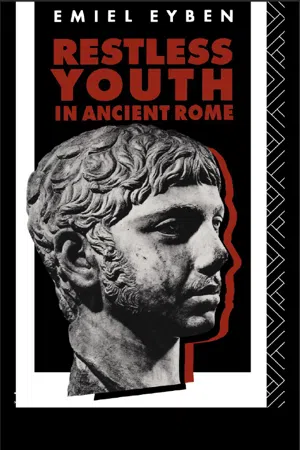
- 376 pages
- English
- ePUB (mobile friendly)
- Available on iOS & Android
eBook - ePub
Restless Youth in Ancient Rome
NOTES
jR in the notes refers to my book De jonge Romein volgens de literaire bronnen der periode ca. 200 v. Chr. tot ca. 500 n. Chr., Brussels: Paleis der Academiën, 1977.
INTRODUCTION
1 Cf. C.N. Degler (1975) 5–6: The definition of history is a changing thing: there is nothing sacred about its content. Today fields of history once central to the subject—like constitutional history—are quite peripheral, while urban history, or black history, once barely known, have pushed to the fore. The definition, or, more accurately, the content of history, will change as we ask where the women [or the youths] have been.’
2 Cf. E. Eyben (1991) 225–55.
3 Cf. D.M. Halperin (1990) 2: ‘Within the last two decades, especially, political movements originating outside the academy have so transformed life within it that a classical scholar who studies ancient Greek sexual practices, including paederasty (the ‘unspeakable’ vice) …can expect not only to be tolerated by the profession but to be materially rewarded by it as well.’
4 All other books on Roman youth are from a recent date. Cf. J.-P. Néraudau (1979), who deals mainly with youth from the period before 200 BC; L.Giuliano (1979), who studies some aspects of republican youth; M. Kleijwegt (1991), whose mainly epigraphical study—which appeared when the text of this book was substantially complete—focuses on some aspects of youth (especially politics) in the cities of the Graeco-Roman world under the Empire. For a bibliography on child and youth in antiquity, cf. M.Karras/ J.Wiesehöfer (1981).
5 Cf. G.R.Lambert (1982) 56 n. 7: ‘Rather full quotations have often been given for the reason stated by A.O.Lovejoy in his now virtually classic statement of what is involved in the study of history of ideas (The Great Chain of Being, 1936, p. ix): “…In my own reading I have often been exasperated by finding précis or para phrases where I desiderated the actual language of the authors whose ideas were under consideration: and my rule has therefore been to give the words of relevant texts as fully as was consistent with reasonable brevity”.’
I YOUTH AS A DISTINCT AGE OF MAN
1 Cf. jR 62–128. An earlier version of this chapter appeared as E. Eyben (1987).
2 J.H.Van den Bergh (1956); Ph. Ariès (1960).
3 F.Musgrove (1968) 13ff. (‘Making adolescents’); 33ff. (The invention of the adolescent’). These views influenced classical scholars such as H.W.Pleket (1979) 173–92 and M.Kleijwegt (1991), who founded their thesis mainly on epigraphical material. On this inspiring—but in my eyes incorrect—point of view, cf. E.Eyben (1981a) 328–50.
4 A.Kriekemans (1967) 298.
5 Cf. jR. 65ff.; E.Eyben (1981b) 133–40; (1981a) 328–50.
6 Cf. jR. 5–40. On age qualifiction in (Roman) antiquity, cf. F.Boll (1950) 156–224; E.Eyben (1973b) 150–90; D.Slu anski (1974) 103– 21, 267–96, 345–69, 437–51, 563–78; W.Suder (1978) 5–9.
7 Varro, in Censorinus, 14, 2. Cf. jR 21ff.; D.Slu anski (1973) 103–9. Important also is Isidore of Seville, Orig., 11, 2, 2ff. (a division of the human life-span based on the number seven; youth lasts from 14 until 28). Cf. jR 25ff.
8 Cf. pp. 42ff. Therefore iuventus during the Republic almost always refers to young people as a class rather than to an age.
9 Cf. B.Axelson (1948) 7ff. In late antiquity, however, Church Fathers such as Ambrose and—especially—Augustine apparently distinguish adulescens (from 15 until 30) and iuvenis (from 30 until 45). Cf. jR 35–7. Important also is the fact that Plautus and Terence always use adulescens (or adulescentia) and that poets from Catullus on (almost) always use iuvenis (or iuventus).
10 Cf. H.Harmon (1978) 1596–8; G.Amiotti (1981) 131–40; E.Eyben (1985) 412ff.; T.E. J.Wiedemann (1989) 114–17.
11 Cf. W.W.Fowler (1896) 317–19; E.Eyben (1986) 331–2.
12 Cf. pp. 19ff.
13 Cf. pp. 21–2.
14 On the Lex [P]laetoria and the minor aetas, cf. S.Solazzi (1912); E.Weiss (1931) 578–82; A.Berger (1932) 1860–89; G.Wesener (1974) 571–81; S.di Salvo (1979); E.Eyben (1981a) 329–31; (1985) 426–8; J.- P.Néraudau (1979) 106ff.; L.Giuliano (1979) 73ff. Cf. B.Perrin (1966) 1455–65 (the ...
Table of contents
- COVER PAGE
- TITLE PAGE
- COPYRIGHT PAGE
- INTRODUCTION
- I. YOUTH AS A DISTINCT AGE OF MAN
- II. YOUTH AND THE ESTABLISHED ORDER
- III. THE LEISURE ACTIVITIES OF YOUTH
- IV. YOUTHFUL THINKING
- V. THE EMOTIONAL LIFE OF THE YOUNG ROMAN
- CONCLUSION
- NOTES
- BIBLIOGRAPHY
Trusted by 375,005 students
Access to over 1.5 million titles for a fair monthly price.
Study more efficiently using our study tools.
Frequently asked questions
Yes, you can cancel anytime from the Subscription tab in your account settings on the Perlego website. Your subscription will stay active until the end of your current billing period. Learn how to cancel your subscription
No, books cannot be downloaded as external files, such as PDFs, for use outside of Perlego. However, you can download books within the Perlego app for offline reading on mobile or tablet. Learn how to download books offline
Perlego offers two plans: Essential and Complete
- Essential is ideal for learners and professionals who enjoy exploring a wide range of subjects. Access the Essential Library with 800,000+ trusted titles and best-sellers across business, personal growth, and the humanities. Includes unlimited reading time and Standard Read Aloud voice.
- Complete: Perfect for advanced learners and researchers needing full, unrestricted access. Unlock 1.5M+ books across hundreds of subjects, including academic and specialized titles. The Complete Plan also includes advanced features like Premium Read Aloud and Research Assistant.
We are an online textbook subscription service, where you can get access to an entire online library for less than the price of a single book per month. With over 1.5 million books across 990+ topics, we’ve got you covered! Learn about our mission
Look out for the read-aloud symbol on your next book to see if you can listen to it. The read-aloud tool reads text aloud for you, highlighting the text as it is being read. You can pause it, speed it up and slow it down. Learn more about Read Aloud
Yes! You can use the Perlego app on both iOS and Android devices to read anytime, anywhere — even offline. Perfect for commutes or when you’re on the go.
Please note we cannot support devices running on iOS 13 and Android 7 or earlier. Learn more about using the app
Please note we cannot support devices running on iOS 13 and Android 7 or earlier. Learn more about using the app
Yes, you can access Restless Youth in Ancient Rome by Emiel Eyben in PDF and/or ePUB format, as well as other popular books in History & Ancient History. We have over 1.5 million books available in our catalogue for you to explore.