eBook - ePub
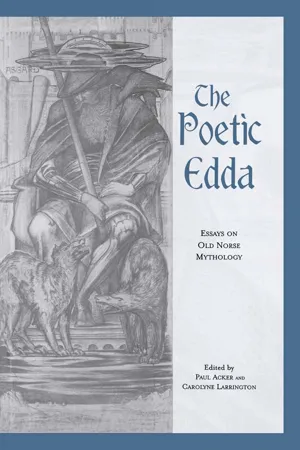
The Poetic Edda
Essays on Old Norse Mythology
- 300 pages
- English
- ePUB (mobile friendly)
- Available on iOS & Android
eBook - ePub
The Poetic Edda
Essays on Old Norse Mythology
About this book
This unique collection of essays applies significant critical approaches to the mythological poetry of the Poetic Edda, a principal source for Old Norse cosmography and the legends of Odin, Loki, and Thor. The volume also provides very useful introductions that sketch the critical history of the Eddas. By applying new theoretical approaches (feminist, structuralist, post-structuralist) to each of the major poems, this book yields a variety of powerful and convincing readings. Contributors to the collection are both young scholars and senior figures in the discipline, and are of varying nationalities (American, British, Australian, Scandinavian, and Icelandic), thus ensuring a range of interpretations from different corners of the scholarly community. The new translations included here make available for the first time to English speaking students the intriguing methodologies that are currently developing in Scandinavia. An essential collection of scholarship for any Old Norse course, The Poetic Edda will also be of interest to scholars of Indo-European myth, as well as those who study the theory of myth.
Information
“The Founding of Miðgarðr (Vǫluspá 1–8)”
Lars Lönnroth
Translated by Faul Acker
Vǫluspá
Vǫluspá is the first poem in the Codex Regius; it also takes pride of place in the poetic record of Old Norse mythology, especially as a source for myths of creation and of the destruction of the world at Ragnarǫk. In his Edda, Snorri drew extensively on the poem, quoting some thirty stanzas and paraphrasing material from sixteen others (Nordal, 1; see also Mundal). In addition to the stanzas quoted in manuscripts of Snorri and the complete version in the Codex Regius, the poem is preserved in a variant version in Hauksbόk (AM 544 4to; see Quinn 1990). Composed mainly in the meter fornyrðislag, Vǫluspá is usually dated to ca. 1000 (see further below).
The poem takes the form of a monologue spoken by a vǫlva, or prophetess. She addresses the father of the slain (Óðinn), who has asked her to ‘declare the ancient histories of men and gods’. She is an ancient being, perhaps even dead (she ‘sinks down’ at the end of the poem), and recalls a time when she was fostered by giants, before the earth, sea and sky were formed. These elements were established by the sons of Burr (Óðinn and his brothers, the male elders of the Æsir) and made orderly by the Æsir on their rǫkstόlar, or thrones of judgment. They build temples, forge tools and live in an age of gold, cheerfully playing checkers, ‘until three giantesses came’. Next the prophetess tells of the creation of dwarves (a long list of dwarf-names intervenes) and of the first two human beings, Askr and Embla; she also mentions Yggdrasill (the World-Tree) and the well of three maidens whose names mean (roughly) Past, Present and Future; they cast lots to determine human destinies.
Sts. 21–4 tell of a war between the Æsir and the Vanir. The Æsir try to burn Gullveigr (Gold Drink), who is thrice reborn and becomes Heiðr (Heath), who teaches seiðr, or witchcraft, among human women (Gullveigr and Heiðr probably represent aspects of Freyja). Óðinn throws his deadly spear but his stronghold is shattered and the Vanir survive, perhaps signifying that “the unfailing killing power of Óðinn was united with the unfailing regenerative power of Freyja” (Dronke ed., 44). Another crisis ensues (sts. 25–6): a giant is about to wed Freyja but Þόrr kills him. (Snorri tells a more elaborate version [Gylf., ch. 42]; Freyja was promised to the giant if he could rebuild Ásgarðr in what seemed an impossibly short time.) Do you want to know more, or what? The prophetess asks for the first of nine times. She alludes to Óðinn’s pledging his eye for a drink of mead from Mímir’s well, then tells of another crisis: Óðinn’s son Baldr is killed when Ηǫðr throws a sprig of mistletoe at him. (Again Snorri provides more details [Gylf., ch. 49]: Óðinn’s wife Frigg had received vows from all things, with the exception of mistletoe, not to harm Baldr. Loki then gave a piece of mistletoe to Ηǫðr, who was blind, to throw at Baldr when the gods were amusing themselves by hurling missiles at him.)
The remainder of the poem leads up to and beyond the climactic battle at Ragnarǫk (the fate or doom of the gods, st. 43). The prophetess sees the punishment of Loki and of men in the realm of the dead. Monstrous wolves are born and the sun grows dim in a rain of blood. Roosters crow to waken the warriors of Óðinn and of Hel. The monstrous dog Garmr howls outside his cave, about to break free of his chains. Brothers kill each other, siblings commit incest and the human world is full of whoredom and violence. Heimdallr blows his horn and the world-tree trembles where it stands. The giant (Loki, in his final incarnation) slips free; so do the World-Serpent and the Ship of the Dead. Surtr advances with his sword of fire, mountains collide and the heavens split. Óðinn goes to fight the wolf Fenrir, Freyr faces Surtr and both gods are killed, to Frigg’s sorrow. Þόrr strikes furiously at the World-Serpent, then steps back nine paces and dies. The sun grows black, the land sinks into the sea, the stars fall from the sky, and the world ends in towering flames.
But the prophetess sees even further than that. She sees the earth rise up a second time. The surviving Æsir meet again on Iðavǫll (Eddying Plain?, st. 57; cf. st. 7) and find one of their golden checkers in the grass. Hǫðr and Baldr, slayer and slain, live again, first in the hall where Óðinn once reigned victorious, then in the new hall of Gimlé (Shelter from the Flames). Meanwhile, in the Dark Mountains, a dragon comes flying, carrying corpses in its wings.
Scholarly studies on mythology and Vǫluspá through about 1985 are annotated in Lindow; recent studies through 1983 are surveyed in Harris. Criticism of Vǫluspá in English in the twentieth century has been briefly surveyed by Quinn (1994), focusing on (for recent works) the scholarly debate on orality and the nature of manuscript texts, a subject also explored in her published conference paper (1990). Quinn mentions the comparison of Vǫluspá with Greek and Latin oracular texts made by Dronke (1992); this, as well as Dronke’s earlier studies on the poem are now reprinted in Dronke (1996) and integrated into her translation and commentary on the poem (1997; see also the commentary by Schach). Martin compares and contrasts creation myths in Vǫluspá, other Eddic poems and Snorra Edda. Jochens (1989) explores the images of women in the poem; since they are not very positive on the whole, she thinks it unlikely that the author of Vǫluspá was a woman, as some other scholars have suggested. Motz argues that both Gullveig and Heiðr represent the first brewing of mead.
Lönnroth (1981) provides a critical background for his chapter on Vǫluspá translated below. After the student revolutions of 1968, Scandinavian scholars became more interested in ideologically oriented criticism and reception theory, which focuses on how an audience, medieval or modern, receives a text rather than on how an author creates it. Lönnroth thus conceives of a prophetic persona delivering the poem to an Icelandic audience at the time the poem was written down (the thirteenth century), through which the dominant ideology of the powerful chieftains and their clerical allies validates itself through myth. Lönnroth was also responding to the influential interpretations of Sigurður Nordal, who had imagined an Icelandic poet wrestling with pagan and Christian influences at the dawn of the millennium, when Nordal supposed the poem to have been composed. While Lönnroth usually writes for a scholarly audience, his interpretation printed here was originally published as a chapter in a book directed at a Swedish popular audience, the subtitle of which translates as ‘oral poetry from Edda to ABBA’ (the Swedish musical group of the 1970s). It is here translated into English for the first time.
Paul Acker
Further Reading
Dronke, Ursula, ed. and tr. The Poetic Edda. II. Mythological Poems. Oxford: Clarendon Press, 1997.
——. “Vǫluspá and Sibylline Traditions.” Latin Culture and Medieval Germanic Europe: Proceedings of the First Germania Patina Conference held at the University of Groningen 26 May 1989. Ed. Richard North and Tette Hofstra. Germania Latina, 1. Groningen: Egbert Forsten, 1992. 3–23. Rpt. in Ursula Dronke, Myth and Fiction in Early Norse Lands. Variorum Collected Studies Series. Aldershot: Ashgate, 1996. Item II (separate pagination).
Jochens, Jenny. “Vǫluspá: Matrix of Norse Womanhood.” Journal of English and Germanic Philology 88 (1989): 344–62.
Lönnroth, Lars. “The New Critics of 1968: Political Persuasion and Literary Scholarship in Scandinavia after the Student Revolution.” Scandinavian Studies 53 (1981): 30–51.
Martin, John Stanley. “Ár ν as alda. Ancient Scandinavian creation myths reconsidered.” Speculum norroenum: Norse Studies in Memory of Gabriel Turville-Petre. Ed. Ursula Dronke, et al. Odense: Odense University Press, 1981. 357–69.
Motz, Lotte. “Gullveig’s Ordeal; a New Interpretation.” Arkiv för nor disk filologi 108 (1993): 80–92.
Mundal, Else. “Snorri og Vǫluspá.” Snorrastefna. Ed. Úlfar Bragason. Reykjavik: Stofnun Sigurðar Nordals, 1992. 180–92. Nordal, Sigurður, ed. Vǫluspá. 1923; rev. 1952. Tr. B.S. Benedikz & John McKinnell. Durham and St. Andrews Medieval Texts, 1. Durham & St. Andrews: Durham & St. Andrews Universities, 1978.
Quinn, Judy. “Vǫluspá and the Composition of Eddic Verse.” Poetry in the Scandinavian Middle Ages. The Seventh International Saga Conference. Atti del 12o congresso internazionale di studi sull’alto medioevo. Spoleto 4–10 set-tembre 1988. Spoleto: Presso la sede del centro studi, 1990. 303–20.
——. “Vǫluspá in Twentieth-Century Scholarship in English.” Old Norse Studies in the New World. Ed. Geraldine Barnes, et al. Sydney: Dept. of English, University of Sydney, 1994. 120–137.
Schach, Paul. “Some Thoughts on Vǫluspá.” Edda: A Collection of Essays. Ed. Robert J. Glendinning and Haraldur Bessason. University of Manitoba Icelandic Studies, 4. Winnipeg: University of Manitoba Press, 1983. 86–116.
The Founding of Miðgarðr (Vǫluspá 1–8)
I
Vǫluspá, or ‘The Sibyl’s Prophecy’, is the most noteworthy and the most often discussed of the Eddic mythological poems.1 It was probably composed during heathen times but no one can say precisely when, where or by whom. The text must have changed considerably during oral transmission before being written down finally in thirteenth-century Iceland in three versions that differ from each other at several points; they would all seem to be highly corrupt descendants of an original version. The Icelandic text which is given on the preceding pages, and which provides the basis for my translation, is to be seen as a reconstruction.2 It may be supposed that the reconstruction gives a fairly good picture of the poem as it generally was performed on the farms of Icelandic chieftains some two hundred years after the introduction of Christianity. On the other hand, we can make only vague speculations as to what the poem was like during earlier periods.3
Consequently it is not worth speculating about the intentions of the “original” poet of The Sibyl’s Prophecy,’ although researchers have spent a great deal of time and effort on just this sort of guesswork. We must be content to try and imagine how the poem was received by its thirteenth-century Icelandic audience. This requires, however, that we know something of how Eddic poems in general were performed and how this genre of poetry developed since ancient Germanic times.4
Old Germanic poetry, of which the Edda is a late example, was performed to the accompaniment of a harp, probably in a sort of incantatory, half-singing delivery somewhere between recitation and actual song. At first the poetry was not divided into regular stanzas but trotted along from line to line, as for example in the Old English poem Beowulf, which from a technical standpoint can be regarded as a precursor of Eddie poems:
“Lo! We have heard
the folk-kings’ glory
how those noblemen
Often Scyld Scefing
from manv tribes,
of the Spear-Danes,
in days of yore,
made known their courage.
from troops of foes,
took away mead-benches…5
Several poems, including Beowulf, give descriptions of wandering singers and harp-players producing even streams of such verses at drinking-parties in the king’s mead-hall before the assembled warriors and courtiers. Their repertory seems to have consisted of long narratives about the gods and heroes of ancient times. At the center of these tales is that same heroic/courtly locale, the mead-hall, where the performance is taking place.6 The reference to ‘mead-benches’ in the fifth line of Beowulf is a good example of the “double scene” phenomenon: the word functions within the fictive reality of the poem, but at the same time it is directed at the more obvious reality witnessed by the audience as it listens to the recitation.7
The oldest surviving poems of this kind are highly formulaic and were probably improvised during the performance itself, like the Yugoslavian heroic songs studied by Parry and Lord. The simple meter of two heavily stressed syllables per line, plus alliteration, made improvisation possible for the singer who had learned in advance a considerable number of formulas and systems. With the aid of the harp he was able to maintain the flow of words in an even and rhythmical manner, filling in the occasional pauses with music.8
In the Viking North, however, the genre underwent a radical change, which seems to have resulted primarily from a change in the rules of performance. The harp was set aside and the ancient tales began to be narrated in prose. The Old Germanic verse forms were reserved now for a few highly dramatic scenes and episodes, in which the main characters of the story express their thoughts and feelings in direct speech. As a result, the poems became to a greater extent dialogue or monologue poems, set within prose narratives of varying lengths. At about the same time the verse form developed towards greater regularity and metrical strictness: regular stanzas were introduced, the lines grew shorter, and the diction became more precise and concentrated, with considerably fewer formulas and repetitions. To improvise poems of this new kind was scarcely possible, but neither was it necessary, for the increasing concentration and brevity made it possible to learn the texts by heart. The manuscripts show clearly that the Eddic poems were written down from more or less completely memorized oral texts, rather like the ballads and folk songs of later times.
All of these changes were probably interrelated; they should be perceived as parts of a single development. Thus it is natural to assume that the verses became more strict in form and fixed within the oral tradition as the poetry took on a more limited function, while the prose took over the main part of the narrative. When the harp ceased to be used in performance, poetic improvisation was made difficult but at the same time it became easi...
Table of contents
- Cover
- Half Title
- Title Page
- Copyright Page
- Table of Contents
- Illustrations
- Preface
- Introduction: “Edda 2000”
- 1. “The Founding of Miðgarðr (Vgluspá 1–8)” [tr. Paul Acker]
- 2. “Gunnlǫð and the Precious Mead” [tr. Katrina Attwood] [Hávamál]
- 3. “ Vafþrúðnismál and Grímnismál: Cosmic History, Cosmic Geography“
- 4. “Cursing with the Thistle: ‘Skírnismál’ 31, 6–8, and OE Metrical Charm 9, 16–17“
- 5. “Hárbarðsljόð as Generic Farce”
- 6. “Þorr’s Fishing Expedition” [Hymiskviða] [tr. Kirsten Williams]
- 7. “Form and Content in Lokasenna: A Re-evaluation”
- 8. “Loki’s Mythological Function in the Tripartite System” [Lokasenna]
- 9. “Reading Þrymskviða”
- 10. “The Context of Vǫlundarkviða”
- 11. “Dwarf-lore in Alvíssmál”
- 12. “Rígsþula: Some Medieval Christian Analogues”
- 13. “Dialogue with a vǫlva: Vǫluspá, Baldrs draumar and Hyndluljόð“
- General Bibliography
- Contributors
- Index
Trusted by 375,005 students
Access to over 1.5 million titles for a fair monthly price.
Study more efficiently using our study tools.
Frequently asked questions
Yes, you can cancel anytime from the Subscription tab in your account settings on the Perlego website. Your subscription will stay active until the end of your current billing period. Learn how to cancel your subscription
No, books cannot be downloaded as external files, such as PDFs, for use outside of Perlego. However, you can download books within the Perlego app for offline reading on mobile or tablet. Learn how to download books offline
We are an online textbook subscription service, where you can get access to an entire online library for less than the price of a single book per month. With over 1.5 million books across 990+ topics, we’ve got you covered! Learn about our mission
Look out for the read-aloud symbol on your next book to see if you can listen to it. The read-aloud tool reads text aloud for you, highlighting the text as it is being read. You can pause it, speed it up and slow it down. Learn more about Read Aloud
Yes! You can use the Perlego app on both iOS and Android devices to read anytime, anywhere — even offline. Perfect for commutes or when you’re on the go.
Please note we cannot support devices running on iOS 13 and Android 7 or earlier. Learn more about using the app
Please note we cannot support devices running on iOS 13 and Android 7 or earlier. Learn more about using the app
Yes, you can access The Poetic Edda by Paul Acker, Carolyne Larrington, Paul L. Acker,Carolyne Larrington,Paul Acker in PDF and/or ePUB format, as well as other popular books in Literature & Literary Criticism. We have over 1.5 million books available in our catalogue for you to explore.