The Assault on American Excellence
eBook - ePub

The Assault on American Excellence

  1. 288 pages
  2. English
  3. ePUB (mobile friendly)
  4. Available on iOS & Android
eBook - ePub

The Assault on American Excellence

About this book

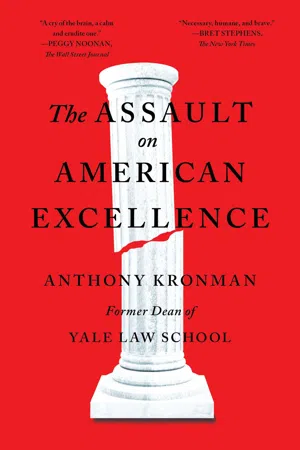
"I want to call it a cry of the heart, but it's more like a cry of the brain, a calm and erudite one." — Peggy Noonan, The Wall Street Journal The former dean of Yale Law School argues that the feverish egalitarianism gripping college campuses today is a threat to our democracy. College education is under attack from all sides these days. Most of the handwringing—over free speech, safe zones, trigger warnings, and the babying of students—has focused on the excesses of political correctness. That may be true, but as Anthony Kronman shows, it's not the real problem."Necessary, humane, and brave" (Bret Stephens, The New York Times ), The Assault on American Excellence makes the case that the boundless impulse for democratic equality gripping college campuses today is a threat to institutions whose job is to prepare citizens to live in a vibrant democracy. Three centuries ago, the founders of our nation saw that for this country to have a robust government, it must have citizens trained to have tough skins, to make up their own minds, and to win arguments not on the basis of emotion but because their side is closer to the truth. Without that, Americans would risk electing demagogues.Kronman is the first to tie today's campus clashes to the history of American values, drawing on luminaries like Alexis de Tocqueville and John Adams to argue that our modern controversies threaten the best of our intellectual traditions. His tone is warm and wise, that of an educator who has devoted his life to helping students be capable of living up to the demands of a free society—and to do so, they must first be tested in a system that isn't focused on sympathy at the expense of rigor and that values excellence above all.
Frequently asked questions

Yes, you can cancel anytime from the Subscription tab in your account settings on the Perlego website. Your subscription will stay active until the end of your current billing period. Learn how to cancel your subscription.
No, books cannot be downloaded as external files, such as PDFs, for use outside of Perlego. However, you can download books within the Perlego app for offline reading on mobile or tablet. Learn more here.
Perlego offers two plans: Essential and Complete
  • Essential is ideal for learners and professionals who enjoy exploring a wide range of subjects. Access the Essential Library with 800,000+ trusted titles and best-sellers across business, personal growth, and the humanities. Includes unlimited reading time and Standard Read Aloud voice.
  • Complete: Perfect for advanced learners and researchers needing full, unrestricted access. Unlock 1.4M+ books across hundreds of subjects, including academic and specialized titles. The Complete Plan also includes advanced features like Premium Read Aloud and Research Assistant.
Both plans are available with monthly, semester, or annual billing cycles.
We are an online textbook subscription service, where you can get access to an entire online library for less than the price of a single book per month. With over 1 million books across 1000+ topics, we’ve got you covered! Learn more here.
Look out for the read-aloud symbol on your next book to see if you can listen to it. The read-aloud tool reads text aloud for you, highlighting the text as it is being read. You can pause it, speed it up and slow it down. Learn more here.
Yes! You can use the Perlego app on both iOS or Android devices to read anytime, anywhere — even offline. Perfect for commutes or when you’re on the go.
Please note we cannot support devices running on iOS 13 and Android 7 or earlier. Learn more about using the app.
Yes, you can access The Assault on American Excellence by Anthony T. Kronman in PDF and/or ePUB format, as well as other popular books in Education & Education General. We have over one million books available in our catalogue for you to explore.

Information

Publisher
Free Press
Year
2019
Print ISBN
9781501199493

ONE


Excellence

I.

MANY PEOPLE HAVE AN ALLERGY to the word “aristocracy.” To them it implies unearned privilege and exploitative domination. In the original sense, though, the word simply means the rule of the best.
This is an idea that makes obvious sense wherever human beings are engaged in a well-defined task with a specific and limited objective. In most pursuits of this kind, those who are best at the work ought to lead and direct it, and be the judge of whether it is well or shoddily done. They are the ones who rightly enjoy the most authority. This is as true in an automobile repair shop as a radiology clinic. The same applies in a class on the history of the American Revolution, where the teacher is presumably the one best prepared to guide the students in their examination of the subject, and in an atelier, like the one I visited some years ago in New York City, where young painters were learning the art of classical portraiture under the eye of a master. In settings like these, and countless others, the participants accept without hesitation the rule of the best, so far as the work at hand is concerned. In this sense they acknowledge, on a limited scale, the validity of the aristocratic ideal. Nor do they view the rule of the best as either unearned or exploitative. They recognize that it has been earned by superior training and accomplishment and concede that it is generally for the benefit of those who are new to the work or less skilled at it. The classroom is an obvious example.
Where people balk, of course, is at the generalization of the ideal. It may be that there are those who are best at reading a CT scan or diagnosing a cranky carburetor. But who is the best at being human? When it comes to the all-embracing work of living the best life that one can, the disagreements are so large, and the differences of judgment so profound, that the aristocratic principle seems, in the eyes of many, to no longer have any application at all. While most people accept this principle in the hospital room and repair shop, they are skeptical of the idea that there is an identifiable group of men and women who are “best” at living in some comprehensive sense. Even more emphatically, they reject the notion that there is a class of superior human beings who ought to manage the affairs of their community as a whole because of their presumptive wisdom or virtue. If this is what one means by aristocracy, it has few defenders today.
The rejection of aristocratic rule as a principle of large-scale political organization is one of the most widely shared convictions of our age. Nearly everyone claims to endorse some version of democratic rule instead. Democracy comes in many different forms: presidential, parliamentary, plebiscitary, constitutional, and the like. But the fundamental difference between it and every aristocratic regime is that democracy is essentially egalitarian in nature.
Several considerations support the belief that a large and heterogeneous society like ours can only be organized on democratic-egalitarian lines. Three in particular are worth mentioning.
The first is practical in nature. The citizens of a modern state are all entitled to some say in how it is governed. Given the variety of views about the definition and meaning of a good life, it is impossible to organize the whole of society according to any one definition of it and to distribute power and authority on its basis without alienating those who hold some other view of human fulfillment and feel entitled to a share in their country’s government too. It is therefore imperative to find ways of distributing power and authority that are agnostic with respect to the question of what constitutes an excellent life overall. This inevitably leads to what the political philosopher Michael Sandel calls a “procedural” form of government. It also eliminates the possibility of every type of aristocratic rule, which always assumes some basic agreement as to what makes certain lives better than others in a general sense, and one way of living the best of all.
A second consideration that weighs strongly in favor of the democratic-egalitarian ideal of government is philosophical rather than practical. It is the widespread acceptance across party lines of what might be called the “moral” point of view. The moralist insists that every human being must be treated with equal respect—that whatever a person’s race, gender, age, or economic standing he or she has certain elementary rights that deserve to be honored with the same care and concern as the equal rights of everyone else. This is a principle whose strength has been growing for centuries. No other principle today commands as much authority. Its most striking contemporary expression is the human rights movement, which extends the principle of equal rights to the whole of humankind with unprecedented moral urgency.
This is a powerful and precious idea. It is one of the most valuable legacies of Western civilization. But it also puts the aristocratic principle under a shadow of doubt. That is because, in defining a person’s humanity, the moral point of view puts a heavy if not exclusive weight on those attributes that all human beings share—most importantly on their equal capacity to decide for themselves how they wish to live their lives. This tends to depreciate the other dimensions of our humanity—all those qualities of wit, intelligence, imagination, and character that human beings neither possess nor develop to the same degree.
The moral point of view puts these qualities in second place at best. It draws attention away from them and reduces their importance in our judgments about who deserves respect and why. It encourages the belief that the best way of living can be defined in simple terms as the one that conforms to the moral law. But this is too thin a conception of human excellence to support the distinctions among more and less outstanding human beings that every aristocratic ideal takes for granted. Indeed, the moral point of view is profoundly hostile to this ideal. This has hastened the near-total elimination of aristocratic values from the sphere of political life and their depreciation even outside it.
A third consideration points in the same direction. Like the second, it is more philosophical than practical. It reflects the force of an idea familiar to us all—that there is no disputing about taste. This idea fits comfortably with the moralistic view of human nature. The latter insists that we are all the same when it comes to our basic rights. The moralist also acknowledges—what can hardly be disputed—that we have the most diverse preferences, interests, and tastes. But as to these, he is generally as relaxed as he is rigorous where our rights are concerned. Moral judgments, he insists, are imperative and universal. Everyone agrees that it is wrong to steal, lie, and kill. But those who maintain that judgments of this kind are binding on us all also often declare, with equal conviction, that judgments about what is beautiful, tasteful, and refined, as opposed to ugly, crude, and base, are peculiar to those making them and cannot be weighed by anything remotely like a universal standard of evaluation. As to judgments of the latter kind, they say, each individual is entitled to his or her own. This applies to judgments about food, hobbies, sexual habits, works of art, and styles of life. When it comes to the meaning of the “best” in all these cases, meaning is widely thought to be in the eye of the beholder. Many people today insist as strenuously on the absence of objective standards of judgment outside the narrow field of morality as they do on the presence of such standards within it.
Once upon a time, judgments about the relative excellence of different preferences and tastes, and the ways of living based upon them, had the same objective solidity that today only our moral judgments possess. According to Aristotle, everyone agrees that flute playing is an activity that may be performed well or badly. Can it be, he asks, that when it comes to the activity of living in general, there is not a similar standard of excellence by which to judge the performance of different human beings? Aristotle thought that the existence of such a standard is obvious. Today, many people are likely to think that its absence is equally obvious. The reasons for this shift in perspective are many and complex. Aristotle’s view rested on metaphysical, psychological, and political assumptions that are no longer credible today. Perhaps the most important cause of their displacement has been the growing authority of what I call the moral point of view, which contracts the field of objective judgment to compliance with the moral law alone, leaving everything outside it to the vagaries of private preference and taste. In any case, the reduction of human achievement to simple questions of right and wrong, and the consignment of every other dimension of human excellence to a realm of subjective preference and choice, together undermine the aristocratic belief that some live better lives than others in an overall sense. Aristotle still took this belief for granted, as did every ancient thinker. And because he did, he was able to conclude—what seems absurd today—that the best political regime is obviously the one that is led and run by the best human beings.
But if the aristocratic principle has been discredited as a basis of political organization, is its application therefore permanently shrunk to the domain of specialized activities like flute playing and automobile repair? Or might it still have some bearing on the general question of how one ought to live? Could it be that there are better and worse ways of living—that there are grades of excellence in the work of being human—even if there is no single way that is demonstrably the best of all? Could it be that there is a form of education that increases a student’s chances of becoming an excellent human being, just as there are educational programs for those who want to be outstanding flute players and mechanics? And could it be that those who receive an education in human excellence are, just for that reason, better equipped to play a special and needed role in our democracy despite, or rather because of, its staunch rejection of the aristocratic principle as a basis for organizing the distribution of power and authority in society at large? This book proceeds on the assumption that the answer to all these questions is yes.
What I call “an education in human excellence” is a phrase that best fits those disciplines we still collectively describe as the humanities. These put the question of the meaning of life at the center of attention. They explore the various answers that have been given to it and invite the students studying them to make the question their own. They stress the urgency of confronting with a reflective eye the very largest topics in the wide field of human concern, rather than treating them as subjects that are too personal to reward systematic study.
What is love? Does death make life meaningless or is it, in Wallace Stevens’s words, “the mother of beauty”? How should the “ancient quarrel” between philosophy and poetry be settled? What is the relation between self-knowledge and freedom? To what extent can we transcend the circumstances of our birth and join the company of others, living and dead, whose social, political, and psychological situation is remote from our own? Does modern science illuminate the human condition or obscure it? And perhaps most important, among the diverse examples of lives in which these questions have been pursued with unusual courage and clarity, and the potential for human self-inspection realized to an exceptional degree, is there one or some that might serve as an inspiration for my own?
The life of a thinker, perhaps, like Socrates or Plato? Of a statesman like Lincoln or Douglass? A scientist like Galileo? A solitary poet like Emily Dickinson? A psychologist like Montaigne or Freud? A saint like Augustine? This particular list is personal. It reflects my own education and ideas about excellence in living. Others will have different lists. But any list of the sort I have in mind will be more than a casual collection of writers one happens to like. It will reflect a considered judgment regarding the best way to live, arrived at after a disciplined study of alternatives. It will be the product of an organized program of reading and reflection founded on the belief that the question of what constitutes the best life overall is neither too personal to be approached in an “academic” way nor too deeply conditioned by prior prejudices to be worth asking at all.
This belief is the premise on which the humanities rest, today as in the past. Over the years many things have changed in the way the humanities are taught. But this bedrock belief remains the same, along with its three most important corollaries. The first is that the question of the meaning of life is not like any of the more circumscribed questions one studies in school (How does economics define the condition of general equilibrium? Could the Civil War have been avoided? Can the theory of evolution explain the development of moral culture?). The second is that, despite its generality, the question of the meaning of life is a genuine one, even if the answers students give, after the most careful study, diverge and are rarely if ever perfectly stable. And the third is that, even with these qualifications, it is possible to speak of progress in the study of the question—those who get farther experiencing, and enjoying, a fuller engagement with what, for lack of a better phrase, we might call the human condition, thereby becoming, in a perfectly intelligible sense, more fully developed as human beings, not just more knowledgeable in a particular field.
My experience as a teacher of the humanities confirms this. The freshman who reports, with an excitement he can barely contain, that reading War and Peace over spring break has been the most thrilling experience of his life and that he now cannot imagine living without Pierre, Natasha, and Prince Andrei; the young woman who tells me that Aristotle’s cosmos, where everything is in its proper place, is the most beautiful thing she has ever encountered and wonders, with a mixture of resignation and resolve, whether it can be brought back to life again today; the student who, on first reading Kant’s Critique of Pure Reason, confesses that he is baffled by the transcendental deduction but announces his determination to get to the bottom of it “if it takes a lifetime”; his classmate who has become obsessed with the disjunction between personal and cosmic time in Virginia Woolf’s To the Lighthouse and views it as the key to the riddle of human existence—these are more than book reports; they are declarations of an existential sort that suggest a basic shift in the students’ orientation toward the question of the meaning of life. I hear them all the time.
These are only anecdotes, of course, but they illustrate and validate my confidence that the humanities do more than add to one’s storehouse of knowledge—that they stretch and strengthen the students’ human being too. They confirm that a person’s humanity can grow: that there are grades and distinctions of human fulfillment in the life of a single person and between the lives of different ones as well. They justify the conviction that better and worse, if not, perhaps, the unequivocal best, is a notion that has application beyond the realm of specific tasks, like flute playing, in the all-encompassing work of being human. And they vindicate the relevance of the aristocratic principle to this wider endeavor, as Holmes rightly assumed.
Holmes also recognized that this principle has no place in our political democracy. He nevertheless believed it essential to protect the aristocratic ideal in the academic world of “spiritual things” against the leveling effects of democratic equality. Others, before and since, have stressed the importance of doing so as a corrective to the excesses of democratic life itself. Today, these beliefs have few defenders. But they have a long and honorable lineage in American thought. In later chapters we will see how the various campus movements I survey all spring from what Holmes calls “the effervescence of democratic negation.” First, though, it is important to recover some sense of how others have understood and defended the role of aristocratic habits in this most democratic of all countries, especially as these manifest themselves in the world of higher education. I want the comfort of their company, of course, but some historical perspective is essential.
John Adams was the most philosophically minded of the Founding Fathers. He gives us a good place to start.

II.

When the new constitution was drafted in 1787, Adams was in London, serving as his country’s first ambassador to the British royal court. Though an important participant in the early phase of the Revolution, Adams was away when it ended and had no direct hand in fashioning the system of government that emerged from the failures of the Continental Congress. But Adams was eager that his own views about the nature and purpose of the American constitution not be overlooked or underappreciated. To this end, he set his ideas down at length in writing. In 1787, two years before he was elected vice president—a role in which he served until 1796, when he was elected president—Adams completed a massive multivolume treatise titled A Defence of the Constitutions of Government of the United States. He supplemented it with a further series of essays written during the early days of his vice presidency (amid what he later called “the constant scenes of business and dissipation” in which he was “enveloped”). These latter essays contain the most concise statement of Adams’s political philosophy. They were published under his own name in 1805 as the Discourses on Davila.
When the Discourses were written, America was seized with the question of how to view the French Revolution and whether or not to support it. On one side were those who enthusiastically endorsed its egalitarian principles and wished to see them extended to the United States in a stronger form than the new constitution allowed. ...

Table of contents

  1. Cover
  2. Dedication
  3. Introduction
  4. Chapter One: Excellence
  5. Chapter Two: Speech
  6. Chapter Three: Diversity
  7. Chapter Four: Memory
  8. Epilogue
  9. Acknowledgments
  10. About the Author
  11. Notes
  12. Index
  13. Copyright