eBook - ePub
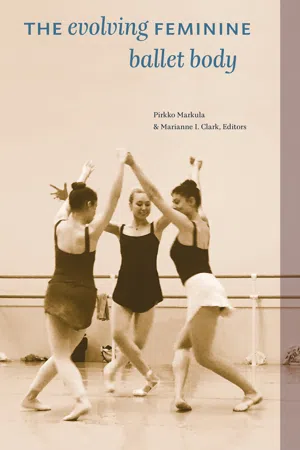
The Evolving Feminine Ballet Body
- 248 pages
- English
- ePUB (mobile friendly)
- Available on iOS & Android
eBook - ePub
The Evolving Feminine Ballet Body
About this book
Dance has become increasingly visible within contemporary culture: just think of reality TV shows featuring this art form. This shift brings the ballet body into renewed focus. Historically both celebrated and critiqued for its thin, flexible, and highly feminized aesthetic, the ballet body now takes on new and complex meanings at the intersections of performance art, popular culture, and fitness. The Evolving Feminine Ballet Body provides a local perspective to enrich the broader cultural narratives of ballet through historical, socio-cultural, political, and artistic lenses, redefining what many consider to be "high art." Scholars in gender studies, folklore, popular culture, and cultural studies will be interested in this collection, as well as those involved in the dance world.
Contributors: Kelsie Acton, Marianne I. Clark, Kate Z. Davies, Lindsay Eales, Pirkko Markula, Carolyn Millar, Jodie Vandekerkhove
Information
Subtopic
Dance
1
READING THE BALLET BODY IN CHILDREN’S FICTION
The ballerina is an enduring symbol of girlhood (Turk, 2014). As a testament to its popularity, many Canadian girls and women have taken ballet class, owned a pair of ballet slippers, and worn a leotard with a tutu at some point in their lives (Miskec, 2014). Ballet is also visible in mainstream media. For example, Angelina Ballerina, a dancing mouse, is a popular computer game, television, and book series read by many girls (Turk, 2014). A number of other children’s books have an underlying theme of ballet. These mediated texts, in their part, shape how children come to understand dance and the dancing body, particularly the ballet body, in contemporary society.
To understand what it means to be a dancing body during childhood requires knowledge of how such meanings are produced and reproduced. To achieve this end, I examine the meaning of ballet in children’s picture books. This chapter is part of my doctoral research, which analyzes how meanings of the active body are (re)produced across thirty children’s picture books. In this discussion, however, I examine six stories about ballet from my larger sample of books about children’s physical activity: Ballerina Rosie, Tallulah’s Tutu, Ballet Stars, Miss Lina’s Ballerinas and the Prince, Ella Bella Ballerina and Swan Lake, and The Only Boy in Ballet Class. To begin, I situate the research within the wider body of literature on ballet and children. I then introduce my Foucauldian approach to explain how I conduct my analysis. After presenting my results, I conclude with a discussion of the knowledges that (re)produce the ballet body in children’s books. In the review of literature that follows, I critique how gender has been analyzed in the academic literature on children’s active bodies, thereby providing a rationale for the Foucauldian-inspired approach underpinning this study.
Appropriate Gendered Identities?
Children’s literature is a powerful medium through which meanings of the body are normalized and conveyed during childhood (Hunt, 1985; Rogers, 2008; Saric, 2005; Stallcup, 2004). Paterson and Lach (1990) argue that “books can and do have profound effects on children” (195). Moreover, Worland (2008) asserts that
picture books exert a unique influence on their audience…Most significantly, the audience receives messages in the text at a point in their lives when they are especially impressionable and when they first begin to formulate ideas about culture, society and values…In addition, picture books…promote ideas with increased impact because of the power of the illustrations…Thus, picture books deliver their messages twice, with words and illustrations…Research shows that children translate the values and messages in books into attitudes and behavior…Their behavior and their expectations of other’s behaviors often reveal acceptance and conformity to what they have been most exposed to in books. (42–43)
Although scholarship that examines representations of children’s active bodies is scarce, there is some research regarding gender roles in children’s literature. These studies focus on the body as a site where meanings of disability, race, ethnicity, and gender are (re)produced and/or contested (Hamilton, Anderson, Broaddus, & Young, 2006; Hunter, 1982; Matthews, 2009; Nilges & Spencer, 2002; Rogers & Christian, 2007; Singleton, 2004; Stott, 1979; Weiller & Higgs, 1989).
For example, in a study that analyzes a project developed to make children’s bodies with disabilities visible in children’s picture books, Matthews (2009) found that the visibility of these bodies was contingent upon and constrained by dominant social understandings of disability that tended to render disabled bodies “impermissible.” Hamdi and Newbery (2004) further observe that children’s books are generally devoid of discussions of impermissible bodies. Such deliberate omissions are linked to the belief that inappropriate references to the body may encourage children’s “uncivilized behavior” (Stallcup, 2004, 91). Given that ballet is considered to require highly able bodies, I am also interested in how impermissible bodies are reproduced in these books.
Rogers and Christian (2007) examine the construction of race in a selection of multicultural children’s books that, as they argue, “intentionally bring Whiteness to the surface” (21). Their intent was to reveal how children’s literature marginalizes people of colour. Based on their findings, the authors suggest that multiple and contradictory meanings underpin the messages conveyed in the selected books. For example, they note that “the talk in texts between White characters sometimes re-centers Whiteness and other times disrupts Whiteness as the center” (21). While the multicultural children’s literature aims to address the oppression of marginalized populations, based on Rogers and Christian’s (2007) study, there is also potential to perpetuate oppression by revealing “the effects, both productive (when Whiteness is decentered) and repressive (when Whiteness is re-centered), of discourse and through them, the use of power” (47). I am interested in examining how children’s ballet books might represent race and ethnicity considering that high-art “theatre dance,” such as ballet, with studio fees, has often been seen, at least in Canada, as a middle-class, white women’s and girls’ activity (Boyd, 2004).
Relevant to my topic of the depictions of the ballet body, several studies have focused on the gender differences in children’s books. In a study of the pictorial representation of gender and physical activity level in Caldecott Medal–winning children’s literature between 1940 and 1999, Nilges and Spencer (2002) found that both females and physical activity were underrepresented in these awarding-winning books. In a survey of two hundred popular children’s books, Hamilton et al. (2006) concluded that female characters continued to be underrepresented. In addition, while twice as many male characters occupied jobs outside the home, nurturing behaviour appeared to be more common among female characters despite the decline of such behaviours from 1970 to 1980. Although female characters (79%) were just as likely as male characters (86%) to be portrayed as active bodies, the study did not specify whether the types of activities girls and boys engaged in were similar (Hamilton et al., 2006, 762). However, according to Weiller and Higgs (1989), “many reading materials available in the school libraries present certain prescribed roles for girls and boys in sport activities” (66). For example, “in dance and tennis females were represented six out of six times [and]…five out of six times in gymnastics as opposed to three out of six by males” (Weiller & Higgs, 1989, 66). Based on their findings, Weiller and Higgs (1989) conclude that these readings reified the traditional gender order. As I noted at the beginning of my chapter, ballet tends to be popular particularly among girls. Thus, part of my concern in this chapter is whether ballet picture books provide a different gender balance.
Some researchers have, indeed, focused on books aimed specifically at girls. For example, Dohnt and Tiggemann (2008) conducted a study “to evaluate the potential for the picture book, Shapesville, to promote positive body image in young girls” (222). The story, which depicts five friends who range in shape, size, and colour, is intended to encourage diversity and acceptance. Based on their results, Dohnt and Tiggemann (2008) conclude that “Shapesville can be a successful prevention tool for use with young girls” (232). For example, the study reports, “[The girls’] knowledge of the five food groups increased significantly [after reading Shapesville]. The promotion of healthy eating is important to obesity prevention and Shapesville may assist in this cause” (231). Dohnt and Tiggemann (2008) then state, “The girls reported learning that appearance is not important, commonly, ‘It doesn’t matter what you look like’” (231). The authors conclude that Shapesville appears to be a useful tool in the prevention of obesity and disordered eating. In a study of images featuring Barbie and the Emme doll (the latter based on a plus-size model), Dittmar, Halliwell, and Ive (2006) suggest that by the age of eight, girls who had been exposed to thin-ideal body images may internalize these images to the point where viewing images of a larger body, such as the Emme doll, actually elicits a negative response toward the larger size image.
Instead of body image concerns, Kane (1998) examines the portrayal of female protagonists in sport novels published between 1970 and 1997. Based on earlier work, she organized and analyzed the texts according to one of two themes: “lone girl” and “women’s team sport” (236). Using a feminist perspective, she found “strong support for heterosexual relationships” across the novels (256). According to Kane, this “redirection” is problematic for two reasons. First, it “undermines women’s connections with each other.” Second, “it simultaneously reassures the reader that all of the female characters are unequivocally heterosexual” (256). Through her analysis, Kane also demonstrates that to be accepted as an athlete, female protagonists must behave just as their male counterparts would, notably when injured. Singleton’s (2004) analysis of female protagonists from two early twentieth-century adventure series for teenage girls supported this latter finding. Like Kane (1998), she employs a feminist perspective to find that “these highly active and physically competent female characters support, through their continuous iterations of femininity, the ideological attribution of maleness to physical skill, risk taking and adventures” (Singleton, 2004, 131). These findings provide interesting intersections with my research on ballet where the injury rates, similar to sport, are high. However, it must be noted that the sport research focused on young adult sports fiction or women’s sports fiction. Indeed, research on the impact of ballet in children’s developing bodies exists.
A significant portion of the academic literature investigating the influence of ballet on children is concerned with the physiological (Kadel, Donaldson-Fletcher, Gerberg, & Micheli, 2005; Moller & Masharawi, 2011; Stokić, Srdić, & Barak, 2005) or psychosocial (Bettle, Bettle, Neumarker, & Neumarker, 2001) effects of ballet training. Moller and Masharawi (2011), for example, examine the effect of participating in ballet on the developing child’s posture. They found that young children who engaged in ballet training to increase flexibility were predisposed to back problems later in life. With the exception of Pickard (2013), who, drawing from Bourdieu, examines “what is perceived and believed to be an ideal ballet body by young ballet dancers” (3), research that critiques what it means to be a dancing body is limited to adolescent and adult dancers, similar to sport research (Oliver, 2005; Sherlock, 1991; Wainwright, Williams, & Turner, 2007). Moreover, most of the dance studies research focuses on the ideal body of the female ballerina.
Although research on girls’ sporting or physically active bodies is rare, the two studies I identified to examine ballet in children’s literature focus specifically on girls. In her essay about the prominence of the foot in children’s stories about ballet, Miskec (2014) suggests that “ballet is the perfect space for ideal femininity: thin bodies, frilly skirts, speechlessness; graceful movements making it all look easy while hiding the pain, physical anguish for beauty” (240). In particular, Miskec argues that the image of the ballet foot is problematic not only because it sexualizes young girls, but also because it simultaneously infantilizes the female dancers whom these girls epitomize. In contrast, Turk (2014), who studies American children’s literature and girls, contends that images of ballet, specifically “literary representations of ballet in girls’ culture…can be used to speak to contemporary girls’ lives and imaginations, including ways in which ballet provides enriching girlhood experience” (483). For example, she discusses how the princess image of the ballerina provides space for Olivia, the dancing pig, to shed the stereotypical Disney princess/ballerina costume for ones that represent princesses of different cultures such as India. Turk challenges Miskec, asserting, “‘ideal femininity’…can engage young people in valuable questions about the art form’s past, present, and future” (501). Although relevant and necessary, these two studies do not employ a systematic social science methodology to evidence either one of their arguments.
Based on the reading of previous literature, a certain type of “ideal femininity” (thin, pale skin, heterosexual, engaged in nurturing activities but enduring pain) appears to persist in children’s books across several physical activity contexts. These studies use a variety of theoretical and methodological approaches. I aim to continue to examine the representations of the ballet body in children’s picture books, but employ a Foucauldian theoretical approach to guide my analysis. This approach not only highlights what type of body is represented but also examines why certain representations persist in these books.
Foucauldian Approach to Children’s Active Bodies
To examine how children’s bodies are (re)produced in children’s picture books with the unifying theme of ballet, I draw from Michel Foucault’s ideas about power, knowledge, and the body. More specifically, I consider how ballet functions as a truth game that shapes meanings of the dancing body through children’s picture books.
Foucault (1980) was interested in the relationship between power/knowledge and what he termed “discourse,” or the ways that we know about a topic or phenomenon, such as ballet. Some discourses, he noted, become dominant over time, in a discontinuous manner, thereby making it difficult to trace a particular discourse back to a particular individual or instance (Markula & Pringle, 2006). Moreover, Foucault asserted that discourses are constrained and enabled by the knowledge available at a given time and within a given context. Therefore, of the discourses that are available or possible, only a few are actually reproduced (Markula & Pringle, 2006). For example, based on my literature review, a certain way of understanding femininity was reproduced in children’s books. These dominant discourses do not represent truth per se, but instead operate as “truthful,” what Foucault (1980) refers to as “effects of truth” (94) that then circulate through texts such as children’s books.
Dominant discourses are those that have endured a process of division and rejection whereby competing discourses are discarded, not because these discourses are less “true,” but because dominant discourses sustain the power-relation of the specific sociohistoric context in which they operate (Markula & Pringle, 2006). It was the process of how a particular discourse becomes dominant and produces a truth-effect that interested Foucault and underpinned his approach to discourse analysis (Markula & Silk, 2011). I discuss this approach in more detail, in the Methods section. For the purpose of this discussion, it is necessary to explain Foucault’s understanding of discourse in terms of its relation to power/knowledge.
Central to Foucault’s theorizat...
Table of contents
- Cover
- Title Page
- Copyright Page
- Dedication
- Contents
- Acknowledgements
- Preface
- Introduction
- Part 1
- Part 2
- Conclusion
- Contributors
- Index
- Other Titles from The University of Alberta Press
Trusted by 375,005 students
Access to over 1.5 million titles for a fair monthly price.
Study more efficiently using our study tools.
Frequently asked questions
Yes, you can cancel anytime from the Subscription tab in your account settings on the Perlego website. Your subscription will stay active until the end of your current billing period. Learn how to cancel your subscription
No, books cannot be downloaded as external files, such as PDFs, for use outside of Perlego. However, you can download books within the Perlego app for offline reading on mobile or tablet. Learn how to download books offline
Perlego offers two plans: Essential and Complete
- Essential is ideal for learners and professionals who enjoy exploring a wide range of subjects. Access the Essential Library with 800,000+ trusted titles and best-sellers across business, personal growth, and the humanities. Includes unlimited reading time and Standard Read Aloud voice.
- Complete: Perfect for advanced learners and researchers needing full, unrestricted access. Unlock 1.5M+ books across hundreds of subjects, including academic and specialized titles. The Complete Plan also includes advanced features like Premium Read Aloud and Research Assistant.
We are an online textbook subscription service, where you can get access to an entire online library for less than the price of a single book per month. With over 1.5 million books across 990+ topics, we’ve got you covered! Learn about our mission
Look out for the read-aloud symbol on your next book to see if you can listen to it. The read-aloud tool reads text aloud for you, highlighting the text as it is being read. You can pause it, speed it up and slow it down. Learn more about Read Aloud
Yes! You can use the Perlego app on both iOS and Android devices to read anytime, anywhere — even offline. Perfect for commutes or when you’re on the go.
Please note we cannot support devices running on iOS 13 and Android 7 or earlier. Learn more about using the app
Please note we cannot support devices running on iOS 13 and Android 7 or earlier. Learn more about using the app
Yes, you can access The Evolving Feminine Ballet Body by Pirkko Markula,Marianne I. Clark, Pirkko Markula, Marianne I. Clark in PDF and/or ePUB format, as well as other popular books in Media & Performing Arts & Dance. We have over 1.5 million books available in our catalogue for you to explore.