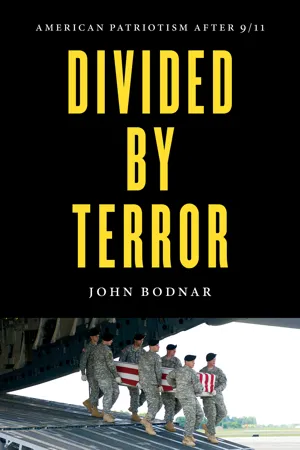
Americans responded to the deadly terrorist attacks on September 11, 2001, with an outpouring of patriotism, though all were not united in their expression. A war-based patriotism inspired millions of Americans to wave the flag and support a brutal War on Terror in Afghanistan and Iraq, while many other Americans demanded an empathic patriotism that would bear witness to the death and suffering surrounding the attack. Twenty years later, the war still simmers, and both forms of patriotism continue to shape historical understandings of 9/11’s legacy and the political life of the nation.
John Bodnar’s compelling history shifts the focus on America’s War on Terror from the battlefield to the arena of political and cultural conflict, revealing how fierce debates over the war are inseparable from debates about the meaning of patriotism itself. Bodnar probes how honor, brutality, trauma, and suffering have become highly contested in commemorations, congressional correspondence, films, soldier memoirs, and works of art. He concludes that Americans continue to be deeply divided over the War on Terror and how to define the terms of their allegiance — a fissure that has deepened as American politics has become dangerously polarized over the first two decades of this new century.
- 320 pages
- English
- ePUB (mobile friendly)
- Available on iOS & Android
eBook - ePub
About this book
Information
1 First Responses
A War on Terror was only one of myriad responses to the spectacular assault on the United States. While many citizens certainly reacted with a militant patriotic fervor and called for a decisive military defeat of distant enemies, others were bewildered by the events of 9/11 and overwhelmed by uncertainty and confusion. The sense of security they felt in their everyday lives was shattered by the dramatic impact of the destruction that took place at Ground Zero, the Pentagon, and Shanksville, Pennsylvania. News coverage was continuous, air transportation was suspended for days, and rumors of more assaults were rampant. Conspiracy theorists charged that the government actually allowed the attacks in order to secure a rationale to launch a global war. Some falsely claimed that Israel was behind the attacks in order to foster a war against its enemies and that no Jews died at Ground Zero, having been warned in advance to stay away from work on the fateful day. To the extent that there was something like a national psyche, it was clearly traumatized. People lost their bearings and felt suspended in a twilight zone saturated with conflicting sensations of fear, sorrow, insecurity, and anger. Everyday routines that guided daily life were knocked off balance. Concerns of what the next day would bring were exacerbated. Interviewed in late September 2001, First Lady Laura Bush recalled how “apprehensive” she felt staying in the White House in those days. “There was just so much uncertainty associated with everything that happened,” she said. “I worried … that there would be some sort of strike back immediately. I think that was the scary part.” She readily admitted that she was “nervous” and “anxious.”1
The first lady was not alone. National surveys reported that nearly one-half of all Americans experienced symptoms of posttraumatic stress after the attacks. An even greater proportion expressed fears of additional attacks similar to Laura Bush’s, a dread that contributed to widespread feelings of vulnerability. Pharmacists reported a spike in demand for antianxiety medicines. Psychologists have argued that such disruptions in feelings and attitudes also prompted a widespread quest to discover the “meaning” of the shocking event, a process that apparently helped to calm the anxiety as well. They explained that terrorism tends “to shatter people’s beliefs in a benevolent and predictable world” and thus intensifies a renewed quest to reestablish not only a sense of security but stable meanings that can wipe away clouds of doubt.2
In an atmosphere of confusion and vulnerability, a traditional war-based patriotism steeped in ideals of heroic warriors and military prowess was an important way in which many Americans sought to restore a sense of security and normalcy. National devotion served as an antidote to fear and doubt in the immediate aftermath of the attacks, although the dread and uncertainty remained. Patriotism’s implicit call for expressions of loyalty to the nation and its institutions helped to unite the populace and, at least on the surface, transform the pandemonium of the times into a wave of purposeful action.
Citizens demonstrated their allegiance by displaying national symbols like the flag or even tattooing national emblems like the American eagle on parts of their body. Bloomingdale’s department store in New York began selling a replica of the flag made from Waterford Crystal, calling it the “Emblem of the Land that We Love.” The store proclaimed that such souvenirs “reminded us now more than ever of freedom, tolerance, and bravery.” An advertising executive forced to drive from Las Vegas to New York after air flights had been suspended was so struck by the outpouring of patriotic signs that he saw on his trip that he had his company create an advertising campaign for the Miller Brewing Company that included slogans such as “America the Beautiful” and “Go U.S.A.” The sale of American flags and other similar items rose dramatically, with many stores reporting that they had difficulty keeping their shelves stocked. A rare exception to this occurred in a general store run by Mennonites in Lancaster County, Pennsylvania, whose pacifist owners actually decided not to stock their shelves with flags, explaining that flag waving would only encourage “jingoistic attitudes and actions.” They may have had a point, but the local populace, at least at this time, was not amenable to Mennonite and Amish beliefs about nonviolence steeped in the teachings of Jesus and criticized the proprietors for being “anti-American.” Soon the owners found shelf space for this popular national emblem. Rallying around the flag and similar American icons promised to temper the huge wave of insecurity that swept over the land; patriotism like religion and other traditional values offered steadiness in stormy seas and a promise that normalcy would be restored.3
Mixed Emotions
Flag-waving may have alleviated some concerns, but it did not obliterate widespread confusion and apprehension. The many communications citizens sent to the Library of Congress in the fall of 2001 in response to a request for people to send a record of their personal reactions to 9/11 vividly illustrates the mayhem the attacks brought. A series of emails a man sent to a friend describes rapidly shifting emotions: annoyance, shock, anger, pity, and fear. In his first note he reported that there was “another explosion at the WTC.… Goddamnit I have to go to a meeting now.… Mother Fuck. The South Tower is now down.” He then sent a second message saying that “the president is in the air.… The south tower collapsed.… Liberation of Palestine is claiming responsibility. Sears Tower is being evacuated.” In subsequent emails he told his friend that “bodies were falling from the buildings.… Somebody will fucking pay for this.… I feel very sorry for these people.… There has been an explosion on capitol hill.… Seven planes have been hijacked.… Bush is a wimp.… I am going to my igloo in Antarctica.” His thoughts were swarming. He was not even close to a point of having a clear and reasoned interpretation of what he had just witnessed.
Others near Ground Zero at the time were no closer to grasping what happened than the emailer. A businessman from Arizona in New York for a meeting was standing in the lobby of the Hilton Hotel across from the towers when he noticed papers floating to the ground outside. His first thought was that there might be a ticker-tape parade in the city. When he saw smoke coming from one of the towers, he called several colleagues that he was about to meet to make them aware of the strange scene unfolding before him.
The visitor reported that he was suddenly startled to see “four large objects falling from the buildings.” He soon realized they were human bodies that “blew apart like if you dropped fruit off a rooftop and they left large red stains.” He noticed “the torso of one person skitter in one direction and while the legs went in another.” “This all happened in a second or two,” the stunned spectator recalled. When he realized that he was watching people fall to their deaths, he tried to look away from the falling objects, thinking that that would be a “less horrible” option. He concluded that to continue to gaze at the point of impact he would have to be “a sick bastard” living in a “morbid society.” Returning to his hotel room he saw more falling bodies but tried not to stare. “They floated by my window like leaves in the wind,” he mused, “I saw at least fifty people go by.”
Repulsed by the horror and gripped by fear, this stranger in the city soon joined large crowds heading uptown away from the site of danger. When the towers fell, he realized “tons of people were dead.” Adding to his sense of revulsion and confusion was the fact that all he could think about was returning to his hotel to retrieve his luggage. Later as he watched television reports of death tolls, he became infuriated because they were unable to convey the stark viciousness of splattered bodies that he had witnessed. He wondered what it must have been like for people inside the towers fleeing down stairways and feeling the intensity of the burning inferno inside. He was also put off by news coverage that obsessed about death counts. In his mind there was something “sick and twisted” in this fixation on matters that might better be “left unspoken.” Ultimately the response of this startled visitor was one of repugnance and distaste over witnessing the brutal end of fellow human beings.4
Laura Barti also witnessed the horror of Ground Zero. While working on the fifty-ninth floor of the North Tower, she felt the building actually “shake and sway.” Instantly she headed for the stairs, passing firemen on the way up whom she later realized were probably killed when the structure fell to the ground. Her first thoughts as she fled, however, were more practical: “The air is cleaner as we go lower”; “Spirits are good, breathing is good”; “Finding little things to laugh at keeps us from freaking out.” Once on the ground, she headed for the Hilton Hotel, where she felt the vibration from the collapse of the second tower. Soon she too joined the march uptown, where she joked with a friend whose shoe had broken that they both would have worn more sensible footwear if they knew there was going to be a “bombing.”
Later, reflecting on her getaway, Barti was not laughing but experiencing something close to a religious experience. She did not frame the day as an attack upon a nation or even upon political freedom but an event that, in her view, was part of a divine plan. For her the goals of the terrorists were not as important as “God’s plan for me.” In her mind she was able to find a way out of the tower before it collapsed because of heavenly intervention. She was actually saddened by the prospect of a war because it might bring harm to people she cared about, although she acknowledged that the cost of freedom could be high. Her ambivalence toward a military response to the attacks was not matched by her faith. She insisted that everyone now needed to seek “the Lord’s guidance.”5
One did not have to be at the site of the attacks to experience confusion, fear, and other strong but contradictory emotions. Cynthia Fukami, a professor of management at the University of Denver, decided to collect the “evolving thoughts and emotions” of faculty and students in management courses from throughout the nation to the dramatic attacks. Most instructors made it clear that students were basically stunned by what they saw. Ann Mooney at Stevens Institute of Technology in New Jersey reported that many of her students actually saw the buildings collapse and were so distraught they simply began to roam the campus. Not far away at Fordham University, two instructors indicated that “the emotional weight of the sadness and the terror were like a mantle difficult to lift for several days.” Mooney felt that the tragedy had such an impact on daily life that students needed to be free to find their own way to cope with all that had happened.
At Bloomsburg University in Pennsylvania, students were asked to write down their thoughts and feelings about 9/11. Many viewed the assault as “the end of the world,” and a few saw 9/11 as the start of World War III. Other classes reported that students and teachers began talking about what had happened in order to try to make sense of it. Some teachers felt that in exchanging opinions and feelings of the day, people achieved a level of comfort at a moment that seemed frightening. In a class at Illinois State University, students decided to sell T-shirts and send proceeds to a relief fund for victims. Their instructor also saw value in this exercise because it offered students training in “decision making techniques” and “establishing purchase orders via the internet.” At Texas Tech a professor concluded that the horrific affair had actually caused her students to show more compassion toward others.”6
At West Georgia College, students similarly exhibited a range of reactions, but they seemed to coalesce around the theme of shock, loss, and fear. “Although my life is not affected as deeply as some,” an undergraduate said, “I worry about the terrorists’ next move and am concerned for the safety of my uncle who is a pilot in Atlanta.” Another student claimed he experienced anger at first, but his feelings soon changed to “sadness” over the thought of so many children watching their parents going to work on September 11th and never seeing them come home. A fellow student was also upset by the realization that many families who lost loved ones would endure suffering and now “only wanted to be around people I loved and let them know I loved them.”7
In Iowa, a location far removed from Ground Zero, residents also grappled with the stunning news of what had happened on 9/11. Janet Freeman heard about the plane crashes the morning of 9/11 on her radio as she sat in her home in Iowa City. Seeing the two towers crumple on television prompted her to clean her house as a way to settle her emotions. She began scrubbing the stove, cleaning her oven, and washing floors. It was three o’clock in the afternoon before she realized that she was still wearing her pajamas and that her hands were covered in dirt. Another Iowa City resident, Jessica Kardon, felt nauseated after seeing the calamity and felt like vomiting. She kept searching for small tasks to tackle as the day passed. When her son asked her if they had lost any relatives in the carnage of the day, she told him that they had not but she felt as if they had. At the public library in Iowa City, Maureen Delaney felt “great shock and sadness.” She was duly impressed by the “bravery of the rescue workers” but could not shake feeling depressed over the realization that so many had to die. In writing a poem on 9/11, she could only think about “people noise, explosions, screaming.”8
In Fort Dodge, Peter Rouderbush, who taught in the town’s high school, felt “stunned, shocked and upset.” Personally he said he also felt “abused.” Rouderbush claimed there were no good reasons for the attacks and felt it was imperative for students to discuss them and why they occurred in the first place. Other Iowa residents claimed for a time they thought the entire image at Ground Zero was simply the results of “special effects” on television. Lorna Truck of Des Moines felt “extreme sadness for all those who lost their lives” and actually kept hoping it was not really true. She recalled being profoundly aware of all the lives that were lost and regretted that many bodies would never be found.”9
It was not unusual for citizens who actually thought the attacks could lead to war to express hope that such an event could be avoided because so many blameless people would be harmed. One California resident insisted that “we show our humanitarian side to the people of Afghanistan” rather than launch an attack against them. A few citizens noted that there were other ways to resolve issues “besides bombing and killing innocent people.” A person who said he hated “all the ‘hawk’ rhetoric and the ‘wanted dead or alive’ mentality” felt that in war the “collateral damage was always too great. “Enough Death!” Others insisted that if there was to be any sort of violent reprisal, it should be limited to finding and killing Osama bin Laden and not be expanded into a wider attack upon Afghanistan.10
In Knoxville, Tennessee, a group of local citizens installed a temporary memorial ten days after the 9/11 planes crashed to honor those who died. Called a “Wall of Unity,” the structure was placed near a shopping center with the aim of fostering an “environment of unity, healing, and brotherhood.” Residents were encouraged to post their own “words, remembrances, and icons of encouragement” during a two-month period from September to November 2001. Notes on the wall show that Americans were anything but united in their responses to the attacks, and instead reveal the sweeping range of thought that pervaded the public mind in the aftermath of 9/11 that included religious faith, compassion, patriotic vengeance, and hopes for peace:
“Always keep the faith and God will see you through”“Jesus is with us”“They have darkened our hearts but we will see the lights once again. May God bless.”“For all the parents who lost children in the terrorist attacks. Jesus will be here for you.”“Jesus loves you, this I know.”“May those who are strong stand up for what they believe in and let them stand strong. We cannot be broken by acts of hatred but brought together.”“Divided We Fall. United We Stand.”“All Races. All Colors. All Religions. All Americans. Together we unite and pray. God bless us all....
Table of contents
- Cover
- Title Page
- Copyright
- Dedication
- Contents
- List of Illustrations
- Introduction. The Patriots’ Debate
- 1. First Responses
- 2. Memorializing 9/11
- 3. Unmasking Suffering and Iraq
- 4. Visualizing the War
- 5. The Soldiers’ Debate
- 6. Camera Angles
- 7. Patriots Hating
- Conclusion. A House Divided
- Acknowledgments
- Notes
- Bibliography
- Index
Trusted by 375,005 students
Access to over 1.5 million titles for a fair monthly price.
Study more efficiently using our study tools.
Frequently asked questions
Yes, you can cancel anytime from the Subscription tab in your account settings on the Perlego website. Your subscription will stay active until the end of your current billing period. Learn how to cancel your subscription
No, books cannot be downloaded as external files, such as PDFs, for use outside of Perlego. However, you can download books within the Perlego app for offline reading on mobile or tablet. Learn how to download books offline
Perlego offers two plans: Essential and Complete
- Essential is ideal for learners and professionals who enjoy exploring a wide range of subjects. Access the Essential Library with 800,000+ trusted titles and best-sellers across business, personal growth, and the humanities. Includes unlimited reading time and Standard Read Aloud voice.
- Complete: Perfect for advanced learners and researchers needing full, unrestricted access. Unlock 1.5M+ books across hundreds of subjects, including academic and specialized titles. The Complete Plan also includes advanced features like Premium Read Aloud and Research Assistant.
We are an online textbook subscription service, where you can get access to an entire online library for less than the price of a single book per month. With over 1.5 million books across 990+ topics, we’ve got you covered! Learn about our mission
Look out for the read-aloud symbol on your next book to see if you can listen to it. The read-aloud tool reads text aloud for you, highlighting the text as it is being read. You can pause it, speed it up and slow it down. Learn more about Read Aloud
Yes! You can use the Perlego app on both iOS and Android devices to read anytime, anywhere — even offline. Perfect for commutes or when you’re on the go.
Please note we cannot support devices running on iOS 13 and Android 7 or earlier. Learn more about using the app
Please note we cannot support devices running on iOS 13 and Android 7 or earlier. Learn more about using the app
Yes, you can access Divided by Terror by John Bodnar in PDF and/or ePUB format, as well as other popular books in History & North American History. We have over 1.5 million books available in our catalogue for you to explore.