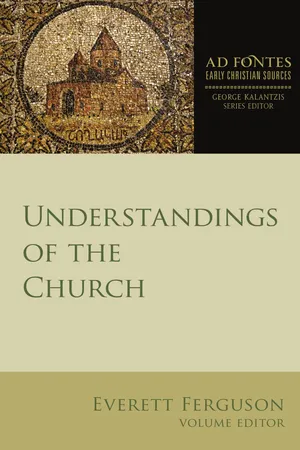
Understandings of the Church
eBook - ePub

Understandings of the Church

  1. 192 pages
  2. English
  3. ePUB (mobile friendly)
  4. Available on iOS & Android
eBook - ePub

About this book

Understandings of the Church explores the ways imagery is used by biblical writers and early Christian teachers such as Cyprian, Ignatius of Antioch, Tertullian, Clement of Alexandria, and Origen to describe the concept of church.

Ad Fontes: Early Christian Sources is a series designed to present ancient Christian texts essential to an understanding of Christian theology, ecclesiology, and practice. The books in the series will make the wealth of early Christian thought available to new generations of students of theology and provide a valuable resource for the church. Developed in light of recent patristic scholarship, the volumes will provide a representative sampling of theological contributions from both East and West.

The volumes of the series are relevant for a variety of courses from introduction to theology to classes on doctrine and the development of Christian thought. The goal of each volume is not to be exhaustive, but rather representative enough to denote for a nonspecialist audience the multivalent character of early Christian thought, allowing readers to see how and why early Christian doctrine and practice developed the way it did.

Trusted by 375,005 students

Access to over 1.5 million titles for a fair monthly price.

Study more efficiently using our study tools.

Information

Year
2016
Print ISBN
9781451496369
eBook ISBN
9781506416922

2

1 Clement

The work known as 1 Clement is actually a letter from “the church of God that resides in Rome to the church of God that resides in Corinth.”[1] The actual author was early said, probably correctly, to be Clement, one of the bishops of Rome. The date of the letter was probably in the closing years of the decade of the 90s of the first century. The occasion for the letter was once more a matter of division in the church at Corinth, a problem addressed in Paul’s first letter to the Corinthian church, only this time the problem was specifically the removal of some of the elders at the instigation of the younger members of the congregation. Their motive is not stated, although modern scholars offer several speculations. Clues within the letter do not go beyond an assumed spirit of jealousy and rebellion. The letter appeals to Paul’s analogy of the church to the human body of many members, each necessary for the harmonious working of the whole.[2] The following passages are valuable for their testimony to the early organizational structure of the church and testimony that this was of divine and apostolic origin. First Clement agrees with other early sources that each congregation was led by a plurality of those called presbyters (elders) or bishops (used interchangeably in the second passage) assisted by deacons (contrast Ignatius, below). The second passage makes incidental reference to the image of the local church as a flock of sheep belonging to Christ.

1 Clement 42.1–5

42.1–5. The apostles were given the gospel for us from the Lord Jesus Christ; Jesus the Christ was sent from God. 2. Christ therefore is from God, and the apostles are from Christ. They both, therefore, came in good order from the will of God. 3. When they received his commands, were fully convinced by the resurrection of our Lord Jesus Christ, and having placed their faith in the word of God, the apostles went out with the full assurance of the Holy Spirit, preaching the gospel that the kingdom of God is about to come. 4. They preached in every district and every city, and they appointed their first converts, after testing them by the Spirit, as bishops and deacons of those who were going to believe. 5. . . . For thus the Scripture says somewhere, “I will appoint their bishops in righteousness and their deacons in faith.”[3]

1 Clement 44.1–6

44.1–6. Our apostles knew through our Lord Jesus Christ that there would be strife concerning the name of the episcopate. 2. For this reason, therefore, and having received perfect foreknowledge, they appointed those we mentioned above, and afterward they gave the rule that if these should die, other tested men should succeed to their ministry. 3. The men, therefore, who have been appointed by the apostles or afterward by other eminent men with the consent of the whole church and who have ministered blamelessly to the flock of Christ humbly, quietly, and unselfishly, men who have been well testified to by all for many years—these men we do not consider it just to expel from their ministry. 4. For it will be no small sin to us if we expel from the episcopate those who have offered the gifts blamelessly and in a holy manner. 5. Blessed are those presbyters who have died previously and had a fruitful and perfect departure. For they have no fear that someone will remove them from their established place. 6. For we see that you have removed some who have conducted themselves well from the ministry that has been blamelessly distinguished by them.

  1. 1 Clement prologue.
  2. 1 Clem. 37.5.
  3. An otherwise unattested reading of Isa 60:17, which in the Greek says, “I will give your rulers in peace and your bishops [overseers] in righteousness.”

3

2 Clement

The work known as 2 Clement is a hortatory sermon on repentance that in its transmission was incorrectly ascribed to Clement of Rome. It may have originated in Rome, Corinth, or Alexandria; its date is uncertain, perhaps the early or mid-second century. The author, perhaps distinct from the presbyters to whom he refers (17.3, 5), read his exhortation (19.1) following the Scripture reading, which at least included Isa 54:1, interpreted of the church, once barren but now bearing children (2.1). The reference to “the books and the apostles” refers to the Jewish Scriptures and the teachings and/or writings of the apostles. Notable ideas about the church are its existence before creation in the mind or plan of God but like Christ revealed in the new era; its association with life, the Spirit, salvation, and the Lord’s election; and its identification as the body of Christ with his flesh along with the accompanying obligations for the kind of life lived in the flesh.[1]

2 Clement 14.1–5

14.1–5. So then, brothers and sisters, if we do the will of God our Father, we will belong to the first church, the spiritual church, which was created before the sun and moon. But if we do not do the will of the Lord, we will belong to those of whom the Scripture says, “My house has become a robbers’ cave.”[2] So then, let us choose to belong to the church of life in order that we may be saved. 2. I do not suppose you to be ignorant that the living church is the body of Christ, for the Scripture says, “God made the human being male and female.”[3] The male is Christ; the female is the church. And you are not ignorant that the books and the apostles say that the church exists not only in the present but also from the beginning. For she was spiritual, as was also our Jesus, but she was manifested in the last days in order that she might save us. 3. Although the church was spiritual, she was manifested in the flesh of Christ, making clear to us that if anyone of us should guard her and not corrupt her in the flesh, he will receive her back in the Holy Spirit. For this flesh is a copy of the Spirit. Therefore, no one who corrupts the copy will receive the original. Hence, brothers and sisters, this means, “Guard the flesh so that you may receive the Spirit.” 4. If we say that the flesh is the church and the Spirit is Christ, then, therefore, the person who abuses the flesh abuses the church. Such a person, therefore, will not receive the Spirit, which is Christ. 5. This flesh is capable of receiving such an incorruptible life, if the Holy Spirit clings to it. Nor is one able to express or tell what the Lord has prepared for his chosen ones.

  1. See 2 Clem. 9.1–5.
  2. Jer 7:11; Matt 21:13.
  3. Gen 1:27.

4

Ignatius of Antioch

Ignatius was bishop of Antioch during the reign of Emperor Trajan (ruled 98–117). Arrested for resisting the imperial cult, he was taken under armed escort to Rome, where he became a martyr for his faith in Christ. On his way across Asia Minor, he wrote letters to six churches and a letter to Polycarp of Smyrna. In these letters, he opposed Jewish practices as observed by Gentile Christians and especially the view that Jesus only appeared to have a human body with its accompanying disparagement of things material. Ignatius advocated unity against the divisions accompanying these practices and obedience to the ministry of the church as the means of achieving this unity. Obedience to a higher authority as the way to maintain unity has a long history in Christian practice but with dubious results. Ignatius championed the threefold ministry of one bishop, a plurality of presbyters, and deacons in each church, a pattern for which he is the first witness but which came to prevail in the second century. Ignatius indicates that the assembly, Eucharist, love feast, and baptism were important congregational activities. All church functions were to be conducted by the bishop or by someone he designated. Ignatius reflects themes from the writings of both Paul and John in the New Testament, including the ideas of being members of the body of Christ and particularly the emphasis on unity. Although the musical analogy for unity is common, Ignatius’s elaboration of it for unity with the bishop is distinctive. Similarly he puts his own stamp on the use of temple and sacrificial imagery for the church.

Ephesians 4–6

4.1. Hence it is proper for you to live together in harmony with the mind of the bishop, as indeed you are doing. For your most worthy presbytery, worthy of God, is so attuned to the bishop as strings to a lyre. Accordingly Jesus Christ is sung by your harmony and symphonic love. 2. Now each of you individually become a chorus, so that in harmony like a symphony, taking your keynote from God, you may sing in unison through Jesus Christ to the Father. The purpose is that he may hear you and recognize through the things that you do well that you are members of his Son. Therefore, it is useful for you to be in blameless unity so that you may always have a share in God.
5.1. For since in a short time I established such fellowship with your bishop, which was not human but spiritual, how much more do I count you blessed who are so uni...

Table of contents

  1. Cover
  2. Title Page
  3. Copyright
  4. Table Of Contents
  5. Series Foreword
  6. Introduction
  7. 1 Clement
  8. 2 Clement
  9. Ignatius of Antioch
  10. Hermas, Shepherd
  11. Justin Martyr
  12. Irenaeus
  13. Letter of the Churches of Vienne and Lyons
  14. Clement of Alexandria
  15. Tertullian
  16. Hippolytus
  17. Pseudo-Clement
  18. Origen
  19. Cyprian
  20. Firmilian
  21. Methodius
  22. Eusebius
  23. Athanasius
  24. Cyril of Jerusalem
  25. Basil the Great
  26. Gregory of Nyssa
  27. Ephrem the Syrian
  28. Ambrose
  29. The Niceno-Constantinopolitan Creed of 381
  30. John Chrysostom
  31. Theodore of Mopsuestia
  32. Augustine
  33. Bibliography
  34. Index of Scripture
  35. Index of Patristics
  36. Index of Names and Subjects

Frequently asked questions

Yes, you can cancel anytime from the Subscription tab in your account settings on the Perlego website. Your subscription will stay active until the end of your current billing period. Learn how to cancel your subscription
No, books cannot be downloaded as external files, such as PDFs, for use outside of Perlego. However, you can download books within the Perlego app for offline reading on mobile or tablet. Learn how to download books offline
We are an online textbook subscription service, where you can get access to an entire online library for less than the price of a single book per month. With over 1.5 million books across 990+ topics, we’ve got you covered! Learn about our mission
Look out for the read-aloud symbol on your next book to see if you can listen to it. The read-aloud tool reads text aloud for you, highlighting the text as it is being read. You can pause it, speed it up and slow it down. Learn more about Read Aloud
Yes! You can use the Perlego app on both iOS and Android devices to read anytime, anywhere — even offline. Perfect for commutes or when you’re on the go.
Please note we cannot support devices running on iOS 13 and Android 7 or earlier. Learn more about using the app
Yes, you can access Understandings of the Church by Everett Ferguson, George Kalantzis, Everett Ferguson,George Kalantzis in PDF and/or ePUB format, as well as other popular books in Theology & Religion & Christian Theology. We have over 1.5 million books available in our catalogue for you to explore.