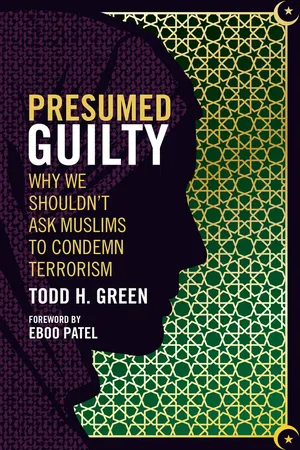
All of us should condemn terrorism--whether the perpetrators are Muslim extremists, white supremacists, Marxist revolutionaries, or our own government. But it's time for us to stop asking Muslims to condemn terrorism under the assumption they are guilty of harboring terrorist sympathies or promoting violence until they prove otherwise. Renowned expert on Islamophobia Todd Green shows us how this line of questioning is riddled with false assumptions that say much more about "us" than "them."
Green offers three compelling reasons why we should stop asking Muslims to condemn terrorism:
1) The question wrongly assumes Islam is the driving force behind terrorism
2) The question ignores the many ways Muslims already condemn terrorism.
3) The question diverts attention from unjust Western violence.
This book is an invitation for self-examination when it comes to the questions we ask of Muslims and ourselves about violence. It will open the door to asking better questions of our Muslim neighbors, questions based not on the presumption of guilt but on the promise of friendship.
- 194 pages
- English
- ePUB (mobile friendly)
- Available on iOS & Android
eBook - ePub
About this book
Information
Topic
Theology & ReligionSubtopic
Islamic TheologyIII
Diverting Attention from Western Violence
5
The Sins of the Fathers
I’m not a big fan of the National Prayer Breakfast. I have always been suspicious of politicians putting their piety on display. It comes across as an insincere ploy to get votes from people of faith. It also brings to mind Jesus’s admonition against praying in order to be seen and admired by others.
Many politicians and faith leaders don’t share my opinion of the prayer breakfast. On the first Thursday in February, they ceremoniously gather in Washington to showcase their faith for the media and the American public. A less cynical view is they are setting aside partisan divisions for one day to celebrate the spiritual ties that bind the nation together. Perhaps. But I’m still not convinced that a televised prayer event spotlighting clergy, congressional representatives, and the commander-in-chief is capable of transcending political expediency.
My skepticism normally prompts me to tune out the prayer breakfast. But in 2015, I was in a different mood. This time, I made sure to tune in. I wanted to hear what President Obama had to say. What changed my mind was ISIS. ISIS was the new global threat weighing on everyone’s mind, and I wanted to hear how our theologian-in-chief was going to make sense of this threat from the perspective of his Christian faith. I held out hope that the political setting wouldn’t prompt him to pander to the American public and engage in simplistic anecdotes pitting civilized Christians against backward Muslims.
Obama didn’t disappoint. He exercised his theological chops and reflected on religion’s potential to inspire love and hatred, peace and violence. In addressing Islam, his initial focus was on the recent atrocities committed in its name from Pakistan to Paris. He took particular aim at ISIS’s “unspeakable acts of barbarism,” including its persecution of Yazidis and its recourse to rape as a tool for war.[1]
Then he turned his attention to Christianity. He urged his audience to “remember that during the Crusades and the Inquisition, people committed terrible deeds in the name of Christ,” adding that “slavery and Jim Crow all too often was justified in the name of Christ.” The sinful tendency to distort religion for violent ends was not unique to one place or one religion. Humility, not hubris, was in order when tackling the problem of religiously framed violence.
I loved his speech. But I was in the minority. Religious leaders, politicians, and mainstream journalists went on the attack. They chastised Obama for his insensitivity to Christians and for his failure to keep his focus on “radical Islamic terrorism.”
Russell Moore, president of the Southern Baptist Ethics and Religious Liberty Commission, called Obama’s comments “an unfortunate attempt at a wrongheaded moral comparison.”[2] Governor Bobby Jindal of Louisiana mocked the president for giving an irrelevant history lesson, assuring him that the “medieval Christian threat is under control.”[3] A journalist I respect greatly, NBC’s Andrea Mitchell, scolded the president for invoking the Crusades and digging into the past. In light of ISIS’s current atrocities, “you don’t lean over backwards to be philosophical about the sins of the fathers.”[4]
Obama’s great crime in all of this was to tell the truth. He acknowledged unjust violence targeting civilians or inflicting terror on the innocent is a human problem, not confined to any one people, religion, or nation. He diverted attention away from violent Muslims to address violent Christians. It was a brief detour—two sentences to be exact—but enough of one to cast doubt that Muslim extremists have a monopoly on barbarity and bloodshed.
Obama was not supposed to tell this story. None of us are. I once spoke at a monastery and noted the kinds of atrocities committed by ISIS—rape, torture, genocide—have been committed by Western Christians too, and not just in the distant past. It didn’t go over well. One of the monks wrote to me afterward to express his concern that I was blaming Christians for violence instead of keeping my focus on violent Muslims. He made it clear that Christians doing violent things was not on the table for discussion.
Telling the story of Western violence and the role of Christians in it will not endear you to many. But the fact that there’s so much resistance to this story is an indication there are truths in our history we must confront, skeletons in our national and religious closets that must see the light of day. It’s time to tell this story and to wrestle with these truths, difficult and painful as it may be.
The story I will tell is suggestive, not exhaustive. It’s the story of how unjust violence has shaped our history going back to the Middle Ages, and how this violence informs national identities in Europe and the United States to this day. It’s also the story of how categories of violence assumed to be endemic to Islam feature prominently in our history. Holy wars and inquisitions, the subject of this chapter, illustrate this point. Fighting wars and persecuting heretics in the name of God characterize extremist groups like ISIS. But they characterize Western Christians at various points in history too.
We need help in remembering that unspeakable violence is not just something “they” do but factors into the collective histories of all peoples. Sadly, many of us don’t know our own history of violence, or we only know sanitized versions of it that reinforce a sense of Western and Christian superiority. Focusing attention on Western violence is a humbling exercise. It collapses the false dichotomy pitting a “violent Islam” against a “peaceful West.” It also wards off the temptation to project onto Muslim communities our own sins of commission and omission when it comes to violence.
At a more basic level, we must face the truth about ourselves. We are who we are today because of a long history of unjust violence, much of it performed within a Christian framework. This violence gave birth to modern Western nations, sustained systemic injustices, and paved the way for Western global domination. If we wish to start a new chapter of history, one characterized not by war and terrorism but by reconciliation and healing between and within nations and religions, we must own this truth. As James Baldwin noted: “Not everything that is faced can be changed, but nothing can be changed until it is faced.”[5]
Crusades and Holy War
A good place to start when facing uncomfortable truths about Western violence is holy war. Holy war refers to war ordained or mandated by God. Those on the other side of the conflict, combatants and noncombatants, are enemies of God and of the one true religion. Other motives for fighting, whether economic or political, may come into play, but holy warriors depend heavily on religion to sanctify their cause.
We often think of holy war as primitive, the relic of a bygone era. Only jihadists still fight holy wars, invoking God to justify their bloodshed. But as we’ll see, holy war is more integral to Western history than is often assumed.
The Crusades stand out as the quintessential example of Christians going to battle on the conviction that it was God’s will. The Crusades were a series of European military campaigns, sanctioned and promoted by the Catholic Church, from the eleventh through thirteenth centuries. Their main purpose was to conquer and retake territory from Muslims in Palestine. Pope Urban II ordered the First Crusade in 1095 in response to the Byzantine emperor’s call for assistance to fight off invading Muslim Turks.
The First Crusade focused on capturing Jerusalem. In 1099, Christian armies succeeded in this task and went on to establish other kingdoms. Holding on to Jerusalem proved difficult, however, as the city fell to the great Muslim general Saladin less than a century later. Additional crusades ensued, often prompted by Muslim conquests of territory held by Christian rulers. Most of these crusades failed. By the end of the thirteenth century, the last great European stronghold in the region had fallen into Muslim hands.
All of these crusading battles reflected a basic theological premise: Christians must wipe out Muslims because “God wills it.” Pope Urban II did not mince words about God’s hatred for Muslims. He described Muslims as “an accursed race, a race utterly alienated from God.” Christians were obligated “to exterminate this vile race from our lands.”[6]
Violent language translated into violent actions. When Christians attacked Jerusalem during the First Crusade, they massacred some thirty thousand people in the span of three days. The invading army spared no Muslim, male or female. A prominent chronicler of the First Crusade observed: “Men rode in blood up to their knees and bridle reins. Indeed, it was a just and splendid judgment of God that this place should be filled with the blood of unbelievers.”[7] The body count was so high that the crusaders didn’t know what to do with all of the bodies. Six months later, an overwhelming stench emanating from decaying corpses was on hand to meet visitors to the city.
Muslims were not the only victims. The Christian army rounded up the Jews of Jerusalem into the synagogue and massacred them. In fact, the Crusades set off a wave of violence against Jews, understandable given that many Crusaders lumped Jews in with Muslims as enemies of the faith. In 1096, a German crusading army attacked Jewish communities in the Rhineland region, killing between four and eight thousand Jews. Some Jews avoided death only after submitting to forced conversions.
Though holy war reached its zenith with the Crusades, Europe witnessed other conflicts in which participants saw themselves fighting (or encouraging others to fight) to fulfill God’s will. Ferdinand II, emperor of Germany during the Thirty Years’ War (1618–1648), viewed battles against Protestants as ordained by God. In the lead-up to the English Civil War (1642–1651), Protestant clergy such as William Gouge heralded wars “extraordinarily made by express charge from God.”[8] Giuseppe Mazzini, a nineteenth-century Italian revolutionary, believed the quest to unify Italy was a holy struggle, an effort to realize God’s plan for an independent nation.
Romanticized notions of the Crusades also took a firm hold in nineteenth-century art and literature. King Louis-Philippe of France opened a series of rooms known as the Hall of Crusades in the Palace of Versailles in 1843. Over 120 paintings dedicated to the glories of the Crus...
Table of contents
- Cover
- Praise for Presumed Guilty
- Title Page
- Copyright
- Table Of Contents
- Acknowledgments
- Foreword
- Introduction
- Assuming Islam Is the Cause of Terrorism
- Ignoring Muslims Who Condemn Terrorism
- Diverting Attention from Western Violence
- Conclusion: Assuming the Best of Our Muslim Neighbors
- Suggested Further Reading
- Index
Trusted by 375,005 students
Access to over 1.5 million titles for a fair monthly price.
Study more efficiently using our study tools.
Frequently asked questions
Yes, you can cancel anytime from the Subscription tab in your account settings on the Perlego website. Your subscription will stay active until the end of your current billing period. Learn how to cancel your subscription
No, books cannot be downloaded as external files, such as PDFs, for use outside of Perlego. However, you can download books within the Perlego app for offline reading on mobile or tablet. Learn how to download books offline
Perlego offers two plans: Essential and Complete
- Essential is ideal for learners and professionals who enjoy exploring a wide range of subjects. Access the Essential Library with 800,000+ trusted titles and best-sellers across business, personal growth, and the humanities. Includes unlimited reading time and Standard Read Aloud voice.
- Complete: Perfect for advanced learners and researchers needing full, unrestricted access. Unlock 1.5M+ books across hundreds of subjects, including academic and specialized titles. The Complete Plan also includes advanced features like Premium Read Aloud and Research Assistant.
We are an online textbook subscription service, where you can get access to an entire online library for less than the price of a single book per month. With over 1.5 million books across 990+ topics, we’ve got you covered! Learn about our mission
Look out for the read-aloud symbol on your next book to see if you can listen to it. The read-aloud tool reads text aloud for you, highlighting the text as it is being read. You can pause it, speed it up and slow it down. Learn more about Read Aloud
Yes! You can use the Perlego app on both iOS and Android devices to read anytime, anywhere — even offline. Perfect for commutes or when you’re on the go.
Please note we cannot support devices running on iOS 13 and Android 7 or earlier. Learn more about using the app
Please note we cannot support devices running on iOS 13 and Android 7 or earlier. Learn more about using the app
Yes, you can access Presumed Guilty by Todd Green,Todd Green in PDF and/or ePUB format, as well as other popular books in Theology & Religion & Islamic Theology. We have over 1.5 million books available in our catalogue for you to explore.