Presents oral histories and interviews of women who belong to Nation of Islam
With vocal public figures such as Malcolm X, Elijah Muhammad, and Louis Farrakhan, the Nation of Islam often appears to be a male-centric religious movement, and over 60 years of scholarship have perpetuated that notion. Yet, women have been pivotal in the NOI's development, playing a major role in creating the public image that made it appealing and captivating.
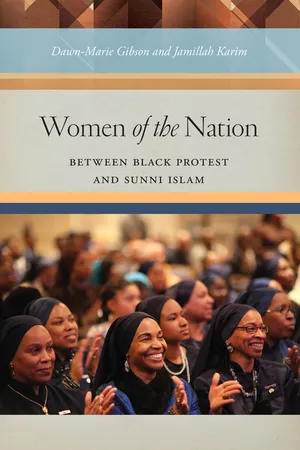
Women of the Nation draws on oral histories and interviews with approximately 100 women across several cities to provide an overview of women's historical contributions and their varied experiences of the NOI, including both its continuing community under Farrakhan and its offshoot into Sunni Islam under Imam W.D. Mohammed. The authors examine how women have interpreted and navigated the NOI's gender ideologies and practices, illuminating the experiences of African-American, Latina, and Native American women within the NOI and their changing roles within this patriarchal movement. The book argues that the Nation of Islam experience for women has been characterized by an expression of Islam sensitive to American cultural messages about race and gender, but also by gender and race ideals in the Islamic tradition. It offers the first exhaustive study of women's experiences in both the NOI and the W.D. Mohammed community.
eBook - ePub
Women of the Nation
Between Black Protest and Sunni Islam
- 288 pages
- English
- ePUB (mobile friendly)
- Available on iOS & Android
eBook - ePub
About this book
Information
1
“Our Nation”
Women and the NOI, Pre-1975
I really felt that I was going to die if I had stayed in the streets. I had suicidal tendencies. I really just didn’t have much of a motivation for living. I felt like a failure and the Nation of Islam took me as I was, and not having my degree wasn’t a big deal.… Initially the idea of the white man being the devil was appealing to me. I was very angry. I grew up under the Jim Crow laws. My mother worked in a restaurant where we couldn’t go in the front of it. If we wanted to buy something, we had to buy it through the back door. My grandmother worked for $17.00 a week for a family that was nice and kind, but my grandmother was still like a slave to them. My granddad died at the age of 52 as a result of alcoholism—he was a sharecropper, and it was because he felt he had no manhood and he couldn’t demonstrate his dignity as a result of the way he was treated by white people.
—Jessica Muhammad
The Nation of Islam was about business. They established businesses, they treated their women well and they educated their children. They were model citizens. I mean, if you did something wrong, you were banned. It was just unacceptable.
—Safiyyah Shahid
Look at this sister here. She came to Chicago about twelve years ago from a town seventy-two miles from Little Rock, Arkansas. She reunited with the Nation seven years ago. She was nothing when she came in. Now she is morally regenerated and materially well-to-do. She lives on the West Side. She owns a gas station and rents out two flats. All praise is due to Allah for His blessings upon us the Lost-Found Nation of Islam.
—Elijah Muhammad
Jessica arrived at the Nation of Islam’s Temple No. 15 in Atlanta in 1974 while struggling to overcome low self-esteem, homelessness, drug use, and fractured family relationships. Prior to attending the NOI, Jessica had been a promising student at Spelman, a historically Black college for women. Jessica’s experiences of race, gender, and class discrimination made the NOI’s critique of the U.S. racial hierarchy and castigation of Caucasians as “blue-eyed devils” particularly attractive. Elijah Muhammad’s NOI provided a framework and structure that enabled women like Jessica to transform their lives, relying almost exclusively on their isolated community via the creation of alternative kinship networks. Indeed, the organization prided itself on its perceived ability to convert disillusioned men and women into what former Nation member and school director Safiyyah Shahid describes as “model citizens.” Safiyyah’s belief that the NOI converted women like Jessica into “model citizens” is shared by countless observers of the Black Muslim movement. In a speech delivered at Imam Mohammed’s inauguration in February 1975, for example, Rev. Jesse Jackson described Elijah Muhammad as having “transformed his followers from shooting dope in their veins to pushing hope in their brains.”1
Elijah Muhammad’s gender ideology was intensely conservative and contradictory yet fully compatible with the national discourse on traditional gender roles and spheres of influence. The NOI placed the development of progressive patriarchal communities, communal regeneration, and independence from white institutions above all other concerns. Nation women were integral to the fulfillment of these ideals. African American women encountered Elijah Muhammad’s patriarchal group via several outlets, including the Nation’s official newspaper, Muhammad Speaks (MS), and recruiting efforts by local ministers. Women were attracted to the Nation for many of the same reasons as their male counterparts. They embraced the NOI’s critique of race relations and pooled resources to achieve the NOI’s nation-building aims. It is important to note that Elijah Muhammad’s gender ideology was rarely a significant consideration in women’s decisions to join the Nation. Our findings suggest that women embraced the NOI’s concept of “natural beauty” and the protection the organization offered them via the Fruit of Islam, a paramilitary division of the NOI for male members. Indeed, many women found these aspects of the gender ideology empowering. Yet varied interpretations of the gender ideology and dictates about coeducation and marriage caused some women a significant degree of distress. Despite this, women arrived at NOI temples throughout the United States in search of solutions to their shared experiences of racial injustice and economic exploitation. Many Nation women shared Elijah Muhammad’s critique of the Black church but privately questioned the NOI’s theology. Nation women directed and taught classes in the Nation’s independent schools, which were commonly known as the Muhammad University of Islam. They worked for and managed NOI businesses and labored together to meet the NOI’s financial needs. The Nation’s hierarchical structure locked women out of positions of leadership in ministry on par with their male counterparts, but they exercised agency in most aspects of the group. Women’s experiences in Elijah Muhammad’s NOI varied greatly. Nevertheless, their narratives reveal important commonalities of experience and provide a unique insight into what has been America’s most successful and ambitious Black nationalist entity. The NOI had an enduring impact on its female members. Numerous aspects of the NOI’s dietary laws, dress codes, and gender politics followed Nation women into both the Imam W. D. Mohammed community and Louis Farrakhan’s Resurrected NOI.
Encountering the NOI
African American women came into contact with the NOI primarily via friends, the recruitment efforts of local temple ministers, the Fruit of Islam, and the group’s growing body of propagation literature, which by 1959 included Messenger Magazine and The Supreme Wisdom. In the 1960s, Muhammad Speaks provided women with an opportunity to acquaint themselves with NOI teachings and gender dictates. The overwhelming majority of women encountered the group in their early twenties and thirties. Their religious backgrounds were primarily nominally Christian. Contrary to popular thought, not all of the women who arrived at the NOI’s temples were poorly educated members of the proletariat. A significant number of women who joined the NOI had college degrees or were pursuing an advanced degree. Women’s motives for joining the NOI varied considerably. For some women the Nation stood out as a beacon of “Black consciousness” while for others it offered the potential for “rehabilitation,” “structure,” and “family.” Several scholars, including historian Bayyinah Jeffries, suggest that women were lured to the NOI by the prospect of securing a “good man.”2 This proposition is misinformed. Oral history narratives reveal a more complex portrait of women’s motives for joining the NOI. They found the NOI’s efforts to combat social ills, its do-for-self ethos, and its respect for Black women attractive attributes. Former Nation member Lynice Muhammad exemplifies this sentiment when she comments:
The part of the Nation I found attractive was the part of them encouraging structure.… I liked the idea of them giving structure, giving people, at that time African Americans, the ideal of being a part of something that we could not be at that time.… I really liked the idea of them giving us backbone, structure and helping us to be somebody.
Lynice’s remarks are telling for two reasons. They speak to the reality of Black exclusion and subjugation in the United States, and they reaffirm that the Nation’s appeal lay largely in the perceived strength of its community and the sense of pride it instilled in its followers. Former Nation member Safiyyah Shahid explains that the women who joined the Nation chose to “determine their own destiny” and that of their communities. Women were also drawn to the Nation as a result of what historian Ula Taylor describes as its “rhetoric of love, protection and respect.”3 Indeed, such rhetoric helped define the NOI to women and those on the fringes of the movement as a place where Black women were treated like and commonly referred to as “queens” and the “mothers of civilization.” While such rhetoric was not the primary factor propelling women’s engagement with the NOI, it did offer them a powerful corrective to dominant attitudes pertaining to standards of white hegemonic beauty. Former member Shirley Morton remarks that the NOI’s rhetoric of love and respect empowered her to embrace a concept of “natural beauty”:
I am proud and happy just to be Black.… I can proclaim to the rest of the world that through the teachings of the Honorable Elijah Muhammad, I know that I am the mother of civilization. I wear the clothes of civilized people. My dresses are far below my knees and I love it. This makes me respect myself better, but it also makes other people respect me.… The Honorable Elijah Muhammad teaches us that we Black women are the most beautiful of all women.4
In her comments we can see that first and foremost being a part of the NOI enabled Shirley to embrace and become “proud” of her skin color. Again, this suggests that the NOI’s message appealed to women primarily on the basis of its racial politics. It is important to note, however, that Shirley’s remarks highlight that Nation women made the gender ideology work for them. In Shirley’s case, we can see that it empowered her to appreciate herself and her Nation sisters as “the most beautiful of all women.”
Nation women tend to describe their initial impression of the NOI as being very positive. NOI attire, strict search procedures for security purposes, and the segregation of male and female members within each temple ensured that those attending the Nation for the first time understood the group to be, if nothing else, organized and respectful. Former member Zubaydah Madyun comments that she came away from her first NOI meeting in Chicago in the early 1960s with the impression that they “were very nice looking, decent people.” Nation women were instructed to make “sisters feel at home” during the newcomers’ first NOI meeting.5 This included embracing other women as equals regardless of their socioeconomic standing, educational background, and marital status. Thus, perhaps unsurprisingly, women recall being welcomed with open arms in the NOI.
Women usually attended weekly NOI temple meetings for around six months before their request for membership was processed and approved. This apparently lengthy process provided women with sufficient time to familiarize themselves with the NOI’s teachings and, perhaps more important, to sample the life of Nation women before formally committing to the organization. Letters requesting membership in the NOI were standardized and sent directly to Elijah Muhammad in Chicago for consideration:
Dear Mr. Mohammed,
In the name of Allah, the merciful, all holy, praise is to Allah, the lord of the world. I have been attending the teachings of Islam by one of your Ministers, and I believe in Islam, my own religion, and I desire to claim my own. Please take away this old slave name of the devil and give me my own holy righteous name.6
Muhammad personally reviewed such letters meticulously. Misspellings or grammatical errors would result in a letter’s being declined or returned with a request to resubmit. Former NOI member Islah Umar, who joined the Nation while working toward a master’s in speech pathology and audiology, recalls that her first letter for membership was declined because the Nation wanted her “to submit … to make you feel you failed and that you’re not all you thought you were.” Islah’s second letter was, however, approved. Receipt of approved letters authorized women like Islah to replace their surname with an “X,” and from 1967 onward it enabled them to begin wearing the official MGT uniform.
Pursuing membership in the NOI carried with it the very real possibility of family rejection, discrimination, and marginalization in the workplace and surrounding community. Familial and societal attitudes toward the NOI were shaped by the national media and so-called moderate Negro leaders. The notion that the NOI represented a “sickness” in U.S. race relations had taken root prior to WNTA-TV’s airing The Hate That Hate Produced in 1959. In 1957, for example, readers of the Pittsburgh Courier described Elijah Muhammad’s occasional articles for the paper as “biased in nature, misleading as to facts and history … and wholly undesirable for consumption by high school students.”7 Women were cognizant of the fact that their decision to join the NOI could result in rejection by their family circle and isolation from their kinship networks given the popular portrayal of the NOI in the media as a subversive and dangerous cult. Indeed, so much was the fear surrounding the NOI that former member Amidah Salahuddin notes that her mother took out an insurance policy on her when she joined the Nation’s Harlem temple in 1968. Much of the rejection that women experienced from their families stemmed not so much from a fear that the NOI was dangerous but from the fact that it was not Christian.
Former Nation women convey a common impression of being disillusioned with the Black church before attending NOI meetings. It is important to note that their dissatisfaction was not a result of theological uncertainties or questions pertaining to Christ’s divinity. Indeed, in our sample of interviewees we have found that while women privately questioned whether Wallace D. Fard Muhammad could be both fully man and fully God, most never questioned Christ’s divinity. Race-based concepts associated with Western Christianity troubled women, as did the perceived inability of the Christian church to speak to their concerns. The theology of the NOI, as articulated by Elijah Muhammad, rarely played a significant role in attracting women to the NOI. Many former Nation women speak of their struggles to accept the theology of the Nation and their privately questioning it. Jeanette Nu’Man, for example, notes:
The more I studied the Bible, the more problems I had with the church itself. I began to have the same challenges with the NOI as I read the Qur’an and then saw what was happening in the NOI.… There is no reference to Fard Muhammad in the Qur’an. Pride in being a Black person and the history of Black people attracted me to the NOI. Fard Muhammad was not Black and he was not white; he was this Asiatic Black man. He looked Caucasian and he was supposed to be God.
Jeanette’s doubts were shared by other women, although they never relayed them to their ministers or MGT captains. Moreover, not all Nation women were familiar with Qur’anic teachings or the Qur’an itself. Thus, while Jeanette’s doubts resulted from Fard’s absence from the Qur’an, other women expressed doubts that related to a more particular aspect of NOI theology. Former Nation member Khayriyyah Faiz describes feeling uncomfortable with the notion that all Caucasians were “devils”:
I thought about the white man being the devil and the Black man being God. That didn’t quite fit in my mind set because I knew that in the nature of human beings, that there were African American people who were not necessarily pure in their thinking and in their hearts, and I knew of Caucasians who I had met who were good people. So that idea didn’t fit comfortably within my paradigm, psychologically or spiritually, but at the same time, I knew that the racist society that I grew up in kind of attested to a lot of that.
Nation women found much in the organization that they liked. These positive aspects, as Zubaydah Madyun describes, often “overrode” the uncertainties that she’d had about the theology of the movement:
I did not believe that Master Fard was God. All the other things overrode that. I just always felt that maybe he did come and do some good and get us going just like Noble Drew Ali and Marcus Garvey. I thought there was some truth in there somewhere, but I just did not believe that he was God in that person. I could not get with that.
In these narratives we can see that although the Nation’s critique of white supremacy appealed to women, the intricacies of NOI theology did not. Indeed, as Jeanette’s comments suggest, some women were at least partially aware of the stark differences between the NOI’s teachings and Qur’an-based teachings. We have found, however, that not all Nation women based their disbelief on the fact that there was no mention of Fard Muhammad in the Qur’an. Nation women read the theology of the organization as something that was designed to get them on the road to Islam and help them to overcome the effects of pervasive ideologies of racial supremacy.
Families reacted angrily, and at times with despair, to news that their children had joined the NOI. Countless Nation women comment that their parents were horrified by their decision to join the organization. Bayyinah Abdul-Aleem registered with the NOI in Philadelphia in 1973 at the age of twenty. She recalls that while her parents were not “intensely religious,” they were “nervous” about her decision to join the Nation. Similarly, Winifred Muhsinah, who joined the NOI in Miami in 1966, notes that her mother was “very upset because I had been raised a Methodist Christian.… My friends sort of weren’t openly offensive, but they looked at me differently.” The Nation assisted its members in overcoming such rejection by providing them with alternative kinship networks that were based on a reciprocal commitment to NOI ideals. New members were kept so busy within the Nation that, as Islah Umar comments, “you did not miss what you had l...
Table of contents
- Cover Page
- Title Page
- Copyright Page
- Dedication
- Contents
- Acknowledgments
- Introduction
- 1. “Our Nation”: Women and the NOI, Pre-1975
- 2. “Thank God It Changed!”: Women’s Transition to Sunni Islam, 1975–80
- 3. Resurrecting the Nation: Women in Louis Farrakhan’s Nation of Islam
- 4. Women in the Nation of Islam and the Warith Deen Mohammed Community: Crafting a Dialogue
- Conclusion
- Notes
- Index
- About the Authors
Trusted by 375,005 students
Access to over 1.5 million titles for a fair monthly price.
Study more efficiently using our study tools.
Frequently asked questions
Yes, you can cancel anytime from the Subscription tab in your account settings on the Perlego website. Your subscription will stay active until the end of your current billing period. Learn how to cancel your subscription
No, books cannot be downloaded as external files, such as PDFs, for use outside of Perlego. However, you can download books within the Perlego app for offline reading on mobile or tablet. Learn how to download books offline
Perlego offers two plans: Essential and Complete
- Essential is ideal for learners and professionals who enjoy exploring a wide range of subjects. Access the Essential Library with 800,000+ trusted titles and best-sellers across business, personal growth, and the humanities. Includes unlimited reading time and Standard Read Aloud voice.
- Complete: Perfect for advanced learners and researchers needing full, unrestricted access. Unlock 1.5M+ books across hundreds of subjects, including academic and specialized titles. The Complete Plan also includes advanced features like Premium Read Aloud and Research Assistant.
We are an online textbook subscription service, where you can get access to an entire online library for less than the price of a single book per month. With over 1.5 million books across 990+ topics, we’ve got you covered! Learn about our mission
Look out for the read-aloud symbol on your next book to see if you can listen to it. The read-aloud tool reads text aloud for you, highlighting the text as it is being read. You can pause it, speed it up and slow it down. Learn more about Read Aloud
Yes! You can use the Perlego app on both iOS and Android devices to read anytime, anywhere — even offline. Perfect for commutes or when you’re on the go.
Please note we cannot support devices running on iOS 13 and Android 7 or earlier. Learn more about using the app
Please note we cannot support devices running on iOS 13 and Android 7 or earlier. Learn more about using the app
Yes, you can access Women of the Nation by Dawn-Marie Gibson,Jamillah Karim in PDF and/or ePUB format, as well as other popular books in Social Sciences & North American History. We have over 1.5 million books available in our catalogue for you to explore.