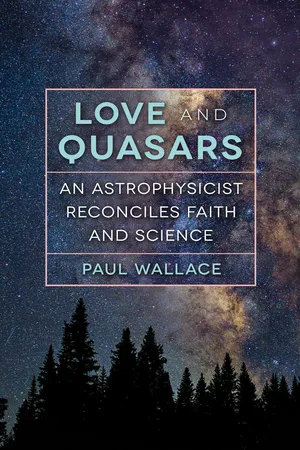
Like many Americans, Paul Wallace grew up as a church-going Christian. Also like many, he lost his faith when he started taking science classes in college. He just didn't see how the rigorous method demanded by science could coexist with the belief in things unseen required by Christianity. But, as a working astrophysicist, he started to wonder if he'd gotten something wrong. Slowly and deliberately, he investigated the claims of Christianity, while also acknowledging that science, too, has limits. Ultimately, he came back to Christianity.
In Love and Quasars, Wallace shows how faith and science are pitted against one another, and he explains how the standard ways of reconciling them don't work. He then proposes a reasonable, thoughtful approach that will appeal to Christians and students of science alike. Readable and wise, Love and Quasars is an indispensable resource for people who wonder if faith and science can coexist.
- 132 pages
- English
- ePUB (mobile friendly)
- Available on iOS & Android
eBook - ePub
About this book
Information
Topic
Theology & ReligionSubtopic
Religion1
Endnotes
Introduction
1. The earliest verifiable and unambiguous Uranus joke is found in the March 30, 1881, issue of Puck, a New York–based satirical magazine. For details, see Albert Stern, “A Deep Dive into Uranus Jokes,” Electric Lit, November 17, 2017, https://tinyurl.com/y9lzq2p2.
2. See “Six Reasons Young Christians Leave Church,” Barna, 2011, https://tinyurl.com/ya2tfhbd.
Chapter 1: Two Ways of Seeing the Sun: Through the Eyes of Faith or the Eyes of Science?
1. Francis’s “Canticle of the Sun” can be found at Catholic Online, tinyurl.com/ycekg9j7.
2. Alice Calaprice, ed., The Quotable Einstein (Princeton, NJ: Princeton University Press, 2005), 208.
Chapter 2: I’m Pretty Sure My Life Was Changed by a Second-Grade Field Trip: The Problem Shows Up and Grows Up
1. Other possibilities exist, all of them equally bleak. This theory is the current leader.
2. Yes, Uranus, like the other gas giants, has rings around it.
3. We have limited ourselves to Christian communities. The world of faith far exceeds this limit!
4. These four relationships have been promoted by Ian Barbour in books such as When Science Meets Religion (New York: HarperCollins, 2000). He refers to them as conflict, independence, dialogue, and integration.
Chapter 3: How Not to Chessbox: Faith and Science Face Off
1. See Ken Ham, “Dinosaurs and the Bible,” Answers in Genesis, November 5, 1999, https://tinyurl.com/yc3ng623.
2. Richard Dawkins, The Blind Watchmaker (London: W. W. Norton, 1996), 448–49.
3. See Daniel G. Taylor, BibViz, bibviz.com, for a fun interactive version.
4. Sam Harris, The Moral Landscape (New York: Free Press, 2010), 2.
5. See Gleb Tsipursky, “Using Science, Not Religion, to Find Your Purpose,” Richard Dawkins Foundation for Reason and Science, April 21, 2015, https://tinyurl.com/y9apd9bk.
Chapter 4: Strangers, Friends, Lovers: Cooperation, Not Competition
1. I don’t believe that faith and science are best described as strangers, but my answer was appropriate for a middle-schooler thinking about these things for the first time.
2. Stephen Jay Gould, “Nonoverlapping Magisteria,” Natural History 106 (March 1997): 16–22, available at Unofficial Stephen Jay Gould Archive, https://tinyurl.com/y8bnpkph.
3. See See Nicholas Bakalarfeb, “On Evolution, Biology Teachers Stray From Lesson Plan,” New York Times, February 7, 2011, https://tinyurl.com/y9poaxuv.
Chapter 5: A Universe with a Point: How Science Enlarges Faith
1. Cosmic gamma rays don’t damage living things on Earth’s surface (or turn them into large, green, angry monsters) because they are absorbed high in the atmosphere. Detecting them requires the use of orbiting telescopes such as Fermi (see Goddard Space Flight Center, “Celebrating 10 Years of Fermi,” NASA, June 11, 2018, https:// tinyurl.com/yd9oj3m7) and INTEGRAL (see European Space Agency, “INTEGRAL,” https://tinyurl.com/y8pee ogs).
2. Steven Weinberg, The First Three Minutes: A Modern View of the Origin of the Universe (New York: Basic, 1977), 154.
3. Martin Luther King Jr., “Our God Is Marching On!,” March 25, 1965, The Martin Luther King, Jr. Research and Education Institute, Stanford University, https:// tinyurl.com/yyd5ukk8.
4. Other roads exist. For example, Buddhism rejects all such speculation, existentialism accepts the first path but goes on to insist that authentic individuals create their own meaning through their commitments, and Hinduism posits a cyclical cosmos. But this book does not argue that the Christian faith stands as the sole alternative to scientific materialism, only that it is not inconsistent with science.
5. P. Z. Myers, The Happy Atheist (New York: Vintage, 2014), 97.
6. Sociobiology, a field of study promoted by biologist and author E. O. Wilson, among others, draws all human social behavior, including religious belief and practice, under the umbrella of science. Wilson travels the first road, viewing religious faith as a trait selected to increase our chances of survival. Others, like the late Stephen Jay Gould, consider faith to be a secondary side effect of evolution, or “spandrel.”
Chapter 6: A Larger, Stranger God: How Science Expands Your View of God
1. Like Beyoncé and Kanye, Tycho (pronounced tee-kō) goes by his first name.
2. There’s Uran- again; in Greek mythology, Urania is the muse of astronomy, and Uranus is the god of the sky. Uraniborg translates to “castle of the sky.”
3. Tycho didn’t live long enough to see Johannes Kepler, one of his research assistants, use his own hard-won naked-eye data to prove Copernicus right.
4. It’s easy to be amused by the ignorance of our ancestors, but what evidence do you have that Earth moves around the sun? Almost certainly you have none, other than the word of your fourth-grade teacher and NASA. It’s really a subtle argument involving Newton’s laws and a phenomenon called the aberration of starlight. The fact of Earth’s motion belongs in the category Not Obvious.
5. Tycho believed the closest stars were about fifty-two million miles from Earth, but if Copernicus was right, then they had to lie at a distance of at least thirty-six billion miles. This was, for him, altogether too much empty space.
6. Victor Thoren, The Lord of Uraniborg (New York: Cambridge University Press, 1990), 304.
7. Alpha Centauri’s three stars cannot be resolved with the naked eye. Without a telescope, they look like a single bright star.
8. A light-year is the distance light travels in a year, about six trillion miles. Similarly, a light-hour is nearly six hundred million miles, about a third of the distance between the sun and Uranus. Tycho thought the distance between Saturn and the stars was no more than about five light-minutes, or about six-tenths of the actual distance between the sun and Earth.
9. No one knows why. This discovery, made by two independent teams of researchers, led to the proposal of what we call dark energy. We don’t know what this energy is (hence the name), but we can measure its effect: the acceleration of cosmic expansion.
Chapter 7: Not Even Wrong: How Science Releases the Bible from Literalism
1. Einstein disliked the name relativity because it is misleading. The fundamental point of relativity is not that time and space are relative, which they are, but that the laws of physics are not relative.
2. See Gerald Schroeder, Genesis and the Big Bang (New York: Bantam, 1990). Schroeder uses general relativity to do this, whereas the Anna-and-Bob example employs special relativity. The special theory is a subset of the general.
3. “Wolfgang Ernst Pauli, 1900–1958,” Biographical Memoirs of Fellows of the Royal Society 5 (February 1960): 186, doi.org/10.1098/rsbm.1960.0014.
4. In the early seventeenth century, Archbishop James Ussher, using the Bible only, calculated that creation began at 6:00 p.m. on October 22, 4004 BCE.
5. This is the same method Tycho Brahe used, unsuccessfully, to determine the distances to the stars. Also, our eyes and brain use parallax to produce depth perception for nearby objects.
6. Th...
Table of contents
- Cover
- Title Page
- Copyright
- Dedication
- Table Of Contents
- Introduction: What This Book Is about and How It Works
- Two Ways of Seeing the Sun: Through the Eyes of Faith or the Eyes of Science?
- I’m Pretty Sure My Life Was Changed by a Second-Grade Field Trip: The Problem Shows Up and Grows Up
- How Not to Chessbox: Faith and Science Face Off
- Strangers, Friends, Lovers: Cooperation, Not Competition
- A Universe with a Point: How Science Enlarges Faith
- A Larger, Stranger God: How Science Expands Your View of God
- Not Even Wrong: How Science Releases the Bible from Literalism
- A Scientist Reads the Bible: How Science Enlarges Scripture
- The Things God Has Made: How Science Enlarges Our View of Life and Death
- At Home with Miracle Max: How Science Expands Our Understanding of Miracles
- How to Manufacture a War: History, like the Universe, Is Larger and More Interesting Than You Thought
- Scary Mom and the Atheists: How an Enlarged Faith Reveals the Limits of Science
- Why I Came Back: Love Embraces the Cosmos
- Endnotes
Trusted by 375,005 students
Access to over 1.5 million titles for a fair monthly price.
Study more efficiently using our study tools.
Frequently asked questions
Yes, you can cancel anytime from the Subscription tab in your account settings on the Perlego website. Your subscription will stay active until the end of your current billing period. Learn how to cancel your subscription
No, books cannot be downloaded as external files, such as PDFs, for use outside of Perlego. However, you can download books within the Perlego app for offline reading on mobile or tablet. Learn how to download books offline
Perlego offers two plans: Essential and Complete
- Essential is ideal for learners and professionals who enjoy exploring a wide range of subjects. Access the Essential Library with 800,000+ trusted titles and best-sellers across business, personal growth, and the humanities. Includes unlimited reading time and Standard Read Aloud voice.
- Complete: Perfect for advanced learners and researchers needing full, unrestricted access. Unlock 1.5M+ books across hundreds of subjects, including academic and specialized titles. The Complete Plan also includes advanced features like Premium Read Aloud and Research Assistant.
We are an online textbook subscription service, where you can get access to an entire online library for less than the price of a single book per month. With over 1.5 million books across 990+ topics, we’ve got you covered! Learn about our mission
Look out for the read-aloud symbol on your next book to see if you can listen to it. The read-aloud tool reads text aloud for you, highlighting the text as it is being read. You can pause it, speed it up and slow it down. Learn more about Read Aloud
Yes! You can use the Perlego app on both iOS and Android devices to read anytime, anywhere — even offline. Perfect for commutes or when you’re on the go.
Please note we cannot support devices running on iOS 13 and Android 7 or earlier. Learn more about using the app
Please note we cannot support devices running on iOS 13 and Android 7 or earlier. Learn more about using the app
Yes, you can access Love and Quasars by Paul Wallace in PDF and/or ePUB format, as well as other popular books in Theology & Religion & Religion. We have over 1.5 million books available in our catalogue for you to explore.