- 452 pages
- English
- ePUB (mobile friendly)
- Available on iOS & Android
eBook - ePub
Agile Systems Engineering
About this book
Agile Systems Engineering presents a vision of systems engineering where precise specification of requirements, structure, and behavior meet larger concerns as such as safety, security, reliability, and performance in an agile engineering context.
World-renown author and speaker Dr. Bruce Powel Douglass incorporates agile methods and model-based systems engineering (MBSE) to define the properties of entire systems while avoiding errors that can occur when using traditional textual specifications. Dr. Douglass covers the lifecycle of systems development, including requirements, analysis, design, and the handoff to specific engineering disciplines. Throughout, Dr. Douglass couples agile methods with SysML and MBSE to arm system engineers with the conceptual and methodological tools they need to avoid specification defects and improve system quality while simultaneously reducing the effort and cost of systems engineering.
- Identifies how the concepts and techniques of agile methods can be effectively applied in systems engineering context
- Shows how to perform model-based functional analysis and tie these analyses back to system requirements and stakeholder needs, and forward to system architecture and interface definition
- Provides a means by which the quality and correctness of systems engineering data can be assured (before the entire system is built!)
- Explains agile system architectural specification and allocation of functionality to system components
- Details how to transition engineering specification data to downstream engineers with no loss of fidelity
- Includes detailed examples from across industries taken through their stages, including the "Waldo" industrial exoskeleton as a complex system
Information
Chapter 1
What Is Model-Based Systems Engineering?
This chapter provides a short overview of systems engineering approaches, activities, and goals and how model-based systems engineering (MBSE) can help achieve them. The chapter makes the distinction between systems and discipline-specific engineering disciplines and then identifies and describes the primary systems engineering activities and their resulting engineering data. Following this, the three primary workflow models (V-Model, Incremental Model, and Hybrid V-Model) are discussed as means for sequencing the system engineering activities.
With that basic understanding in place, the chapter proceeds with the advantages of MBSE over traditional document-centric approaches—such as supporting deeper reasoning about system properties and providing a single source of engineering truth. A short discussion of how to move from traditional methods to MBSE is supplied in the section on “Adopting MBSE.” The chapter winds up with “The Rules of Modeling” to provide a set of guidelines for new practitioners.
Keywords
model-based systems engineering; MBSE; systems engineering; high-precision modeling; adopting MBSE; capability assessment; modeling rules
Systems engineering is an interdisciplinary activity that focuses more on system properties than on specific technologies and has the overall goal of producing optimized systems to meet potentially complex needs. This focus includes specification of necessary system properties (requirements), large-scale system organizational principles (systems architecture), definition of flows and events that travel between the system and elements in its environment as well as between large-scale architectural elements comprising the system (interfaces)—and the selection of key approaches and technologies through optimization analysis (trade studies).
In short,
Systems engineering is an interdisciplinary approach to building complex and technologically diverse systems.
Systems engineering is involved throughout the system specification, development, and verification activities. It provides crucial systems-level oversight of the project. We will focus on the specification activities in this book, but systems engineering encompasses far more.
Systems engineering is distinct from discipline-specific engineering, known collectively as “downstream engineering.” These engineering disciplines include mechanical, electronic, chemical, optical, nuclear, and software engineering. Thus, while systems engineering may define requirements allocated to these specific engineering disciplines, they shouldn’t specify the design or technologies used within them, except, perhaps, at a high level.
1.1 Key Systems Engineering Activities
Figure 1.1 shows the primary aspects of systems engineering, connected in a “traditional” or “classical” flow.
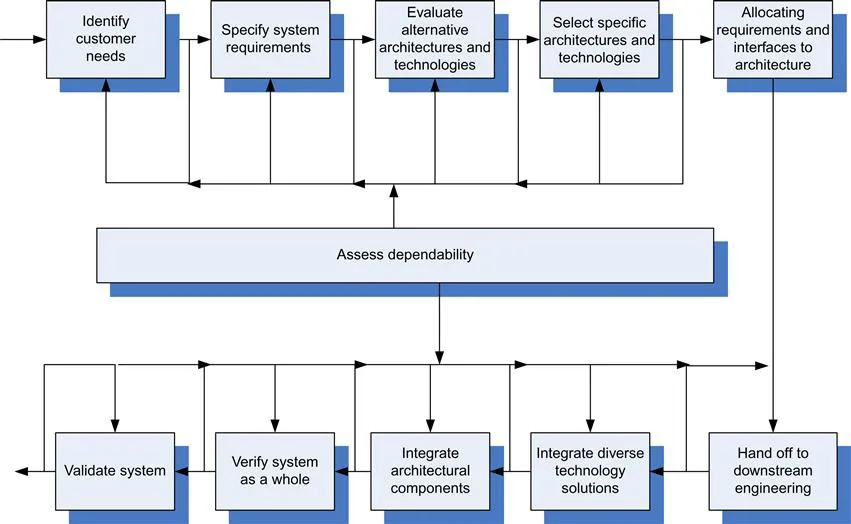
There is, of course, much more to systems engineering than this, and we will cover many of them in this book. For now, this provides a useful set of high-level discussion points. For a more formal definition of systems engineering, readers are referred to the INCOSE Systems Engineering Handbook [1].
The following sections will discuss the purpose and intent of the activities but not how or when they are carried out (that will come in subsequent chapters). Since the focus of this book is to describe how the goals of systems engineering can be achieved in an agile way, how these task are performed will differ from this simplistic discussion. We’ll talk about agile methods in general in Chapter 2 and detail specific best practices for agile methods in subsequent chapters.
1.1.1 Identifying Customer Needs
Ultimately, the reason we create a system is to meet a coherent set of customer’s needs. This is normally captured as a set of stakeholder requirements or customer requirements. I prefer the former term because the set of stakeholders goes beyond the purchaser or even the primary user. We must satisfy the needs of a wide variety of stakeholders, such as
• Purchaser
• User1
• Evaluator
• Marketer
• Seller
• Trainer
• Manufacturer
• Acquirer
• Installer
• Maintenance staff
• Support services
• Operations management
• Certification agencies
• Customer support
• Disposal services
The most common way to represent the stakeholder needs is in a textual stakeholder requirements specification2 but models may be used alone or in combination with textual requirements. It is important to understand that stakeholder requirements must be precise statements about what the stakeholder needs.
1.1.2 Specifying System Requirements
Whereas st...
Table of contents
- Cover image
- Title page
- Table of Contents
- Copyright
- Dedication
- About the Author
- Preface
- Acknowledgments
- Chapter 1. What Is Model-Based Systems Engineering?
- Chapter 2. What Are Agile Methods and Why Should I Care?
- Chapter 3. SysML Introduction
- Chapter 4. Agile Stakeholder Requirements Engineering
- Chapter 5. Agile Systems Requirements Definition and Analysis
- Chapter 6. Agile Systems Architectural Analysis and Trade Studies
- Chapter 7. Agile Systems Architectural Design
- Chapter 8. The Handoff to Downstream Engineering
- Appendix A. T-Wrecks Stakeholder Requirements
- Appendix B. T-Wrecks System Requirements
- Index
Trusted by 375,005 students
Access to over 1.5 million titles for a fair monthly price.
Study more efficiently using our study tools.
Frequently asked questions
Yes, you can cancel anytime from the Subscription tab in your account settings on the Perlego website. Your subscription will stay active until the end of your current billing period. Learn how to cancel your subscription
No, books cannot be downloaded as external files, such as PDFs, for use outside of Perlego. However, you can download books within the Perlego app for offline reading on mobile or tablet. Learn how to download books offline
Perlego offers two plans: Essential and Complete
- Essential is ideal for learners and professionals who enjoy exploring a wide range of subjects. Access the Essential Library with 800,000+ trusted titles and best-sellers across business, personal growth, and the humanities. Includes unlimited reading time and Standard Read Aloud voice.
- Complete: Perfect for advanced learners and researchers needing full, unrestricted access. Unlock 1.5M+ books across hundreds of subjects, including academic and specialized titles. The Complete Plan also includes advanced features like Premium Read Aloud and Research Assistant.
We are an online textbook subscription service, where you can get access to an entire online library for less than the price of a single book per month. With over 1.5 million books across 990+ topics, we’ve got you covered! Learn about our mission
Look out for the read-aloud symbol on your next book to see if you can listen to it. The read-aloud tool reads text aloud for you, highlighting the text as it is being read. You can pause it, speed it up and slow it down. Learn more about Read Aloud
Yes! You can use the Perlego app on both iOS and Android devices to read anytime, anywhere — even offline. Perfect for commutes or when you’re on the go.
Please note we cannot support devices running on iOS 13 and Android 7 or earlier. Learn more about using the app
Please note we cannot support devices running on iOS 13 and Android 7 or earlier. Learn more about using the app
Yes, you can access Agile Systems Engineering by Bruce Powel Douglass in PDF and/or ePUB format, as well as other popular books in Computer Science & Programming. We have over 1.5 million books available in our catalogue for you to explore.