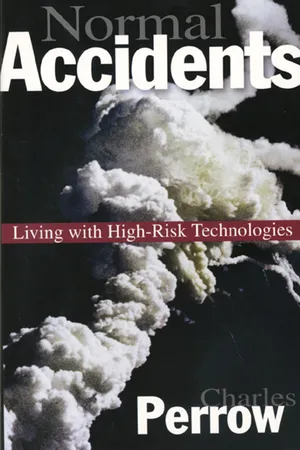
Normal Accidents analyzes the social side of technological risk. Charles Perrow argues that the conventional engineering approach to ensuring safety--building in more warnings and safeguards--fails because systems complexity makes failures inevitable. He asserts that typical precautions, by adding to complexity, may help create new categories of accidents. (At Chernobyl, tests of a new safety system helped produce the meltdown and subsequent fire.) By recognizing two dimensions of risk--complex versus linear interactions, and tight versus loose coupling--this book provides a powerful framework for analyzing risks and the organizations that insist we run them.
The first edition fulfilled one reviewer's prediction that it "may mark the beginning of accident research." In the new afterword to this edition Perrow reviews the extensive work on the major accidents of the last fifteen years, including Bhopal, Chernobyl, and the Challenger disaster. The new postscript probes what the author considers to be the "quintessential 'Normal Accident'" of our time: the Y2K computer problem.
- 464 pages
- English
- ePUB (mobile friendly)
- Available on iOS & Android
eBook - ePub
About this book
Information
Table of contents
- Cover Page
- Title Page
- Copyright Page
- Contents
- Abnormal Blessings
- Introduction
- 1. Normal Accident at Three Mile Island
- 2. Nuclear Power as a High-Risk System: Why We Have Not Had More TMIs—But Will Soon
- 3. Complexity, Coupling, and Catastrophe
- 4. Petrochemical Plants
- 5. Aircraft and Airways
- 6. Marine Accidents
- 7. Earthbound Systems: Dams, Quakes, Mines, and Lakes
- 8. Exotics: Space, Weapons, and DNA
- 9. Living with High-Risk Systems
- Afterword
- Postscript: The Y2K Problem
- List of Acronyms
- Notes
- Bibliography
- Index
Trusted by 375,005 students
Access to over 1.5 million titles for a fair monthly price.
Study more efficiently using our study tools.
Frequently asked questions
Yes, you can cancel anytime from the Subscription tab in your account settings on the Perlego website. Your subscription will stay active until the end of your current billing period. Learn how to cancel your subscription
No, books cannot be downloaded as external files, such as PDFs, for use outside of Perlego. However, you can download books within the Perlego app for offline reading on mobile or tablet. Learn how to download books offline
Perlego offers two plans: Essential and Complete
- Essential is ideal for learners and professionals who enjoy exploring a wide range of subjects. Access the Essential Library with 800,000+ trusted titles and best-sellers across business, personal growth, and the humanities. Includes unlimited reading time and Standard Read Aloud voice.
- Complete: Perfect for advanced learners and researchers needing full, unrestricted access. Unlock 1.5M+ books across hundreds of subjects, including academic and specialized titles. The Complete Plan also includes advanced features like Premium Read Aloud and Research Assistant.
We are an online textbook subscription service, where you can get access to an entire online library for less than the price of a single book per month. With over 1.5 million books across 990+ topics, we’ve got you covered! Learn about our mission
Look out for the read-aloud symbol on your next book to see if you can listen to it. The read-aloud tool reads text aloud for you, highlighting the text as it is being read. You can pause it, speed it up and slow it down. Learn more about Read Aloud
Yes! You can use the Perlego app on both iOS and Android devices to read anytime, anywhere — even offline. Perfect for commutes or when you’re on the go.
Please note we cannot support devices running on iOS 13 and Android 7 or earlier. Learn more about using the app
Please note we cannot support devices running on iOS 13 and Android 7 or earlier. Learn more about using the app
Yes, you can access Normal Accidents by Charles Perrow in PDF and/or ePUB format, as well as other popular books in Technology & Engineering & Engineering General. We have over 1.5 million books available in our catalogue for you to explore.