- 304 pages
- English
- ePUB (mobile friendly)
- Available on iOS & Android
eBook - ePub
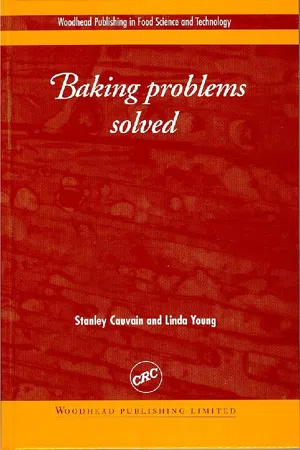
Baking Problems Solved
About this book
When things go wrong in the bakery, the pressures of production do not allow time for research into the solution. Solving these baking problems has always been the province of 'experts'. However, with a methodical approach, keen observation and a suitable reference book then the answers to many bakery problems are straightforward. Baking problems solved is designed to help the busy bakery professional find the information they need quickly. It also enables them to understand the causes and implement solutions. It is arranged in a practical question-and-answer format, with over 200 frequently asked questions. Individual chapters consider the essential raw materials and the main types of bakery products. This book is of invaluable use to all bakery professionals, bakery students, food technologists and product developers.
- Provides immediate solutions to the most frequently encountered problems in baking
- Easy to use and invaluable guidance on improving production and quality in bakery products
- Written by award winning internationally renowned experts
Information
Subtopic
Food Science1
Problem solving – a guide
‘You can’t solve a problem with the same type of thinking that caused it’
Einstein
Problems that show as unexpected variations in bakery product quality do occur from time to time. Often considerable time, effort and money are required to identify the causes and solutions concerned. Unexpected quality variations are not the exclusive province of any particular size of manufacturing unit: they can occur in both large and small bakeries. Nor are they exclusive to the production bakery: even the best-controlled test bakery or laboratory can experience unexpected fluctuations in product quality.
There is no magic to problem solving. It is normally achieved through critical observation, structured thought processes and access to suitable sources of information. In this chapter we offer a guide to some of the methods that might be employed when trying to solve bakery-related problems. In doing so we must recognise that baking is a complex mixture of ingredient and process interactions so that the solutions to our problems may not always be instant in nature.
1.1 How to problem solve
Successful problem solving usually requires a methodical approach. It is perfectly possible to stumble quickly on the required solution by chance but more often than not a haphazard approach to problem solving is wasteful of time, resources and money. Not all problems are solved using exactly the same approach but the critical elements of the problem solving process are largely common.
In problem solving we normally move from the problem to the cause and finally to the corrective action. However, we must recognise that on many occasions the manifestation of a particular problem does not necessarily have a unique and identifiable cause and so there may be other intermediate steps to take into account in determining the real cause of the problem. This situation can be described schematically as follows:

Or in more simple terms as:

The basic process becomes apparent if we consider two examples of problems in bread making; the first low bread volume and the second collapse of the sides of an open top pan loaf, often referred to as ‘keyholing’.
Low bread volume
Externally we observe that the bread is smaller than we expect and this may also have led to a paler crust colour because of the poorer heat transfer to the dough surface. Internally the cell structure may be more open than usual.
Since bread volume is a consequence of expansion of the dough by carbon dioxide gas from yeast fermentation and the retention of that gas within the dough matrix (Cauvain, 1998) there are two potential primary causes of this problem – lack of gas production and lack of gas retention. To separate the two we will need more observations, and an important one will be whether the rate of expansion of the dough in the prover and oven was normal or slower than usual. If the latter was the case then the primary cause of the problem is likely to be lack of gas production and potential contributing factors may include the following:
• yeast activity or level too low;
• lack of yeast substrate (food);
• dough temperature too low;
• proving temperature too low;
• proving time too short;
• salt level too high;
• proving temperature/time/yeast combination incorrect.
On the other hand if the proving had been at a normal rate and there was a lack of oven spring then this would lead us to recognise that the problem would be lack of gas retention. In this case the list of potential reasons for the problem includes:
• improver level too low;
• incorrect improver;
• combination of improver and flour too weak for process;
• enzymic activity too low;
• energy input during mixing too low;
• mixing time too short;
• dough temperature too low.
Note that the ‘dough temperature’ too low appears in both lists because of its effect on yeast activity and the effectiveness of the functional ingredients in the improver.
Keyholing
Externally we observe there is a loss of bread shape but only at the sides of the product. Internally we may see the formation of dark-coloured, dense seams, often referred to as cores. The centre crumb may be more open than we normally expect for the product concerned.
Why has this happened? Clearly we have no problems with gas production since there is no evidence for slow proving and the bread had good volume. We have clearly retained the carbon dioxide gas produced, otherwise the bread would have low volume as described above. In this case the excessive centre crumb expansion leads us to the view that in fact the gas retention is excessive.
Thus, the primary cause of the problem is excessive gas retention arising from a number of potential individual causes or combinations. The contributing factors may include:
• improver level too high;
• incorrect improver;
• combination of improver and flour too strong for process;
• enzymic activity too high;
• energy input during mixing too high;
• mixing time too long.
From the foregoing examples we can see that observation and reasoning are key elements in problem solving. The former can be readily systematised while the latter will rely heavily on the availability of suitable information to use as the basis for comparisons. The potential sources of such information are discussed below.
It is interesting to consider the process by which one might set about identifying the particular cause of a problem, such as the keyholing (excessive gas retention) of bread discussed above. The most likely mental process is one associated with probability achieved by matching the pattern of observations with ones previously experienced and remembered. When we recognise a general similarity between observation and stored image we are likely to explore in more detail the factors most likely to contribute to the pattern we observe.
One potential analogy for how we problem solve is that of a tree. The main line of observation is via the central trunk with the potential to explore branches at many points. In the case of our bread problem if we fail to identify the cause of the problem from our first consideration then we will close down that line of reasoning, go back to the main theme (the trunk) and then set off on another branch of investigation. Our route through the branches of our reasoning tree is complex and occasionally we may jump from branch to branch rather than going back to the trunk before continuing our investigation.
The length of time that we take to identify the cause and the corrective actions needed varies considerably from occasion to occasion and from individual to individual, and is more likely to be related to our accumulated knowledge and e...
Table of contents
- Cover image
- Title page
- Table of Contents
- Copyright page
- Preface
- Dedication
- 1: Problem solving – a guide
- 2: Flours
- 3: Fats
- 4: Improvers
- 5: Other bakery ingredients
- 6: Bread
- 7: Fermented products
- 8: Laminated products
- 9: Short pastry
- 10: Cake and sponges
- 11: Biscuits
- 12: Other bakery products
- 13: What is?
- Index
Trusted by 375,005 students
Access to over 1.5 million titles for a fair monthly price.
Study more efficiently using our study tools.
Frequently asked questions
Yes, you can cancel anytime from the Subscription tab in your account settings on the Perlego website. Your subscription will stay active until the end of your current billing period. Learn how to cancel your subscription
No, books cannot be downloaded as external files, such as PDFs, for use outside of Perlego. However, you can download books within the Perlego app for offline reading on mobile or tablet. Learn how to download books offline
Perlego offers two plans: Essential and Complete
- Essential is ideal for learners and professionals who enjoy exploring a wide range of subjects. Access the Essential Library with 800,000+ trusted titles and best-sellers across business, personal growth, and the humanities. Includes unlimited reading time and Standard Read Aloud voice.
- Complete: Perfect for advanced learners and researchers needing full, unrestricted access. Unlock 1.5M+ books across hundreds of subjects, including academic and specialized titles. The Complete Plan also includes advanced features like Premium Read Aloud and Research Assistant.
We are an online textbook subscription service, where you can get access to an entire online library for less than the price of a single book per month. With over 1.5 million books across 990+ topics, we’ve got you covered! Learn about our mission
Look out for the read-aloud symbol on your next book to see if you can listen to it. The read-aloud tool reads text aloud for you, highlighting the text as it is being read. You can pause it, speed it up and slow it down. Learn more about Read Aloud
Yes! You can use the Perlego app on both iOS and Android devices to read anytime, anywhere — even offline. Perfect for commutes or when you’re on the go.
Please note we cannot support devices running on iOS 13 and Android 7 or earlier. Learn more about using the app
Please note we cannot support devices running on iOS 13 and Android 7 or earlier. Learn more about using the app
Yes, you can access Baking Problems Solved by Stanley P. Cauvain,L S Young in PDF and/or ePUB format, as well as other popular books in Technology & Engineering & Food Science. We have over 1.5 million books available in our catalogue for you to explore.