- 166 pages
- English
- ePUB (mobile friendly)
- Available on iOS & Android
eBook - ePub
About this book
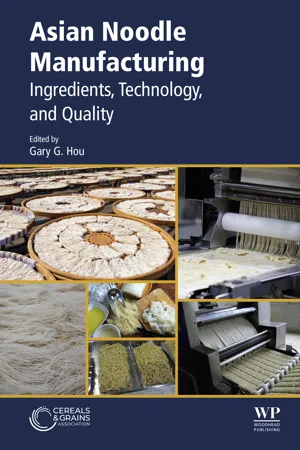
Asian Noodle Manufacturing: Ingredients, Technology, and Quality is a comprehensive handbook for the manufacture of noodles that includes traditional styles and gluten free and whole grain varieties. The book is split into three main sections, with the first detailing the ingredients in noodles and information on how ingredient functionality affects their processing. The second section details the actual manufacture and quality assurance in producing noodle products, with the final section detailing advances in varieties of noodles. Particular attention is paid to gluten free and whole grain noodles, both of which are becoming increasingly popular around the world.
Written by an expert with over twenty years of experience in the production and quality assurance of noodles, the book is essential reading for those in the food industry who are tasked with the development of new noodle based products.
- Contains coverage of ingredient functionality in noodle processing
- Presents sections on traditional noodles, along with whole grain and gluten free varieties
- Presents the latest developments in processing technology
- Discusses how ingredients affect processes
- Includes information on quality control
Information
Chapter 1: Introduction to Asian noodles
Gary G. Hou SPC Group, Seocho-gu, Seoul, South Korea
Abstract
Asian noodles were invented more than 4000 years ago in China. They have evolved into many types and forms and become a global food today. Asian noodles can be made from a variety of raw materials such as wheat flour, rice flour, buckwheat flour, or starches derived from rice, wheat, mung bean, tapioca, sweet potato, sago, or corn. Wheat flour noodles can be classified based on the presence or absence of alkaline salts, type of flour used, noodle strand sizes, and noodle processing technology. White salted noodles have simple formulations containing flour, water, and sodium chloride, but they can be made into different marketing forms. Yellow alkaline noodles contain kansui (a mixture of sodium and potassium carbonates) that modifies noodle color and texture. Rice noodles are classified into two major groups, qiefen (cutting pregelatinized starch sheet) and zhafen (extrusion of pregelatinized starch) based on the molding methods, but the products have different shapes, dimensions, and moisture content. Other starch noodles have also been widely available in Asia. Today, both wheat flour noodles and gluten-free noodles have gained popularity worldwide.
Keywords
Asian noodle history; Ingredients; Noodle classification; Noodle formulation; Processing technology
1. Introduction
The origin of Asian noodles can be dated back to at least 4000 years ago. The discovery of a pot of well-preserved 4000-year-old noodles unearthed in 2005 by Chinese archaeologists in the Lajia archaeological site in northwestern China suggested that the noodles were consumed at least 1000 years earlier than previously speculated, and many centuries before such dishes were documented in Europe (Lu et al., 2005). The noodles were thin (∼0.3 cm in diameter), more than 50 cm in length, and yellow in color. They resemble the La-Mian noodle, a traditional Chinese noodle that is made by repeatedly pulling and stretching the dough by hand. It turned out that these 4000-year-old noodles were made from millet, not from wheat flour as they are commonly made today.
Many Chinese studies have reported the evolution of Chinese noodles (Wei et al., 2017). Bing (flatbread) was considered the prototype of Chinese noodles, and knife-cut buckwheat noodles were their early product. The earliest form of extruded noodles was Hele noodles and they were the primary noodles manufactured in large-scale production. Handmade noodles, a form typically produced at home using the processing skills associated with knife-cut buckwheat noodles and laomian, were developed after wheat was introduced into the western, central Shaanxi plain, and central plain regions of China.
Chinese handmade noodles and its processing technology were introduced to Japan about 1200 years ago (Nagao, 1996). Japanese white salted noodles were thus developed to meet the tastes of local people. Later, Chinese alkaline noodle was introduced to Japan by the Chinese immigrants in Yokahama city at the beginning of the 20th century. Likewise, Chinese noodles were introduced into other Asian countries and beyond where they...
Table of contents
- Cover image
- Title page
- Table of Contents
- Copyright
- Contributors
- About the editor
- Chapter 1. Introduction to Asian noodles
- Chapter 2. Wheat and flour quality requirements
- Chapter 3. Functional ingredients in Asian noodle manufacturing
- Chapter 4. Processing technology of wheat flour noodle
- Chapter 5. Quality evaluation of noodles
- Chapter 6. Whole grain noodles
- Chapter 7. Gluten-free noodles
- Index
Trusted by 375,005 students
Access to over 1.5 million titles for a fair monthly price.
Study more efficiently using our study tools.
Frequently asked questions
Yes, you can cancel anytime from the Subscription tab in your account settings on the Perlego website. Your subscription will stay active until the end of your current billing period. Learn how to cancel your subscription
No, books cannot be downloaded as external files, such as PDFs, for use outside of Perlego. However, you can download books within the Perlego app for offline reading on mobile or tablet. Learn how to download books offline
Perlego offers two plans: Essential and Complete
- Essential is ideal for learners and professionals who enjoy exploring a wide range of subjects. Access the Essential Library with 800,000+ trusted titles and best-sellers across business, personal growth, and the humanities. Includes unlimited reading time and Standard Read Aloud voice.
- Complete: Perfect for advanced learners and researchers needing full, unrestricted access. Unlock 1.5M+ books across hundreds of subjects, including academic and specialized titles. The Complete Plan also includes advanced features like Premium Read Aloud and Research Assistant.
We are an online textbook subscription service, where you can get access to an entire online library for less than the price of a single book per month. With over 1.5 million books across 990+ topics, we’ve got you covered! Learn about our mission
Look out for the read-aloud symbol on your next book to see if you can listen to it. The read-aloud tool reads text aloud for you, highlighting the text as it is being read. You can pause it, speed it up and slow it down. Learn more about Read Aloud
Yes! You can use the Perlego app on both iOS and Android devices to read anytime, anywhere — even offline. Perfect for commutes or when you’re on the go.
Please note we cannot support devices running on iOS 13 and Android 7 or earlier. Learn more about using the app
Please note we cannot support devices running on iOS 13 and Android 7 or earlier. Learn more about using the app
Yes, you can access Asian Noodle Manufacturing by Gary G. Hou in PDF and/or ePUB format, as well as other popular books in Technology & Engineering & Food Science. We have over 1.5 million books available in our catalogue for you to explore.