- 198 pages
- English
- ePUB (mobile friendly)
- Available on iOS & Android
eBook - ePub
About this book
Evidence Found: An Approach to Crime Scene Investigation is not another analysis of forensic errors using an "After the Fact" or "Lessons Learned" approach but a "Before the Fact" guide that examines the thought processes that can lead to those mistakes. Plus a few extras tips and tricks from the author's experience of over 25 years.
Many high-profile crime scene investigations (and routine ones, for that matter) have suffered errors that have had negative impact on the investigation result and in the courtroom. Typically, we examine what happened and develop a useful list of what to do and what not to do, fixing the symptoms but potentially leaving ourselves open to the same error type on the next scene. The reason? Many crime scene mistakes are the result of systemic issues that are repeated due to a failure to include an evaluation of the decision-making process, including our own foundations of knowledge. Through case study and logical argument, this book attempts to provide a framework to recognize, evaluate, and alter negative decision-making patterns, including evaluating our own experience, before they negatively impact an investigation or the overall operation of a forensic unit.
- Enhances the base concepts of evidence search and sequential processing for error avoidance
- Examines the systemic areas/practices of a crime scene investigation where errors can occur
- Includes a Evidence Matrix - a crime scene evaluation tool that aids in sequential processing decisions
- Contains tips on overcoming common crime scene issues, inlcuding night time searches
- Provides courtroom Testimony - communicating comparison findings to a jury
Information
Topic
Sciences socialesSubtopic
Science médico-légaleChapter 1
The Evidence Search—Where It All Begins
Abstract
Review of four basic methods of evidence searching forming the foundation of crime scene investigations. Introduction of the concept of an “intentional planning phase” to begin a scene investigation, intention being a conscious choice not an automatic thought process, characterized by a “direct affirmative statement”; i.e., “this is what we are going to do and the reason we are going to do it.” A Case Study of how issues in evidence search could have been mitigated by an intentional planning phase. Develop a systemic approach. Fifteen minutes of intentional planning saves more time than simply working faster or harder.
Keywords
Evidence search patterns; Forensic mindset; Intentional planningA philosophy of crime scene investigation
It may be tempting to skip to the next chapter where I offer some practical evidence search techniques, but I ask the reader to stay with me. A review of some things we already know will be productive and that review will form the foundation of what I have previously referred to as a Forensic Mindset.
Any investigation begins with a search for evidence, once all other emergent items have been taken care of and secured to the limit of practical ability. Much of the time, the evidence is readily apparent. A gun, a pool of blood, expended cartridges, a vehicle, and the list could fill the rest of a book so I won’t belabor that point. There are many protocols and practices for evidence search methodologies and they seem to fall into basic categories. For purposes of this work I will use the terms Lane, Grid, Circular, and Free Association. I will define what I mean by the use of these terms and if you associate a different term for each description, please do so as you read. I also accept the fact that some of the following methodologies may have subsections within the terms and it is not my intention to delve into them with this book.
A Lane search will be defined as one in which the scene is divided into (ideally) straight avenues of approach, beginning at the outermost area of the scene. The avenues may or may not be physically marked out and they will tend to have a defined width that is within the reasonable ability of the search participant to fully view any possible item of evidence within it. It has been described as the “bowling alley” or the “laned highway” approach, using a width of generally 10 feet, but it can be smaller or larger depending on the terrain and other limitations.
A Grid search will be defined as one in which the scene is divided into squares of varying widths, thus marking it out like a chess or checkerboard. This can be done visually, such as with string, or simply with verbal guidance for on-scene personnel. Depending on the human resources and equipment available, each person may be assigned a section of the grid; the scene may be searched by an agreed upon sequence of grids, or some combination of those approaches. Grid searches can also be vertical, such as those that can occur during the investigation of a clandestine gravesite.
A Circular search will be defined as one in which the investigator circumnavigates the crime scene in a manner that defines a series of concentric circles. Most circular searches will begin at the outer perimeter and work inward toward the approximate center of the scene; however, many have made cogent arguments for searches to begin at the perceived center of the scene (the dead body, for example) and work outward.
A Free Association search has also been called a “path of evidence” search. This will be defined as when obvious evidence, such as a firearm left by a perpetrator, is used as a starting point. A visual examination from that vantage point will then lead to other associated items, with the path being established by where the next discovered evidence is located. It is, more often than not, the methodology that is usually employed, largely because the evidence has presented itself at a scene in a manner that is easy to find using that method. It is also the most natural manner of locating items and is often the one most consistent with the perpetrator’s path of travel and the items can be very obvious in many scenes.
As any experienced forensic investigator can attest, each method has its own advantages and drawbacks. It is clear that we all share the same caution about not letting the obvious evidence distract us from the other, less obvious, evidence items, whatever those may be. Despite this caution and our best efforts, many times that is exactly what happens. The size of the scene, visual obstacles, human resource issues, equipment issues, and even sociopolitical issues can all have an impact in the application of the various search techniques to a given scene.
So what is the solution? Well, the wrong answer would be to simply, “try harder” or “work harder” or “(fill-in-the-blank) harder.” Unfortunately, this is the usual solution to a review of our mistakes. We may successfully identify the specific protocol, practice, or policy that was violated that led to the error and then simply resolve to “try harder.” Even with the best of intentions, I contend that this practice may have practical value for a disciplinary approach, but it may not be the best problem-solving one. These problems can be anticipated and overcome during the planning phase of a forensic investigation. Some may be saying, “Planning phase? What planning phase?” The potential success of any venture, including crime scene investigation, is increased with planning.
Fifteen Minutes of Planning Can Save Hours of Problems
Crime scene work needs an actual and defined planning phase that provides a framework for conducting the investigation. Certainly, subsequent events and evidence discoveries can compel the reevaluation of any plan and this is appropriate. Many times, however, planning consists of a quick overview of the scene followed by an immediate attack of the scene with a reliance on training, experience, and good teamwork for any necessary adjustments. From that point, decisions are made “on the fly” and for the majority of our cases this practice works because of the ability, training, and professionalism of those involved. This would apply to most, if not all of us. However, I am suggesting that this approach is a potential doorway to problems that, fortunately, rarely occur. But sometimes, the doorway is taken and when it is we can miss the reason that the mistake occurred.
The “plan as you go” approach (for lack of a better term) is an existential approach in which the problems of the immediate moment receive our attention. We, subsequently, adjust as we go, thus believing that we are looking ahead because we are adjusting for whatever problem presents itself during the investigation. This approach works a vast majority of the time, which is the reason we do it. It is my contention that the inclusion of an intentional and specific planning period in which we are not processing for prints, packaging evidence, or even doing an additional evidence sweep, lays a firm, reviewable, and cogent framework for an investigation. Such a practice can yield a crime scene mindset that is focused both on the immediate (existential) needs of the scene and on the scene as a whole work product. During this planning period, multiple viewpoints are welcomed and discussed as problem areas can be foreseen and specifically accounted for. Processing issues are voiced and the crime scene team can free itself from what can be called the “tyranny of the urgent.” By all means, anything truly urgent (such as a wet shoeprint on a hot pavement) should be dealt with immediately. However, a planning approach can give a perspective on things that, at first, seem very urgent but can end up being lowered in priority after a short rational discussion of the matter. It can even be decided ahead of time whether to perform a given process or procedure twice, intentionally.
Intention Is a Conscious Choice Not a Default Setting
During the planning phase, intentionality must be a conscious choice and it should never be assumed that it is present. Many times we do things out of excellent habits and well-established and correct procedures, but in the previous case study, all concerned personnel argued that both of these things were followed and, therefore, someone missed their job and missed the evidence. This may have been true, within a limited scope, but this knowledge is not problem solving. The scene responders and subsequent personnel saw the shell casing, the blood, and the bullet entry point and wanted to immediately “get to work” so the scene (parking lot) could be freed for the apartment complex residents. All of this was done with the best of intentions and while some may argue that the residents will simply have to understand the circumstances, our collective circumstance includes the reality that social and political concerns can and do impact a given investigation. That is all the more reason to be more consciously intentional in a crime scene investigation. Before I offer the following as a case in point, I need to note that the agencies involved, dates, locations, names, and any other identifying information have been redacted to maintain focus on the issue/example at hand and for the victim’s privacy. This will be true for all case studies presented throughout this book.
Case Study 1: Cartridges? What Cartridges?
The scene was a shooting investigation on a city street in which, at the time, the victim was injured. At that time, there were a series of drive-by shootings stretched over a period of several weeks that appeared to be gang-related, but the individual events were not necessarily related to each other. The victim had been found in the street after witnesses reported hearing shots fired. Some reported hearing a vehicle but not everyone did. After the victim had been removed by paramedics and by the time that forensic personnel had been called to the scene, the crime scene tape had been placed, contained to the general area of the victim with the street being blocked off for the investigation. The victim’s bloody clothing, with bullet holes in various places, remained on the street and a nearby vehicle appeared to have a bullet strike that would be more closely examined during the investigation (Figure 1.1). Figure 1.1 depicts the details of this case study. The search began for additional bullet strikes on nearby houses to ascertain direction of possible travel of a possible vehicle as well as witnesses who were more specific. During the investigation, forensic personnel were aware that one witness was certain that the sound of the shots came from south of the location of the current scene. They were told by the personnel on the scene that the witness had, in fact, been interviewed and was not considered credible due to the fact that it was the only statement to that effect and that there were other, unspecified, reasons to question the credibility.
Forensic personnel applied a bullet trajectory angle rod to the bullet strike on the vehicle and the angle pointed to the south of the current scene. At this point, the forensic personnel, despite objections by some, traveled the path of the trajectory and located several spent cartridges in the street approximately 75 feet from the initial scene. There was, of course, a level of professional embarrassment among personnel over this discovery. The scene was appropriately expanded and a new evidence search was begun, guided by a more complete understanding of the sequence of events as now shown by the totality of the evidence.
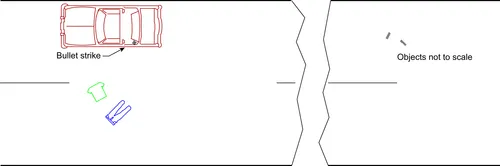
Figure 1.1 Diagram for case study 1.
Case Study 1 Analysis
The evidence search method used in the previous case study was Free Association aided by the use of forensic equipment (trajectory rods) to, literally, point investigators in the right direction. When such cases are reviewed, a problem-solving approach is very important. A blame approach is not helpful—satisfying at times, but not helpful. Fortunately, no one saw the need for disciplinary action, just a revisit of thought processes to ascertain the reason(s) that the single witness was not considered credible and no evidence search was conducted south of the location. It was determined that the decision to discount the witness was based on the fact that no other witnesses reported anything similar. A circular thought process can form the foundation of a presumptive theory in an investigation. The presumption that a witness will not be considered credible because of the presumptive theory and the witness account offered does not support that theory is, therefore, not credible. This is an example of how epistemology impacts a crime scene investigation in a negative way. Not “why” but “how” did we come to an unproductive conclusion?
Many may take the position of “how hard would it have been to send someone to check out the single witness statement to verify it?” However, this is simply another metaphorical doorway that can lead to a blame approach as well as an application of Free Association without considering whether it is the most productive use of available resources. The actual review used a cognitive approach that examined the individual and group thought process that occurred in which evidence was almost missed. If anything was missed it was planning, focus, and intentionality. Th...
Table of contents
- Cover image
- Title page
- Table of Contents
- Copyright
- Foreword
- Preface
- Acknowledgments
- Introduction
- List of Figures
- Chapter 1. The Evidence Search—Where It All Begins
- Chapter 2. Evidence Search Techniques—Tips and Tricks
- Chapter 3. Sequential Processing: Determining Evidence Value
- Chapter 4. Sequential Processing: Evaluating Evidence and Process
- Chapter 5. Sequential Processing: Crime Scene Briefing
- Chapter 6. Evidence Processing: The Decision-Making Process
- Chapter 7. The Schema of Criminal Investigations: Knowing and Not Knowing
- Chapter 8. The CSI Effect: A New Approach
- Chapter 9. Emergencies: Plan, Respond, Create
- Chapter 10. Courtroom Techniques—Old and New
- Chapter 11. Ongoing Challenges
- Chapter 12. Miscellany
- Chapter 13. Final Thoughts
- Index
Trusted by 375,005 students
Access to over 1.5 million titles for a fair monthly price.
Study more efficiently using our study tools.
Frequently asked questions
Yes, you can cancel anytime from the Subscription tab in your account settings on the Perlego website. Your subscription will stay active until the end of your current billing period. Learn how to cancel your subscription
No, books cannot be downloaded as external files, such as PDFs, for use outside of Perlego. However, you can download books within the Perlego app for offline reading on mobile or tablet. Learn how to download books offline
Perlego offers two plans: Essential and Complete
- Essential is ideal for learners and professionals who enjoy exploring a wide range of subjects. Access the Essential Library with 800,000+ trusted titles and best-sellers across business, personal growth, and the humanities. Includes unlimited reading time and Standard Read Aloud voice.
- Complete: Perfect for advanced learners and researchers needing full, unrestricted access. Unlock 1.5M+ books across hundreds of subjects, including academic and specialized titles. The Complete Plan also includes advanced features like Premium Read Aloud and Research Assistant.
We are an online textbook subscription service, where you can get access to an entire online library for less than the price of a single book per month. With over 1.5 million books across 990+ topics, we’ve got you covered! Learn about our mission
Look out for the read-aloud symbol on your next book to see if you can listen to it. The read-aloud tool reads text aloud for you, highlighting the text as it is being read. You can pause it, speed it up and slow it down. Learn more about Read Aloud
Yes! You can use the Perlego app on both iOS and Android devices to read anytime, anywhere — even offline. Perfect for commutes or when you’re on the go.
Please note we cannot support devices running on iOS 13 and Android 7 or earlier. Learn more about using the app
Please note we cannot support devices running on iOS 13 and Android 7 or earlier. Learn more about using the app
Yes, you can access Evidence Found by David Miranda in PDF and/or ePUB format, as well as other popular books in Sciences sociales & Science médico-légale. We have over 1.5 million books available in our catalogue for you to explore.