- 868 pages
- English
- ePUB (mobile friendly)
- Available on iOS & Android
eBook - ePub
Fabric Structures in Architecture
About this book
Fabric Structures in Architecture covers the varying ways textiles and their properties are used in building construction, with particular focus given to tensile structures. The text begins with the fundamental principles of textiles, including the origins of fabric architecture, then progressing to a discussion of the modern textiles of today. It covers relevant textile materials and their properties, including coatings and membranes. In addition, a range of design considerations are discussed, with detailed information on installation and failure modes. A series of case studies from around the world accompany the discussion, illustrating the applications of textiles in architecture.
- Offers key coverage of the fundamental principles, from the origins of fabric architecture to modern textile
- Provides analysis of relevant textile materials and their properties, including coatings and membranes
- Contains expert insights in to the applications of textiles in architecture, presenting a series of relevant case-studies from around the world
Information
Subtopic
Ingegneria civile1
Introduction
The development of fabric structures in architecture
R. Kronenburg University of Liverpool, Liverpool, UK
Abstract
Fabric structures have been used in architecture since humankind first began to build. Their constructional advantages in terms of economic use of materials, light weight, speedy assembly and flexibility and adaptability in operation were recognised and adopted by traditional cultures across the world. Contemporary fabric structure systems make use of these same characteristics to create dynamic and evocative architectural forms that are simultaneously symbolic of this long history and modern innovation. This chapter charts the history and development of fabric structures in architecture from their earliest use to the present day.
Keywords
Air-supported structures; Fabric structures in architecture; Lightweight building; Temporary and transportable architecture; Tents1.1. The characteristics of fabric structures as used in architecture
Architectural fabric structures are a form of building that can almost be considered a contradiction in terms. Fabrics represent some of the lightest artefacts made by humanity, and yet, buildings represent some of the heaviest. Because of their lightweight nature, fabrics are also flexible and mobile, whilst buildings, at least in their traditional sense, are solid and permanent. However, fabric architecture does exist and has for millennia as one of the earliest forms of building to be manufactured on a regular and widespread basis. It is also one of our most advanced and innovative forms of building, which continues to develop rapidly today, and almost certainly into the foreseeable future.
When we think of fabric structures, it is most usually in the form of the tent, a suspended architectural form redolent with the image of nomadism and mobility. Usually, it is thought of as a small-scale structure to be used for temporary shelter by small numbers of people. However, the contemporary tent, due to advances in materials, construction and erection technologies, can be enormous in scale, can be used for many diverse functions and is capable of accommodating many thousands of people engaged in multiple activities. Though often mobile or temporary, it may also be designed to be a permanent structure with a similar lifespan to buildings built from far more and much heavier material. Contemporary fabric structures may also take other forms besides the tent, notably air-supported structures made possible by air-pressure differential between the internal and external environments, or high-pressure air systems in which the fabrics are formed into structural members. Regardless of their structural system, fabric structures have pronounced formal characteristics that set them apart from other architectural typologies. As well as being light in weight and economic in materials, they have a close relationship to nature that is derived from their frugal response to structural requirements. For this reason, fabric architecture is often described as sensual and organic.
However, with such a minimal approach, problems arise. Where structural limits are at the edge, the danger of collapse is close by. Fabric structures work because every element is working at an optimal level, co-dependent on each other. If one part of the system is damaged or removed, there is little redundancy built in to accommodate eccentric or additional forces, and catastrophic collapse can result. Another issue arises because of the dynamic and developing quality of the materials. New, large buildings are dependent on chemists as much as engineers in determining their lifespan as material technologies are created and tested, often in the field on buildings whose authors have the ambition for them to do more than their predecessors. However, such problems have not formed a barrier to development because of the overwhelmingly clear value that fabric architecture offers – the ability to construct quality building envelopes with great flexibility and mobility in less time using fewer materials. These are buildings that touch the earth lightly with a physical impact and charismatic image in tune with a world that is becoming ever more concerned about ecology and sustainability.
1.2. Prehistoric and traditional fabric structures
The earliest human-made structures were both functional and transient. The pattern of existence for early hominids was as a hunter-gatherer, and their developing skills with tools helped gain access to both an improved diet of animal flesh and the ability to use animal by-products to make weapons, tools, clothing and, of course, shelters. The remains of tent-like structures that utilised animal hides have been identified from as early as 150,000 years ago. Timber-framed buildings clad in Mastodon skins (pieces of which remain attached to the poles) from 13,000 years ago have been found preserved in peat bogs on the banks of the Chinchihuapi Creek in Southern Chile (Dillehey, 1984). Archaeologists have discovered seasonally occupied sites in Pincevent, Northern France, that had 4.5-m-wide tents with wooden poles supporting animal skins, built by nomadic people who probably took their buildings with them as they moved between sites (Scarre, 1988, p. 73) (Figure 1.1). These prehistoric building forms are the ancestors of traditional portable building patterns that are still familiar today such as the Lapp keti, Inuit tupiq or the North American tipi. The keti is usually a conical structure (though it can sometimes take a dome-like form) clad in reindeer skins or softened bark, and it was once used extensively across Siberia by nomadic hunting and herding peoples. The tupiq is the summer tent of the North Canadian or Alaskan Inuit, whose temporary winter dwelling, the igloo, is far better known. Like the keti, it consists of a demountable, triangulated, framed structure made from wooden poles clad this time in caribou or sealskin. The tipi (or tepee) is a much more recent design, developed on the North American plains alongside the introduction of the horse in the nineteenth century that enabled tribes to follow and hunt the bison (sometimes called buffalo) (Laubin & Gladys, 1984). There was many types and variations on the basic conical form of this mobile building, which consists of a structure of braced poles upon which there is a semicircular cladding made from numerous (20 for a 5-m-wide tipi) bison skins sewn together. The technical deficiency of animal skins when used in building tents is their limited tensile strength and relative heavy weight. When it became available, canvas came to be used more frequently for tipi cladding, although the scarcity of available bison hides was also an important factor.
Although skin-clad structures such as the tupiq and the tipi are fascinating links to humankind's earliest buildings, the fabric-clad tent is the most widely adopted form of traditional portable architecture. The tents of the nomadic peoples of North Africa have been in existence for many thousands of years, their layout and detailed design honed to perfection by many hundreds of generations of use and development. Though functional to the smallest detail they are also beautiful and sophisticated, with careful nuances in the design that relate to the environment in which they operate, the way they are occupied and used, and the materials available for their manufacture.
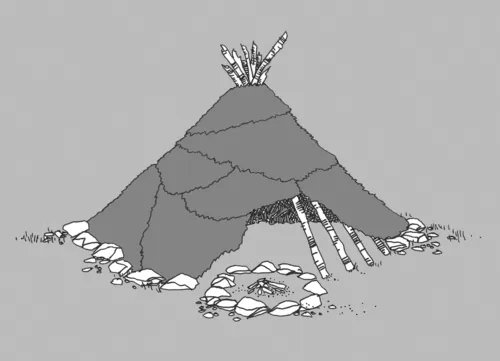
Figure 1.1 Reconstruction of a 10,000-year-old tent structure from remains found at Pincevent, Northern France. © Robert Kronenburg, previously published in Robert Kronenburg, Architecture in Motion, Routledge, 2014.
As with the tipi, there are numerous tribes, each with their own heritage, which has led to distinct patterns of construction and appearance. However, a common factor is that the tent must be capable of being relocated by no more than two people and be able to be moved quickly and easily as new sites are required as the scant resources are used up, perhaps every couple of weeks. The Bedouin black tent is perhaps one of the best known. The fabric is woven from goat hair (sometimes mixed with other wools made from camel or sheep hair) in woven strips 60–70 cm in diameter, sewn together with strengthening tapes running crosswise. The fabric may contain decorative weaving, which complements the other woven components of the dwelling such as the mat floor and cushions. Tension fasteners and ties are also often intricately decorated. During erection, the large rectangular fabric tent membrane is laid out flat on the ground and the wooden poles are raised inside with wooden or cloth spreaders used where they meet the cloth. The perimeter is tensioned and either pegged into the ground or, if conditions do not allow this, tied to bushes that are buried in the sand. The tent's structural system leads to a very flexible building, with walls that can be raised to allow the passage of air for cooling or enclosed against sand storms, and different internal layouts with open or separated spaces (Oliver, 2007, pp. 30–33) (Figure 1.2). Other fabric tent patterns include a Tibetan variation in which the framework forms an exoskeleton from which the fabric is hung.
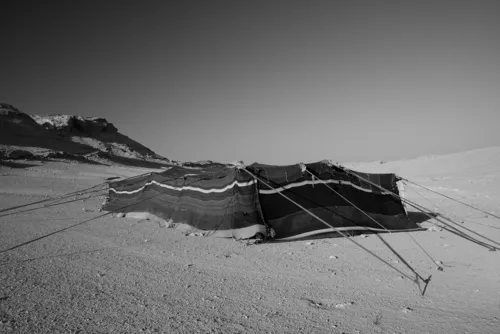
Figure 1.2 Bedouin tent, Syrian desert (photo 2010). © yeowatzup, Creative Commons Attribution 2.0 Generic (CC by 2.0).
Some variations on the tent do not use tensile fabrics but instead use mats or felts. These cladding materials require a more supportive and often more complex structure, although they are not necessarily that much less mobile, demountable or lightweight. The yurta or ger of the Asian plains (yurta is a Turkish word for dwelling; other names are the kherga in Afghanistan and the kabitka in Russia) is a standard building type that has been in use across thousands of miles of terrain from Iran to Mongolia (Guidoni, 1987, pp. 37–40). Used by nomadic groups herding animals between fresh grazing territories, the building is manufactured using a componentised process. It is usually transported dismantled; however, such is its strength that it can also be moved short distances in one piece. The building has willow trellis walls that collapse for transportation, a juniper wood doorframe, and roof poles that locate in a tension band on top of the walls and a circular compression band at the top. The felt mats are layered on top of this structure and held in place with ropes. Up to eight layers might be used in extreme conditions (present-day yurtas often also use canvas coverings, Figure 1.3). Felt is also used for the floor. Mats, though made from dum palm plants, are also used for the tent of the Saharan Tuareg (who also make skin-covered tents of a different, simpler pattern). The structure of this building takes the form of a dome-like semibarrel vault with slender poles arched overhead and then strengthened with cords and finer rods. As with the yurta, the structure must be strong as the mats have little integral strength. However, both buildings can be erected in less than 30 min.
The fabric-clad tent is the most successful and persistent mobile building shelter ever devised. It is a sophisticated device that can take many forms, its detailed design often based closely on the environmental conditions that it must accommodate. Traditional tents are not only practical responses to their builders' needs but are also often physical symbols of complex concepts about shelter and freedom. In these cultures, the tent is both a place of protection and enclosure and a sign of independence and mobility. It is also interesting to speculate if these ancient, lightweight building designs with columns, domes, barrel vaults, etc. form the precedents for the permanent buildings made of...
Table of contents
- Cover image
- Title page
- Table of Contents
- The Textile Institute and Woodhead Publishing
- Copyright
- List of contributors
- Woodhead Publishing Series in Textiles
- In memoriam of Félix Escrig Pallarés
- Preface
- 1. Introduction: the development of fabric structures in architecture
- Part One. Fundamental principles and materials
- Part Two. Design, installation and maintenance
- Part Three. Applications, case studies, recent developments
- Epilogue
- Index
Trusted by 375,005 students
Access to over 1.5 million titles for a fair monthly price.
Study more efficiently using our study tools.
Frequently asked questions
Yes, you can cancel anytime from the Subscription tab in your account settings on the Perlego website. Your subscription will stay active until the end of your current billing period. Learn how to cancel your subscription
No, books cannot be downloaded as external files, such as PDFs, for use outside of Perlego. However, you can download books within the Perlego app for offline reading on mobile or tablet. Learn how to download books offline
We are an online textbook subscription service, where you can get access to an entire online library for less than the price of a single book per month. With over 1.5 million books across 990+ topics, we’ve got you covered! Learn about our mission
Look out for the read-aloud symbol on your next book to see if you can listen to it. The read-aloud tool reads text aloud for you, highlighting the text as it is being read. You can pause it, speed it up and slow it down. Learn more about Read Aloud
Yes! You can use the Perlego app on both iOS and Android devices to read anytime, anywhere — even offline. Perfect for commutes or when you’re on the go.
Please note we cannot support devices running on iOS 13 and Android 7 or earlier. Learn more about using the app
Please note we cannot support devices running on iOS 13 and Android 7 or earlier. Learn more about using the app
Yes, you can access Fabric Structures in Architecture by J Llorens in PDF and/or ePUB format, as well as other popular books in Tecnologia e ingegneria & Ingegneria civile. We have over 1.5 million books available in our catalogue for you to explore.