- 568 pages
- English
- ePUB (mobile friendly)
- Available on iOS & Android
eBook - ePub
About this book
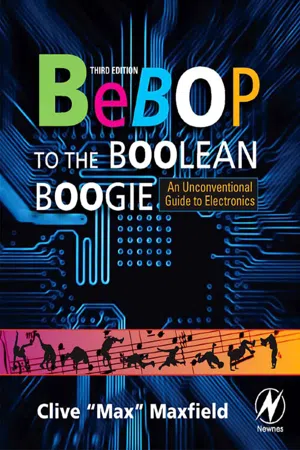
This entertaining and readable book provides a solid, comprehensive introduction to contemporary electronics. It's not a "how-to-do" electronics book, but rather an in-depth explanation of how today's integrated circuits work, how they are designed and manufactured, and how they are put together into powerful and sophisticated electronic systems. In addition to the technical details, it's packed with practical information of interest and use to engineers and support personnel in the electronics industry. It even tells how to pronounce the alphabet soup of acronyms that runs rampant in the industry.
- Written in conversational, fun style that has generated a strong following for the author and sales of over 14,000 copies for the first two editions
- The Third Edition is even bigger and better, with lots of new material, illustrations, and an expanded glossary
- Ideal for training incoming engineers and technicians, and for people in marketing or other related fields or anyone else who needs to familiarize themselves with electronics terms and technology
Information
Part I. Fundamentals
Chapter 1. Analog Versus Digital
It was a dark and stormy night…
Ah, the classic opening: “It was a dark and stormy night…” which was made famous by the Peanuts cartoon character, Snoopy (see Box). I always wanted to start a book this way myself, and this is as good a time as any…
The phrase “It was a dark and stormy night…” is actually the opening sentence of an 1830 book by the British author Edward George Earl Bulwer-Lytton. A legend in his own lunchtime, Bulwer-Lytton became renowned for penning exceptionally bad prose, of which the opening to his book Paul Clifford set the standard for others to follow.For your delectation and delight, the complete opening sentence of Bulwer-Lytton’s masterpiece was: “It was a dark and stormy night; the rain fell in torrents—except at occasional intervals, when it was checked by a violent gust of wind which swept up the streets (for it is in London that our scene lies), rattling along the housetops, and fiercely agitating the scanty flame of the lamps that struggled against the darkness.”Actually, Bulwer-Lytton (1803–1873) was a very popular writer in his day, coining such phrases as “the great unwashed,” “pursuit of the almighty dollar,” and “the pen is mightier than the sword.” However, he may well have fallen into obscurity along with so many of his contemporaries if it were not for the annual Bulwer-Lytton Fiction Contest sponsored by the English Department of San Jose State University.“It was a dark and stormy night …” is now generally understood to represent an extravagantly florid style with redundancies and run-on sentences, and the Bulwer-Lytton Fiction Contest was formed to “celebrate” the worst extremes of this general style of writing. Over the years, the contest has gained international attention and now attracts 10,000 or more entries a year. In fact, I myself have submitted an entry for the 2008 competition, but all I’ve heard so far is an e-mail message saying that I can be assured that my offering “will be given the consideration it deserves.” On the off-chance that you’re interested, I’ve included a copy of my humble submission at the end of this chapter.
Analog versus digital views of the world
Now sit up and pay attention because this bit is important. Electronic engineers split their world into two views, called analog[1] and digital, and it’s necessary to understand the difference between these views to make much sense out of the rest of this book.
1 In England, analog is spelled analogue, and it’s pronounced with a really cool accent.
At this point, even though we’ve barely dipped our toes in the water, I can imagine you rolling your eyes saying to yourself: “Good grief, I already know all of this stuff!” Well, I’m hoping that by the time we reach the end of this first chapter you’ll be thinking: “Hmmm, maybe Max is not as daft as he looks (but, there again, who could be?) I actually learned something here. I can’t wait to read the next chapter. And just as soon as I get a spare moment I will rush out and buy some of Max’s other books!”
In the context of electronics, an analog device or system is one that uses continuously variable signals to represent information for input, processing, output, and so forth. A very simple example of an analog system would be a light controlled by a dimmer switch.
By comparison, a digital device or system is one that uses discrete (that is, discontinuous) values to represent information for input, processing, storage, output, and so forth. A digital quantity is one that can be represented as being in one of a finite number of states, such as 0 and 1, on and off, up and down, etc. As an example of a simple digital system, consider a light switch in a house. When the switch is up, the light is on, and when the switch is down, the light is off.[2]
2 At least, that’s the way they work in America. It’s the opposite way round in England, and you take your chances in the rest of the world.
We can illustrate the differences in the way these two systems work by means of a graph-like diagram (Figure 1.1). Time is considered to progress from left to right, and the solid lines—which engineers often refer to as waveforms—indicate what is happening.
Figure 1.1. Digital versus analog waveforms.

In this illustration, the digital waveform commences in its off state. After some time it changes to its on state, and sometime later it returns to its off state. By comparison, in the case of the analog waveform, we typically don’t think in terms of on and off. Rather, we tend to regard things as being more on or more off with an infinite number of values between these two extremes.
Multi-value digital systems
One interesting point about digital systems is that they can have more than two states. These states are called quanta (from the Latin quantus, meaning “how much” or “how great”), and the accuracy or resolution of a digital value is dependent on the number of quanta employed to represent it. For example, consider a fun-loving fool sliding down a ramp mounted alongside a staircase (Figure 1.2).
Figure 1.2. Staircase and ramp.

In order to accurately determine this person’s position on the ramp, an independent observer would...
Table of contents
- Brief Table of Contents
- Table of Contents
- Copyright Page
- Dedication
- Foreword
- About this Book
- Acknowledgments
- About the Author
- Part I. Fundamentals
- Part II. Components and Processes
- Part III. Design Tools and Stuff
- Appendix A. Assertion-Level Logic
- Appendix B. Positive Versus Negative Logic
- Appendix C. Reed-Müller Logic
- Appendix D. Gray Codes
- Appendix E. Linear Feedback Shift Registers (LFSRs)
- Appendix F. Pass-Transistor Logic
- Appendix G. More on Semiconductors
- Appendix H. Rounding Algorithms 101
- Appendix I. An Interesting Conundrum
- Appendix J. A No-Holds Barred Seafood Gumbo
- Glossary
- Glossary
- Index
Trusted by 375,005 students
Access to over 1.5 million titles for a fair monthly price.
Study more efficiently using our study tools.
Frequently asked questions
Yes, you can cancel anytime from the Subscription tab in your account settings on the Perlego website. Your subscription will stay active until the end of your current billing period. Learn how to cancel your subscription
No, books cannot be downloaded as external files, such as PDFs, for use outside of Perlego. However, you can download books within the Perlego app for offline reading on mobile or tablet. Learn how to download books offline
Perlego offers two plans: Essential and Complete
- Essential is ideal for learners and professionals who enjoy exploring a wide range of subjects. Access the Essential Library with 800,000+ trusted titles and best-sellers across business, personal growth, and the humanities. Includes unlimited reading time and Standard Read Aloud voice.
- Complete: Perfect for advanced learners and researchers needing full, unrestricted access. Unlock 1.5M+ books across hundreds of subjects, including academic and specialized titles. The Complete Plan also includes advanced features like Premium Read Aloud and Research Assistant.
We are an online textbook subscription service, where you can get access to an entire online library for less than the price of a single book per month. With over 1.5 million books across 990+ topics, we’ve got you covered! Learn about our mission
Look out for the read-aloud symbol on your next book to see if you can listen to it. The read-aloud tool reads text aloud for you, highlighting the text as it is being read. You can pause it, speed it up and slow it down. Learn more about Read Aloud
Yes! You can use the Perlego app on both iOS and Android devices to read anytime, anywhere — even offline. Perfect for commutes or when you’re on the go.
Please note we cannot support devices running on iOS 13 and Android 7 or earlier. Learn more about using the app
Please note we cannot support devices running on iOS 13 and Android 7 or earlier. Learn more about using the app
Yes, you can access Bebop to the Boolean Boogie by Clive Maxfield in PDF and/or ePUB format, as well as other popular books in Technology & Engineering & Industrial Design. We have over 1.5 million books available in our catalogue for you to explore.