- 296 pages
- English
- ePUB (mobile friendly)
- Available on iOS & Android
eBook - ePub
About this book
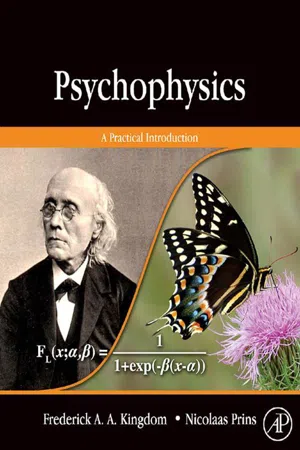
Psychophysics: A Practical Application is a single-volume text that covers the rudimentary principles of psychophysical methods and the practical tools that are important for processing data from psychophysical experiments and tests. It makes complicated concepts and procedures understandable for beginners and non-experts in psychophysics. The book includes a wide array of analytical techniques, such as novel classification schemes for psychophysics experiments; new software packages for collecting and processing psychophysical data; practical tips for designing psychophysical experiments; and the advantages and disadvantages of the different psychophysical methods. The first chapters of the book present the fundamental concepts and terminology of psychophysics, and they familiarize readers with available psychophysical techniques. The remaining chapters discuss a series of topics, such as psychometric functions, adaptive procedures, signal detection measures, scaling methods, and statistical model comparisons. The book serves as an invaluable source of information about psychophysics for researchers and optometrists, as well as for psychology and neuroscience students, on both the graduate and undergraduate level.
- Large variety of analytical methods explained for the non-expert
- Novel classification scheme for psychophysics experiments
- New software package for collecting and analyzing psychophysical data
- Pros and cons of different psychophysical procedures
- Practical tips for designing psychophysical experiments
Information
Subtopic
Cognitive Psychology & CognitionIndex
PsychologyTable of contents
- Cover image
- Title page
- Table of Contents
- Copyright
- Dedication
- Preface
- Acknowledgements
- About the Authors
- Chapter 1. Introduction and Aims
- Chapter 2. Classifying Psychophysical Experiments
- Chapter 3. Varieties of Psychophysical Procedure
- Chapter 4. Psychometric Functions
- Chapter 5. Adaptive Methods
- Chapter 6. Signal Detection Measures
- Chapter 7. Scaling Methods
- Chapter 8. Model Comparisons
- Quick Reference Guide
- List of Acronyms
- Index
Trusted by 375,005 students
Access to over 1.5 million titles for a fair monthly price.
Study more efficiently using our study tools.
Frequently asked questions
Yes, you can cancel anytime from the Subscription tab in your account settings on the Perlego website. Your subscription will stay active until the end of your current billing period. Learn how to cancel your subscription
No, books cannot be downloaded as external files, such as PDFs, for use outside of Perlego. However, you can download books within the Perlego app for offline reading on mobile or tablet. Learn how to download books offline
Perlego offers two plans: Essential and Complete
- Essential is ideal for learners and professionals who enjoy exploring a wide range of subjects. Access the Essential Library with 800,000+ trusted titles and best-sellers across business, personal growth, and the humanities. Includes unlimited reading time and Standard Read Aloud voice.
- Complete: Perfect for advanced learners and researchers needing full, unrestricted access. Unlock 1.5M+ books across hundreds of subjects, including academic and specialized titles. The Complete Plan also includes advanced features like Premium Read Aloud and Research Assistant.
We are an online textbook subscription service, where you can get access to an entire online library for less than the price of a single book per month. With over 1.5 million books across 990+ topics, we’ve got you covered! Learn about our mission
Look out for the read-aloud symbol on your next book to see if you can listen to it. The read-aloud tool reads text aloud for you, highlighting the text as it is being read. You can pause it, speed it up and slow it down. Learn more about Read Aloud
Yes! You can use the Perlego app on both iOS and Android devices to read anytime, anywhere — even offline. Perfect for commutes or when you’re on the go.
Please note we cannot support devices running on iOS 13 and Android 7 or earlier. Learn more about using the app
Please note we cannot support devices running on iOS 13 and Android 7 or earlier. Learn more about using the app
Yes, you can access Psychophysics by Frederick A.A. Kingdom,Nicolaas Prins in PDF and/or ePUB format, as well as other popular books in Psychology & Cognitive Psychology & Cognition. We have over 1.5 million books available in our catalogue for you to explore.