- 324 pages
- English
- ePUB (mobile friendly)
- Available on iOS & Android
eBook - ePub
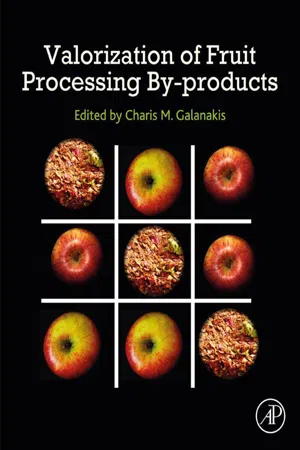
Valorization of Fruit Processing By-products
About this book
Valorization of Fruit Processing By-products covers the most recent advances in the field of fruit processing by-products following sustainability principles. The urgent need for sustainability within the food industry necessitates research to investigate the handling of by-products with another perspective, e.g. by adapting more profitable options. This book covers the latest developments in this particular direction. It promotes success stories and solutions that ensure the sustainable management of different fruit processing by-products (namely apple, apricot, avocado, Castanea sativa, citrus, date, mango, melon, passion fruit, pineapple, pink guava, pomegranate and watermelon), giving emphasis on the recovery of polyphenols, antioxidants and dietary fiber.
Written by a team of experts in food processing and engineering, chemistry and food waste, this title is the definite guide for all the involved partners, engineers, professionals and producers active in the field.
- Explores fruit processing techniques, scale up limitations and economical evaluation for each source of fruit processing by-product
- Discusses the valorization of by-products derived from different fruits
- Features the following fruits, including apple, avocado, chestnut, citrus, date, mango, melon and watermelon, passion fruit, pineapple, pink guava and pomegranate
Information
Chapter 1
Fruit processing by-products as food ingredients
Susanne Struck and Harald Rohm, Chair of Food Engineering, Insitute of Natural Materials Technology, Technische Universität Dresden, Dresden, Germany
Abstract
Frequently, the processing of fruit results in a significant amount of by-product, the so-called pomace. A further utilization of the pomace in food commodities is desirable because of sustainability issues, but further uses are often limited because of the specific physicochemical and technofunctional properties. The dietary fiber in the by-products frequently exhibits high water-binding and swelling capacities and a high oil-binding capacity that significantly affect the characteristics of the respective foods. The present chapter introduces the subject, gives a short overview on the processing of fruit pomace, and explains how pomace composition is influenced by the respective conditions. The chapter highlights the importance of pomace as a nutritionally valuable material and deals with the technofunctional properties that result from pomace chemistry and processing. The incorporation of fruit pomace in selected types of foods is also reviewed. Emphasis is especially placed on soft and brittle bakery products, on bread, and on extruded cereal products including pasta. In addition, applications in meat products are also briefly discussed.
Keywords
Fruit; by-product; pomace; properties; cereal products; pasta; meat
1.1 Introduction
In many cases, and depending on the target commodity, the processing of fruits results in certain amounts of by-products. The respective quantities are close to zero when, for example, berries are processed to jam, but may be around 5%–10% when it comes to peels of apples or pears that are used for the production of fruit sauces, and 20%–30% when juice is extracted from the raw material. Sustainable and integrated value chain management calls for a further use of these by-products, commonly denoted as pomace, to avoid their loss. Potential but uninspired uses are as soil fertilizer, as animal feed, or as substrate for bioenergy generation. Even for these types of utilization, limitations have to be considered because of the high acidity of the pomace, its high content of phytochemicals, and the low amount of digestible energy. Recycling methods that add value to fruit processing residues are therefore of great interest, and it can be expected that the overall profit from fruit processing will be increased by an efficient and sustainable waste stream management. Innovative utilization methods must therefore address the usability of fruit processing residues as value-adding food ingredients, either as a whole or after the extraction of high-value compounds.
Depending on the raw material, residues from fruit processing may contain high amounts of bioactive compounds, including dietary fiber, which therefore makes these residues an attractive source of nutrients. Dietary fiber refers to polymeric carbohydrates with at least 10 monomeric units which are not digested in the human small intestine. They either dissolve in water (soluble dietary fiber) and are metabolized in the large intestine, or they are insoluble and therefore mainly excreted (Viebke et al., 2014). In comparison to fiber from cereals, the amount of soluble dietary fiber in fruit pomace is significantly higher (Sudha, 2011). Many health-promoting effects have been attributed to these bioactive compounds. Some of these that have already been reported are the reduction of risk of cardiovascular diseases and cancer through their antioxidant and antiinflammatory activities that, in turn, reduce oxidative stress (Basu et al., 2010; Mazzoni et al., 2016; Rodriguez-Mateos et al., 2013), and the modulation of intestinal microbiota (Vendrame et al., 2011). Koutsos et al. (2015) summarized in vitro, animal, and human intervention studies that analyzed the influence of apple compounds on gut microbiota and on the risks of cardiovascular diseases. They concluded that significant effects are evident with respect to lipid metabolism (i.e., reduction in total cholesterol), and with respect to metabolites produced in the gut. Teixeira et al. (2014) focused on wine making by-products and reviewed the biological activity of functional compounds such as phenolic acids, flavonoids, and stilbenes. As many phenolic compounds are located in the skin and seed fractions of fruits, the respective by-products are rich in stilbenes and flavonoids. Some of the latter, namely the anthocyanins, are responsible for the color of fruits and their high antioxidant capacity (Laroze et al., 2010). Consequently, the incorporation of bioactive compounds from fruit processing residues in foods increases the supply of valuable nutrients. For that the development of attractive products is necessary, as is the communication of the proposed effects to the consumer.
1.2 Processing of fruit by-products
1.2.1 Pomace processing conditions
The conventional procedure for the production of fruit juice from, for instance, apples, pears, or different berry varieties usually starts by washing the raw materials and removing foreign bodies. It then comprises the crushing of fresh or frozen fruits to mash, heating the mash to 40°C–50°C and, in many cases, treating the mash with depectinizing enzymes (pectin esterases, polygalacturonases, and/or pectin lyases) for a period of approximately 1–3 h. This helps to break down cell wall structures and to disrupt the highly viscous pectin gel that forms during mashing (Hilz et al., 2005), so that juice yield during subsequent pressing is enhanced by 1%–3%. Additionally, more polyphenols are extracted with the juice which, especially in the case of dark fruits, lead to a more intense color that is frequently associated with a higher juice quality by the consumer. The next step is separating the juice from the solid cell materials by using belt presses, basket presses, or Bucher horizontal presses, the selection of which largely depends on the required capacity. For instance, belt presses are more versatile but a severe risk of juice oxidation must be considered. Subsequently the juice is declouded by disk stack or decanter centrifuges and finally pasteurized to assure an appropriate shelf life. In the case of citrus processing, the technological scheme is somewhat different: the most important step is the recovery of the juice from the whole fruit, realized by extractors with different working principles. Remnants from the processing of different types of citrus fruits—these are mainly used for the production of citrus pectin (Wang et al., 2015)—will not be considered further in this chapter.
The pressing residues that remain after fruit extraction contain 50%–80% moisture, and are consequently highly susceptible toward microbial spoilage, especially by yeasts and molds. Factors that contribute to the residual moisture content of the pomace are, among others, the fruit variety itself, any depectinization of the mash, and the processing conditions during pressing (method, pressure). In the cases where the remaining pomace is considered for further use in human nutrition, immediate processing to reduce pomace moisture is essential. Recent reviews related to pomace utilization cover advances in pectin production (Adetunji et al., 2017; Grassino et al., 2018), the use of fruit by-products as edible films (Otoni et al., 2017), the use of these by-products as novel functional ingredients for foods and nutraceuticals (Lai et al., 2017; Quiles et al., 2017; Schieber, 2017; Sharma et al., 2016), the extraction and analysis of the polyphenols (Struck et al., 2016c), but also the application as heavy metal chelating agents for wastewater treatment (Renu et al., 2017). Because of its content of approximately 15%, the traditional utilization of apple pomace is for the production of raw pectin. In brief, hot acidic extraction of soluble materials is followed by their concentration and the subsequent pectin precipitation and purification.
The composition of berry pomace largely depends on the berry cultivar. In blueberries, the mass fractions for skin and seeds are 19% and 1.5%, respectively (Lee and Wrolstad, 2006). After juice extraction, the pomace also contains residual stems, and some wooden parts and leaf fragments remaining from harvesting. For black currant pomace, these constituents account for approximately 6% of the fresh mass, whereas seeds were reported to comprise the main fraction (i.e., 55%) of the dried pomace (Hilz et al., 2005; Sojka and Krol, 2008). For the production of a nonperishable berry powder intended to be brought back into the food value chain, the most important processing step is immediate drying after juice pressing, followed by milling and fractionation. Potential methods for pomace drying include conventional hot-air convection drying, low-temperature vacuum drying, freeze-drying, infrared drying, and microwave drying (the latter two are often combined with convection drying under vacuum). Convection drying of fruit pomace is usually performed in a temperature range of 50°C–80°C at ambient pressure, or at reduced temperature and pressure (e.g., Reque et al., 2014; Sojka et al., 2013). Processing conditions during drying exhibit a significant influence on product characteristics such as appearance, color, and porosity, and also on the content of bioactive compounds. Garau et al. (2007) observed a decreased water retention capacity, and reduced fat adsorption and solubility with increasing drying temperature of by-products from orange processing. In the production of Aronia powder from juice, convection drying resulted in a more intense and darker color of the powder than freeze-drying or spray-drying (Ho...
Table of contents
- Cover image
- Title page
- Table of Contents
- Copyright
- List of Contributors
- Preface
- Chapter 1. Fruit processing by-products as food ingredients
- Chapter 2. Apple
- Chapter 3. Apricot
- Chapter 4. Avocado
- Chapter 5. Berries
- Chapter 6. Chestnut
- Chapter 7. Citrus fruits
- Chapter 8. Mango
- Chapter 9. Passion fruit
- Chapter 10. Pineapple
- Chapter 11. Pink guava
- Chapter 12. Pomegranate
- Chapter 13. Strawberry
- Index
Trusted by 375,005 students
Access to over 1.5 million titles for a fair monthly price.
Study more efficiently using our study tools.
Frequently asked questions
Yes, you can cancel anytime from the Subscription tab in your account settings on the Perlego website. Your subscription will stay active until the end of your current billing period. Learn how to cancel your subscription
No, books cannot be downloaded as external files, such as PDFs, for use outside of Perlego. However, you can download books within the Perlego app for offline reading on mobile or tablet. Learn how to download books offline
Perlego offers two plans: Essential and Complete
- Essential is ideal for learners and professionals who enjoy exploring a wide range of subjects. Access the Essential Library with 800,000+ trusted titles and best-sellers across business, personal growth, and the humanities. Includes unlimited reading time and Standard Read Aloud voice.
- Complete: Perfect for advanced learners and researchers needing full, unrestricted access. Unlock 1.5M+ books across hundreds of subjects, including academic and specialized titles. The Complete Plan also includes advanced features like Premium Read Aloud and Research Assistant.
We are an online textbook subscription service, where you can get access to an entire online library for less than the price of a single book per month. With over 1.5 million books across 990+ topics, we’ve got you covered! Learn about our mission
Look out for the read-aloud symbol on your next book to see if you can listen to it. The read-aloud tool reads text aloud for you, highlighting the text as it is being read. You can pause it, speed it up and slow it down. Learn more about Read Aloud
Yes! You can use the Perlego app on both iOS and Android devices to read anytime, anywhere — even offline. Perfect for commutes or when you’re on the go.
Please note we cannot support devices running on iOS 13 and Android 7 or earlier. Learn more about using the app
Please note we cannot support devices running on iOS 13 and Android 7 or earlier. Learn more about using the app
Yes, you can access Valorization of Fruit Processing By-products by Charis M. Galanakis in PDF and/or ePUB format, as well as other popular books in Technology & Engineering & Food Science. We have over 1.5 million books available in our catalogue for you to explore.