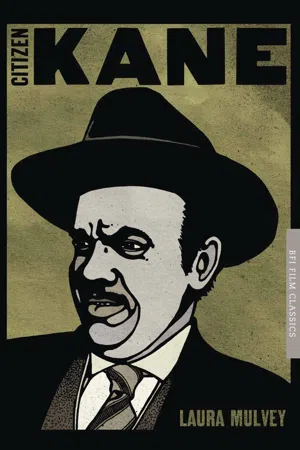
Citizen Kane's reputation as one of the greatest films of all time is matched only by the accumulation of critical commentary that surrounds it. What more can there be to say about a masterpiece so universally acknowledged? Laura Mulvey, in a fresh and original reading, illuminates the richness of the film, both thematically and stylistically, relating it to Welles's political background and its historical context. In a lucid and perceptive critique she also investigates the psychoanalytic structure that underlies the film's presentation of Kane's biography, for once taking seriously what Orson Welles himself disparagingly referred to as 'dollar-book Freud.'
In her foreword to this special edition, published to celebrate the 20th anniversary of the BFI Film Classics series, Laura Mulvey focuses on the film's politics, highlighting the contemporary 'rhymes' in Kane's portrayal of a scandal-prone press baron in a time of economic crisis.
- 104 pages
- English
- ePUB (mobile friendly)
- Available on iOS & Android
eBook - ePub
Citizen Kane
About this book
Information
‘Citizen Kane’
Borges described Citizen Kane as a labyrinth without a centre.3 And its elusiveness is one of the qualities that makes it infinitely re-viewable, re-debatable. So, as though in a quest for a cinematic Holy Grail or philosopher’s stone, each generation of moviegoers, video watchers, film critics, film theorists, sets out in search of the bit of the puzzle that will make it all fall into place. The lasting hold Citizen Kane exerts over cinematic enquiry is a tribute to the enduring powers of a film that is fifty years old as I write. Over these fifty years, from the first moment it appeared in the world, Citizen Kane’s mystique has been further enhanced by gossip about its origins and polemics over its place in film culture. And in both areas personalities have reigned supreme, above all the two awesome personalities of Orson Welles and William Randolph Hearst, the original of the Kane portrait. Over the last few years, Citizen Kane criticism has become less polemical and more rigorous and is now beginning to liberate the film from its own reputation so that it can begin to speak, as it were, for itself.
New research and scholarship is beginning to illuminate some of those areas of debate that had previously been shrouded by polemic as well as by the passing of time. Robert Carringer’s book The Making of Citizen Kane4 quietly describes the production history of the film and the collaborative conditions of work under which Welles developed the Citizen Kane project, in such a way as to do justice to all creative contributions while also describing just how and why disputes arose. His book puts paid to the ‘Who is the true author of Citizen Kane?’ debate, with a researched rather than rhetorical assessment of Welles’s central role, while also illuminating the complexities of authorship in Hollywood, studio system, cinema. And historical scholarship is also beginning to place Citizen Kane within its cultural and political context, bringing a ‘monstre sacré’ down to earth without diminishing either its cinematic power or its critical interest. Quite the contrary, to place Citizen Kane in the context of New Deal culture and to show Welles to be inextricably involved in the politics of his moment reveals other, enhancing, aspects of both director and film; no longer need either seem simply to be brilliant, mutually reinforcing, one-off, flash-in-the-pan oddities. Very suggestive work on Welles and his political context has appeared in a special issue of Persistence of Vision, containing the proceedings of a conference on Orson Welles held at New York University in 1989.5 James Naremore’s The Magic World of Orson Welles has not only an extremely perceptive chapter on Citizen Kane but also invaluable documentation on Welles’s ‘essential liberalism and intense concern with political affairs’.6
Citizen Kane has been surrounded by extra-textual myths and legends from the moment of its birth. It is as though the flamboyant nature of its subject, a legendary and enigmatic tycoon, came to haunt both its creator and the film itself. Both were constantly to be beset by controversy, starting from Welles’s arrival in Hollywood in July 1939 to sign the contract between the Mercury Theatre and RKO that immediately achieved legendary status. Welles’s adaptation of Shakespeare’s history plays, Five Kings, had just flopped, leaving him badly damaged financially, critically and personally. All the same, he claims that he had no particular interest in moving to Hollywood and, had it not been for the favourable conditions and creative freedom guaranteed in the contract, he would have turned down the offer from George Schaefer, recently hired to bring outside, East coast, talent to RKO.
Schaefer was bitterly attacked in Hollywood for putting the cat of genius among the pigeons of the entertainment industry. As it was, he contracted Welles to write, produce, direct and act in two films without studio interference and with rights over the final cut, keeping control only over the choice of story and the budget if it ran over $500,000. The first project, Conrad’s Heart of Darkness, had to be shelved when it came out way over any possible budget at the end of the pre-production period. It was then, in early January 1940, that the industry gossip began to triumph at the discomfiture of the genius and the just deserts of management irresponsibility. In this atmosphere, heightened as another still-born project, The Smiler with a Knife, failed publicly, the Citizen Kane idea brought a last-minute rescue. When Welles finally launched what was to be the only project he managed to make with the freedom guaranteed by the terms of his fantastic contract with RKO, two industry professionals joined his team from outside the studio. In addition to Gregg Toland, on loan from Goldwyn Studios, Welles brought in Hermann Mankiewicz as his screenwriter.
The question of cinematic authorship, whether the director or the screenwriter should be considered to be the creative core of a film, has been fought over the body of Citizen Kane. Controversies about creative responsibility for the script started, before the film was finished, over the writer’s credit. Rumours that Welles was about to claim sole credit, or that he was going to eliminate the screenwriting credit altogether, were countered by Mankiewicz, who easily whipped up support in the Hollywood community. Finally, in a compromise move, an equal screenwriting credit was proposed to the Guild of Screen Writers and agreed. In 1971 Pauline Kael revived and refuelled old embers of the credit controversy with an ulterior and polemical motive: to counter the auteurist tendency in film criticism. Her – partisan – presentation of Mankiewicz’s script as the source of Citizen Kane’s importance in the cinema7 was then answered by Peter Bogdanovich’s equally partisan presentation of Welles’s case.8 All these debates, and the events surrounding them, add to the mystique that has encrusted the history of Citizen Kane.
Competition over who first came up with an idea seems less significant once the idea has been transformed into film. Although it might be of academic interest to trace an idea to an origin other than a director’s decision and vision, the film itself is not affected by contested attributions of authorship. For instance, the opening shots of Citizen Kane, on which a number of critics have based an argument for the ‘readerliness’ of the film, are given exactly in the Mankiewicz version of the script, ‘American’, that he and John Houseman, Welles’s partner and co-founder of the Mercury Theatre, took back to RKO after several months of work, without Welles’s participation or collaboration. On the other hand, the concept and camera strategy used in the opening shots is undoubtedly in keeping with Welles’s aesthetic interests and expressive of the style he was evolving for his first foray into cinema. On the other hand again, according to Carringer, the opening may have been influenced by the first shot of Hitchcock’s Rebecca, just premiered in Hollywood, which also sets up a mysterious space and an investigative camera-eye. Carringer demonstrates that Welles was always open to available influences, whether in the form of ideas or the technical skills of his collaborators. But all the elements and influences he amassed were rigorously filtered through his creative intelligence and instinct, so, in the last resort, what stayed in and what was junked from the project, at all stages of its development and production, was the result of his choice. If the opening of ‘American’ stays unchanged throughout the extensive revisions and rewrites that finally gelled into the script of Citizen Kane, it was because that was the way Welles wanted the film to open.

Welles on the set with Dorothy Comingore. Gregg Toland is fourth from the right
The innovative cinematic style of Citizen Kane has been noticed and debated from the first reviews it received. Its cinematographer, Gregg Toland, received both a major screen credit and critical attention unprecedented for a lighting cameraman in studio system cinema. Welles, from the very beginning of his time in Hollywood, was interested in a camera style that could carry the flow of action and narration. When Toland, on his own initiative, offered to shoot Citizen Kane, Welles had found someone who could transmute his fantasies about film into practical reality. Toland was already a distinguished, Academy Award-winning cinematographer who had been evolving his own idiosyncratic lighting/camera style for some years. The extended pre-production period that Welles’s agreement allowed gave Toland the opportunity to develop his style systematically and in close collaboration with a director who knew very little, had vision and was ready to learn. The deep-focus style that so impressed André Bazin when the film was first shown in Paris after the war was a logical solution to Welles’s wish to maintain continuity of action by eliminating reverse angles and intercutting. The style developed, as it were, both out of the positive factor of Toland’s awareness of new technical possibilities and from the negative factor of Welles knowing what he wanted to avoid. From Toland’s own essay, ‘How I Broke the Rules in Citizen Kane’,9 to Patrick Ogle’s thorough study of the technological developments that Toland exploited in order to break the rules,10 to Barry Salt’s measured reassessment of the film’s innovations,11 Citizen Kane has provided the impetus for invaluable research and discussion about relations between technology, style and the aesthetics of cinema. These accounts show how unusual production circumstances allowed both pre-existing and recent technological changes to be brought together, consciously and systematically, in order to create a new look for film.
It seems daunting, in the light of Citizen Kane’s legendary history and the polemics and critical controversies that have raged around it, to write about it yet again. And now, on its fiftieth birthday, it is once again being exhaustively celebrated. There are two excuses for this further addition to Kane criticism. First, I have tried to bring a European perspective to the film in order to highlight the representations and themes associated with Europe that run through it, and which, I think, draw attention to the precise historical moment at which the film was made. Work started on the Citizen Kane script in February 1940, during the ‘phoney war’ period that followed the German invasion of Poland in September 1939. While work continued on the script in the spring and early summer of 1940, the German offensive moved across Europe and Citizen Kane went into production on 29 June during the bleakest moments of the war, between the fall of France in May and the Battle of Britain, a last stand against Hitler which extended from July to September 1940. As Europe appeared to be falling inexorably to fascism, the battle between intervention and isolationism was bitterly engaged in America, with President Roosevelt unable to swing the nation into support for his interventionist policy. And, when Citizen Kane opened in New York in May 1941, Pearl Harbor was still six months away. Not only was the war in Europe the burning public issue of the time, it was of passionate personal importance to Orson Welles, with his deep involvement with European culture and his long-standing political commitment to Roosevelt’s New Deal and the anti-fascist struggle.
This contemporary background is not explicitly spelled out in the film, but an awareness of its historical moment inflects its interpretation away from intangible questions about human nature and character and towards questions about the nature of American politics encapsulated in a mythic, symptomatic character. In the rhetoric of Citizen Kane, the destiny of isolationism is realised in metaphor: in Kane’s own fate, dying wealthy and lonely, surrounded by the detritus of European culture and history. Hearst, the most important source for the figure of Kane, as a leading isolationist and opponent of the New Deal, forged a link between contemporary politics and the pre-New Deal political system in which different elite interests competed for control. From this perspective, a swing towards the isolationist lobby would have put the political clock back ten years at home while ensuring the victory of fascism abroad. Indeed, a victory for the old breed of American pol...
Table of contents
- Cover
- Title Page
- Contents
- Foreword: Seventy Years of a Film’s Life …
- Acknowledgments
- ‘Citizen Kane’
- Appendix
- Notes
- Credits
- Bibliography
- eCopyright
Trusted by 375,005 students
Access to over 1.5 million titles for a fair monthly price.
Study more efficiently using our study tools.
Frequently asked questions
Yes, you can cancel anytime from the Subscription tab in your account settings on the Perlego website. Your subscription will stay active until the end of your current billing period. Learn how to cancel your subscription
No, books cannot be downloaded as external files, such as PDFs, for use outside of Perlego. However, you can download books within the Perlego app for offline reading on mobile or tablet. Learn how to download books offline
Perlego offers two plans: Essential and Complete
- Essential is ideal for learners and professionals who enjoy exploring a wide range of subjects. Access the Essential Library with 800,000+ trusted titles and best-sellers across business, personal growth, and the humanities. Includes unlimited reading time and Standard Read Aloud voice.
- Complete: Perfect for advanced learners and researchers needing full, unrestricted access. Unlock 1.5M+ books across hundreds of subjects, including academic and specialized titles. The Complete Plan also includes advanced features like Premium Read Aloud and Research Assistant.
We are an online textbook subscription service, where you can get access to an entire online library for less than the price of a single book per month. With over 1.5 million books across 990+ topics, we’ve got you covered! Learn about our mission
Look out for the read-aloud symbol on your next book to see if you can listen to it. The read-aloud tool reads text aloud for you, highlighting the text as it is being read. You can pause it, speed it up and slow it down. Learn more about Read Aloud
Yes! You can use the Perlego app on both iOS and Android devices to read anytime, anywhere — even offline. Perfect for commutes or when you’re on the go.
Please note we cannot support devices running on iOS 13 and Android 7 or earlier. Learn more about using the app
Please note we cannot support devices running on iOS 13 and Android 7 or earlier. Learn more about using the app
Yes, you can access Citizen Kane by Laura Mulvey in PDF and/or ePUB format, as well as other popular books in Media & Performing Arts & Film & Video. We have over 1.5 million books available in our catalogue for you to explore.