Graeae has been a force for change in world-class theatre since it was founded in 1980, placing D/deaf and disabled actors centre stage and challenging preconceptions.
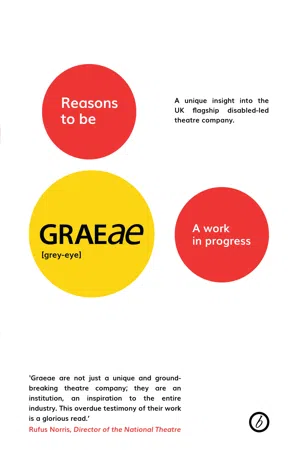
A work in progress contains the full script of Reasons to be cheerful, a brief history of the company, analysis and extracts from their previous shows, memories of Graeae from previous collaborators, including Jack Thorne, Jo Clifford, Kaite O'Reilly and Jonathan Meth, and a host of images.
- 464 pages
- English
- ePUB (mobile friendly)
- Available on iOS & Android
eBook - ePub
About this book
Information
Beginnings
How It All Began
Maria Oshodi
Geof Armstrong
Steve Mannix
Elspeth Morrison
Rachel Hurst
Prof. Anna Furse
Caroline Noh
Jamie Beddard
Daryl Beeton
Dr. Colette Conroy
How It All Began
Nabil Shaban, Graeae Founder: 1981–1983
Interview with Jenny Sealey
Interview with Jenny Sealey
NS You probably already know that the story of Graeae’s origin has several beginnings. The roots of the company go right back to my time at Derwen College and Hereward College where Richard Tomlinson was a tutor. Richard was non-disabled, but he came from a theatrical background. He was a posh bloke, however he was a man of the 1960s. That decade created lecturers who were radically left-wing and who spread out across the UK so that by the early 1970s people like Richard Tomlinson existed. Meanwhile there was me, a natural born rebel with an acting bug who refused to take no for an answer.
JS Where do you think that bug came from?
NS It came from my desire to tell stories. It came from my desire to be something else. To be other characters, to dress up, to live in a world of fantasy, to escape my condition.
JS Was that about escaping your past identity? Your early stages of life were quite traumatic, weren’t they?
NS I don’t think that my early life was any more traumatic than it is for any other disabled person. But I had a very vivid imagination—I enjoyed telling stories and entertaining. From photographs of me at that time it seems that I always had a smile on my face. And I like to stand up for the underdog, it appears. So, in the children’s home, I was usually the adults’ worst enemy because I was nearly always taking the side of my peers and nearly got expelled on many occasions. But the school appreciated my ability to create theatre and liked me organising drama so the staff forgave me a lot.
When I went to Derwen College, I still wanted to be an actor. Every drama school in the country had already refused me by the age of sixteen. They just didn’t want to know. I had also been rejected by amateur dramatics! The British Drama League were determined not to allow a person with a wheelchair to take part in their amateur summer schools.
At Derwen I continued to gather together fellow inmates as I had at school, and did at least two or three productions in the three years I was there. Then I arrived at Hereward College. Richard Tomlinson was on the interview panel and asked me one question and that was about my interest in theatre; he’d seen it listed as a hobby in my application. I elaborated on why I was interested and said I hoped that if I came to Hereward, I would get involved with their drama groups in the evenings. He was pleased about that. Anyway, I got accepted at Hereward.
JS What course did you enrol in?
NS I did an Ordinary National Diploma in Business Studies. Totally unrelated to drama. Richard wasn’t even one of my lecturers. He was somewhere else teaching History and English, but he had a mania for the theatre. The thing about Richard was that he believed that disabled people had important stories to tell about their experiences of being disabled, about their lives, and in every context with every issue. He had a real curiosity about it. He was aware that it would occasionally verge on voyeurism, but so what really—we had to start somewhere! He wanted to create a series of shows where disabled people were telling their stories.
We worked together on a play I entitled Ready Salted Crips, coining the nickname ‘crips’ and took it on tour around Warwickshire—it was a phenomenal success, playing to full houses wherever we went. Richard became excited about the potential of the show and decided we must set up a theatre company to provide opportunities for disabled performers and to educate, demystify, and destroy myths regarding disabled people.
In 1975, I was accepted to Surrey University and Richard had plans to move to Illinois University to work with disabled students. Before we both left Hereward, we decided to do one last project together, called Sideshow. After that show finished he said to me, ‘Do you fancy setting up a theatre company of disabled people?’ I said, ‘Well, yes … but I’m not interested if it means you just want me to be an administrator. I’m an actor; I want to perform. And if we’re going to have a theatre company, don’t expect me to just be a manager. I want to be on that stage!’ He replied, ‘Of course! I couldn’t do it without you as an actor.’ I said, ‘Fair enough.’ And he said, ‘How are we going to go about it?’ and I said, ‘I haven’t a clue!’
I was a friend of Michael Flanders who was the only disabled wheelchair performer in the 1960s. He was a comedy singer; he sang songs about hippos! He said to me, ‘If you want to get on the stage, you have to create your own work and you have to create work which is unique; that no one has seen before. Stop trying to write what other people write. Stop trying to make adaptations of plays that other people can do better than you. Your life and every other disabled person’s life is unique and it’s important that you tell those stories. That’s what you should focus on.’
Richard and I agreed that this is what it should all be about but we still didn’t know what to do. But we were in no great hurry. When I got to Surrey University, I didn’t stop being a student actor. So, although my degree had nothing to do with theatre …
JS And what degree was that?
NS I did a degree in psychology, philosophy, and sociology.
JS You’ve got a massive brain, haven’t you?
NS Nah! I originally went to do economics, sociology, and statistics. But after two weeks, I realised that I was not a capitalist!
JS [Laughs]
NS Anyway, Richard and I kept in touch. He had very rich friends because he was a posho, which meant that he knew how to get bits and pieces of money. Also, his wife and mother-in-law were actors and they were nicely connected!
We needed a name that would say everything we wanted to say about our disabled theatre company. We both agreed that we needed a name that was connected to mythology, to the breaking up of myths and misconceptions. We were toying with mythical creatures that had a disability connection. Obviously, we came up with ridiculous things like Cyclops Theatre Company, or Centaur Theatre Company, or Minotaur Theatre Company.
JS Those are all very male names.
NS Exactly. Then I remembered a myth about the three Graeae sisters who were related to the Gorgons and had one eye between them. I didn’t know then about the tooth, that was something Richard discovered later in the process. So, Richard did a little research …
JS … and that’s when Graeae was born.
NS Absolutely.
JS I love telling the Graeae story. Nobody can ever pronounce Graeae correctly the first time, but it’s the best name for a theatre company.
NS Well you see, one of the reasons why it’s so good is that it’s hard to say.
JS But once people get the message, it stays with them.
NS Exactly, it’s an automatic controversy!
JS Meanwhile, what happened once you had decided on a name for the company?
NS Richard discovered that 1981 had been designated the International Year of Disabled People. And I went, ‘Aha! Right, in that case we should have Graeae up and running by 1981.’
JS An ambitious target to aim for.
NS Exactly. We needed to be a bandwagon for people to jump onto. Because the fact was, we knew that by 1981 there wouldn’t be any other disabled theatre companies around. Everyone would want to do their bit for disabled people because it would be kind of trendy and fashionable at that point. So if we could have Graeae running by 1981, we would be inundated with offers. That was the master plan: be established by 1981.
The next thing that Richard tells me is that in 1980 there is going to be an international conference on rehabilitation and disability in Winnipeg, Canada. He reckoned that if we could have a show ready to perform in Canada in 1980, it would be a perfect launch pad for 1981. I agreed—1980 was the ultimate deadline. The next thing he had to do was write a load of bullshit and claim to the organisers of the conference …
JS … that you were a bona fide, fully established theatre company.
NS Absolutely. So, this is 1978 right, when we are putting this plot—this conspiracy—together.
JS This is like a once upon a time story, isn’t it?
NS Richard writes a proposal letter to the organisers of the conference and of course claims that we have a theatre company, that we have a script, and that it would be good if they would invite us to perform. Well, what do they know? They wrote back and said yes. So, Richard comes back to me and says, ‘We’ve been invited’ and I go, ‘Oh fuck! We better do it then!’ We ended up not just performing at the conference in Canada, we also toured to the United States, starting at Illinois University where we did twenty-seven shows in twenty-three days.
JS You must have performed to a lot of people during that trip.
NS It was a tough baptism of fire. Back home, recruiting actors for the Graeae’s first proper touring show, Sideshow, was a hard slog. We were setting up lots of audition workshops at PHAB clubs (Physically Handicapped and Able Bodied), day centres, and any other kind of place where there was a collection of disabled people. By the summer of 1979 we had a cast of six people including myself.
JS But no D/deaf people.
NS Our stage manager was Deaf, so tokenism! We only had two non-disabled people: Richard and the assistant stage manager. We had a blind woman, Elaine; a woman with muscular dystrophy; and a woman with spina bifida, called Alex. Plus myself, Jag Plah, and a guy called Will Kennan.
Graeae began as a professional company in May, 1981. Our premier was at Surrey University, after which we travelled to America. When we got back, we needed to organise a tour of Britain. Since we were all amateurs, we were only available for performances on Fridays, Saturdays, and Sundays. We had to divide up the country, to cover as much ground as possible. That way, we could perform at three different venues in a weekend.
One of the first theatres I rang was Ovalhouse. I explained to them that we had a show, described it to them and so on. They said it sounded interesting. We agreed a date and they said, ‘So what about £100?’ And I went, ‘What?! A hundred pounds?’ I was thinking we ain’t got a hundred fucking quid! You see, I was used to the idea that you paid to go and perform. I was thinking where am I going to get £100 from? I said, ‘Oh. A hundred pounds?’ And there’s a pause and she responds, ‘Alright, £200’. They wanted to give me £200! I was like, ‘Oh yeah, £200. That sounds reasonable. Yeah, we’ll take that!!!’
JS Good old Ovalhouse. That was where we...
Table of contents
- Front Cover
- Dedication
- Title Page
- WELCOME
- THE 1980s
- THE 1990s
- THE 2000s
- THE 2010s
- TABLE OF CONTENTS
- FOREWORD
- BEGINNINGS
- A SERIES OF FIRSTS
- TRAINING & NEW LEARNING
- PLAYS BEGINNING WITH B
- OUTDOOR WORK
- WRITING & NEW WORK
- INTERNATIONAL
- BEHIND THE SCENES
- THE SCRIPTS
- Copyright Page
Trusted by 375,005 students
Access to over 1.5 million titles for a fair monthly price.
Study more efficiently using our study tools.
Frequently asked questions
Yes, you can cancel anytime from the Subscription tab in your account settings on the Perlego website. Your subscription will stay active until the end of your current billing period. Learn how to cancel your subscription
No, books cannot be downloaded as external files, such as PDFs, for use outside of Perlego. However, you can download books within the Perlego app for offline reading on mobile or tablet. Learn how to download books offline
Perlego offers two plans: Essential and Complete
- Essential is ideal for learners and professionals who enjoy exploring a wide range of subjects. Access the Essential Library with 800,000+ trusted titles and best-sellers across business, personal growth, and the humanities. Includes unlimited reading time and Standard Read Aloud voice.
- Complete: Perfect for advanced learners and researchers needing full, unrestricted access. Unlock 1.5M+ books across hundreds of subjects, including academic and specialized titles. The Complete Plan also includes advanced features like Premium Read Aloud and Research Assistant.
We are an online textbook subscription service, where you can get access to an entire online library for less than the price of a single book per month. With over 1.5 million books across 990+ topics, we’ve got you covered! Learn about our mission
Look out for the read-aloud symbol on your next book to see if you can listen to it. The read-aloud tool reads text aloud for you, highlighting the text as it is being read. You can pause it, speed it up and slow it down. Learn more about Read Aloud
Yes! You can use the Perlego app on both iOS and Android devices to read anytime, anywhere — even offline. Perfect for commutes or when you’re on the go.
Please note we cannot support devices running on iOS 13 and Android 7 or earlier. Learn more about using the app
Please note we cannot support devices running on iOS 13 and Android 7 or earlier. Learn more about using the app
Yes, you can access Reasons to be Graeae by Jenny Sealey in PDF and/or ePUB format, as well as other popular books in Social Sciences & Social Science Biographies. We have over 1.5 million books available in our catalogue for you to explore.