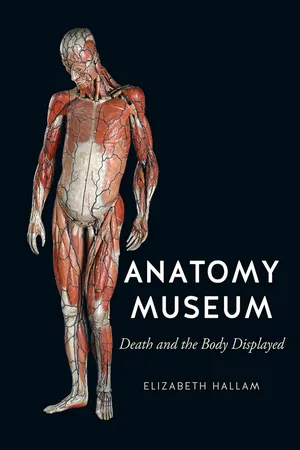
Anatomy museums contain some of the most compelling and challenging displays of the human body. This innovative book focusing on one such museum – in Scotland’s northeast – opens up a wide-ranging history of deceased bodies on display, from medieval relics, to nineteenth-century mega-collections of human remains, to the controversial Body Worlds exhibition that is touring the globe. A surprisingly varied and ever-changing material and visual culture of human anatomy emerges through this history, shaped by multiple factors, including colonialism and war, as well as shifts in medical institutions, technologies and media.
Within its massive granite architecture, the Anatomy Museum of Aberdeen’s medical school has grown and transformed over the last two centuries, in relation to a network of diverse yet interconnected exhibition sites. Many such medical museums in Britain have been used for professional training in which bodies after death are treated as vital sources of knowledge about the living. Anatomists and their associates have preserved the dead and designed exhibits to expose the body’s internal composition and workings – using models, drawings, photographs, X-rays, films and flesh itself. Fascinating yet sometimes disturbing, anatomical displays, made with an array of techniques in substances such as wax, plaster and plastics, have enabled students to examine and understand bodies inside and out.
Strikingly illustrated, Elizabeth Hallam’s book investigates the social relationships and cultural practices that render deceased bodies visible and tangible in spaces of anatomical exploration and beyond.
- English
- ePUB (mobile friendly)
- Available on iOS & Android
eBook - ePub
About this book
Information
Topic
MedicineSubtopic
World HistoryREFERENCES

Introduction: Articulating Anatomy
1 ‘Las Ruinas Circulares’ was first published in Sur 75, in December 1940. The quotation cited is from Jorge Luis Borges, Labyrinths: Selected Stories and Other Writings, ed. Donald A. Yates and James E. Irby (Harmondsworth, 1970), pp. 74–5.
2 Historical distinctions between specimens and preparations are explained in Simon Chaplin, ‘John Hunter and the “Museum Oeconomy”, 1750–1800’, PhD thesis, King’s College London (2009), pp. 101–2.
3 See Arjun Appadurai, ed., The Social Life of Things: Commodities in Cultural Perspective (Cambridge, 1986); Cara Krmpotich, Joost Fontein and John Harries, ‘The Substance of Bones: The Emotive Materiality and Affective Presence of Human Remains’, Journal of Material Culture, XV (2010), pp. 371–84; Henrik B. Lindskoug and Anne Gustavsson, ‘Stories from Below: Human Remains at the Gothenburg Museum of Natural History and the Museum of World Culture’, Journal of the History of Collections, XXVII (2015), pp. 97–109; Katherine Verdery, The Political Lives of Dead Bodies: Reburial and Postsocialist Change (New York, 1999).
4 For studies of anatomy and pathology museums and collections, see Eva Åhrén, Death, Modernity, and the Body: Sweden 1870–1940, trans. Daniel W. Olson (Rochester, NY, 2009); Samuel J.M.M. Alberti, Morbid Curiosities: Medical Museums in Nineteenth-century Britain (Oxford, 2011); Chaplin, ‘John Hunter’; Elizabeth Hallam and Samuel J.M.M. Alberti, ‘Bodies in Museums’, in Medical Museums: Past, Present, Future, ed. Samuel J.M.M. Alberti and Elizabeth Hallam (London, 2013), pp. 1–15; Dawn Kemp with Sara Barnes, Surgeons’ Hall: A Museum Anthology (Edinburgh, 2009); Jonathan Reinarz, ‘The Age of Museum Medicine: The Rise and Fall of the Medical Museum of Birmingham’s School of Medicine’, Social History of Medicine, XVIII (2005), pp. 419–37; Steve Sturdy, ‘Making Sense in the Pathology Museum’, in Anatomy Acts: How We Come to Know Ourselves, ed. Andrew Patrizio and Dawn Kemp (Edinburgh, 2006), pp. 107–15. For histories of public anatomical exhibitions, see Richard D. Altick, The Shows of London: A Panoramic History of Exhibitions, 1600–1862 (Cambridge, MA, 1978); Alan W. Bates, ‘“Indecent and Demoralising Representations”: Public Anatomy Museums in Mid-Victorian England’, Medical History, LII (2008), pp. 1–22; Maritha Rene Burmeister, ‘Popular Anatomical Museums in Nineteenth-century England’, PhD thesis, Rutgers University (2000); Elizabeth Stephens, Anatomy as Spectacle: Public Exhibitions of the Body from to 1700 the Present (Liverpool, 2011).
5 For histories of medical education, see William F. Bynum and Roy Porter, eds, Medicine and the Five Senses (Cambridge, 1993); William F. Bynum et al., The Western Medical Tradition, 1800–2000 (Cambridge, 2006); Thomas Neville Bonner, Becoming a Physician: Medical Education in Britain, France, Germany, and the United States, 1740–1945 (Oxford, 1995); Elizabeth Hurren, Dying for Victorian Medicine: English Anatomy and Its Trade in the Dead Poor, c. 1834–1929 (London, 2012); Fiona Hutton, The Study of Anatomy in Britain, 1700–1900 (London, 2013); Vivian Nutton and Roy Porter, eds, The History of Medical Education in Britain (Amsterdam, 1995); Keir Waddington, Medical Education at St Bartholomew’s Hospital, 1123–1995 (Woodbridge, Suffolk, 2003). Mark Weatherall, Gentlemen, Scientists, and Doctors: Medicine at Cambridge, 1800–1940 (Baltimore, MD, 2000).
6 For analysis of the constitution of knowledge in practice, as discussed in historical studies of science, see for example Lorraine Daston and Peter Galison, Objectivity (New York, 2007); Lorraine Daston and Elizabeth Lunbeck, eds, Histories of Scientific Observation (Chicago, IL, 2011); Jan Golinski, Making Natural Knowledge: Constructivism in the History of Science (Cambridge, 1998); Simon Shapin, A Social History of Truth: Civility and Science in Seventeenth-century England (Chicago, IL, 1994), Simon Shapin, Never Pure: Historical Studies of Science as if It Was Produced by People with Bodies, Situated in Time, Space, Culture, and Society, and Struggling for Credibility (Baltimore, MD, 2010).
7 There is an extensive literature on the history of anatomy, see for example Andrea Carlino, Books of the Body: Anatomical Ritual and Renaissance Learning (Chicago, IL, 1999); Andrew Cunningham, The Anatomist Anatomis’d: An Experimental Discipline in Enlightenment Europe (Farnham, 2010); Anita Guerrini, ‘Anatomists and Entrepreneurs in Early Eighteenth-century London’, Journal of the History of Medicine and Allied Sciences, LIX (2004), pp. 219–39; Hurren, Dying for Victorian Medicine; Hutton, Study of Anatomy; Cynthia Klestinec, Theatres of Anatomy: Students, Teachers, and Traditions of Dissection in Renaissance Venice (Baltimore, MD, 2011); Helen MacDonald, Possessing the Dead: The Artful Science of Anatomy (Melbourne, 2010); Katherine Park, Secrets of Women: Gender, Generation and the Origins of Human Dissection (New York, 2006); Lynda Payne, With Words and Knives: Learning Medical Dispassion in Early Modern England (Aldershot, 2007); Ruth Richardson, Death, Dissection and the Destitute, 2nd edn (London, 2001); Jonathan Sawday, The Body Emblazoned: Dissection and the Human Body in Renaissance Culture (London, 1995); Michael Sappol, A Traffic of Dead Bodies: Anatomy and Embodied Social Identity in Nineteenth-century America (Princeton, NJ, 2002).
8 See Elizabeth Hallam and Tim Ingold, eds, Making and Growing: Anthropological Studies of Organisms and Artefacts (Farnham, 2014).
9 On embodiment, see for example Thomas J. Csordas, Embodiment and Experience: The Existential Ground of Culture and Self (Cambridge, 1994); Christopher Lawrence and Simon Shapin, eds, Science Incarnate: Historical Embodiments of Natural Knowledge (Chicago, IL, 1998); Margaret Lock and Judith Farquhar, eds, Beyond the Body Proper: Reading the Anthropology of Material Life (Durham, NC, 2007); Rachel Prentice, Bodies in Formation: An Ethnography of Anatomy and Surgery Education (Durham, NC, 2013).
10 The University of Aberdeen’s Anatomy Department (or Anatomy Facility) is currently (to date) part of the School of Medicine and Dentistry. Acknowledgements regarding my research at this site are given at the end of this book. Elizabeth Hallam, ‘Anat...
Table of contents
- Front Cover
- Half Title
- Title Page
- Copyright
- CONTENTS
- Introduction: Articulating Anatomy
- One Hand and Eye: Dynamics of Tactile Display
- Two Animations: Relics, Rarities and Anatomical Preparations
- Three Nerve Centre: Museum Formation I
- Four Skeletal Growth: Museum Formation II
- Five Visualizing the Interior
- Six Living Anatomy
- Seven Paper, Wax and Plastic
- Eight Relocations and Memorials
- Abbreviations
- References
- Select Bibliography
- Acknowledgements
- Photo Acknowledgements
- Index
Trusted by 375,005 students
Access to over 1.5 million titles for a fair monthly price.
Study more efficiently using our study tools.
Frequently asked questions
Yes, you can cancel anytime from the Subscription tab in your account settings on the Perlego website. Your subscription will stay active until the end of your current billing period. Learn how to cancel your subscription
No, books cannot be downloaded as external files, such as PDFs, for use outside of Perlego. However, you can download books within the Perlego app for offline reading on mobile or tablet. Learn how to download books offline
We are an online textbook subscription service, where you can get access to an entire online library for less than the price of a single book per month. With over 1.5 million books across 990+ topics, we’ve got you covered! Learn about our mission
Look out for the read-aloud symbol on your next book to see if you can listen to it. The read-aloud tool reads text aloud for you, highlighting the text as it is being read. You can pause it, speed it up and slow it down. Learn more about Read Aloud
Yes! You can use the Perlego app on both iOS and Android devices to read anytime, anywhere — even offline. Perfect for commutes or when you’re on the go.
Please note we cannot support devices running on iOS 13 and Android 7 or earlier. Learn more about using the app
Please note we cannot support devices running on iOS 13 and Android 7 or earlier. Learn more about using the app
Yes, you can access Anatomy Museum by Elizabeth Hallam in PDF and/or ePUB format, as well as other popular books in Medicine & World History. We have over 1.5 million books available in our catalogue for you to explore.