- 512 pages
- English
- ePUB (mobile friendly)
- Available on iOS & Android
eBook - ePub
About this book
Wine Tasting: A Professional Handbook is an essential guide for any professional or serious connoisseur seeking to understand both the theory and practice of wine tasting. From techniques for assessing wine properties and quality, including physiological, psychological, and physicochemical sensory evaluation, to the latest information on types of wine, the author guides the reader to a clear and applicable understanding of the wine tasting process.
Including illustrative data and testing technique descriptions, Wine Tasting is for professional tasters, those who train tasters and those involved in designing wine tastings as well as the connoisseur seeking to maximize their perception and appreciation of wine.
- Revised and updated coverage, notably the physiology and neurology taste and odor perception
- Expanded coverage of the statistical aspect of wine tasting (specific examples to show the process), qualitative wine tasting (examples for winery staff tasting their own wines; more examples for consumer groups and restaurants), tripling of the material on wine styles and types, wine language, the origins of wine quality, and food and wine combination
- Flow chart of wine tasting steps
- Flow chart of wine production procedures
- Practical details on wine storage and problems during and following bottle opening
- Examples of tasting sheets
- Details of errors to be avoided
- Procedures for training and testing sensory skill
Information
Chapter 1
Introduction
Chapter Contents
Tasting Process
Appearance
Odor
In-mouth Sensations
Finish
Overall Quality
Postscript
As befits one of life’s finest pleasures, wine deserves serious attention. Nevertheless, no wine tasting procedure has achieved universal adoption. Most experienced wine tasters have their own preferred procedure. Although essential for critical tasting, those described here are too detailed for the dinner table. The difference is equivalent to score analysis versus music appreciation. Critical tasting compares one or several wines against a real or theoretical standard. In contrast, wine with a meal is intended to be savored as a liquid refreshment. Although critical wine assessment is ill designed for the dining room, due to the distractions of conversation and the interference of food flavors, the concentration involved in wine analysis can greatly enhance appreciation.
Tasting Process
The technique discussed here (Fig. 1.1) is a synopsis of experience gained from assessing tasters, but is a reasonable starting point. No technique is ideal for everyone. Probably the most essential property of a serious taster is the willingness, desire, and ability to focus his or her attention on the wine’s characteristics.
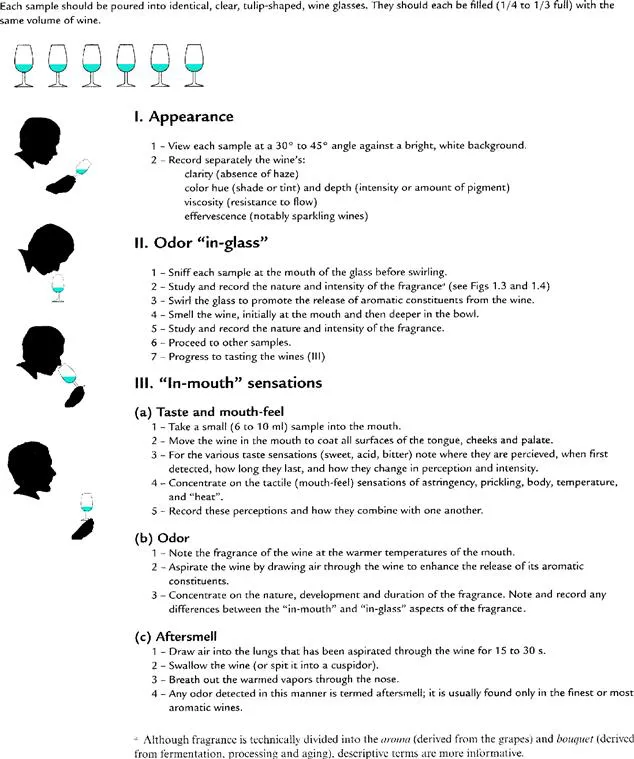
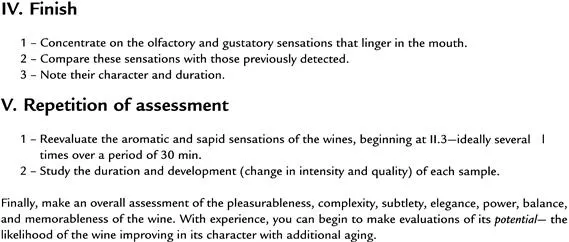
Figure 1.1 Sequence of wine tasting.
Peynaud (1987) advocates rinsing the mouth with wine before embarking on serious tasting. Where tasters are unfamiliar with the characteristics of the wines to be tasted, it can familiarize the senses to the basic attributes of the wines. However, the introductory sample must be chosen with care to avoid setting an inappropriate standard and distorting expectations. Peynaud also cautions against rinsing the palate between samples. He feels that it may alter sensitivity, and complicate comparing wines. In this recommendation, Peynaud is at variance with other authorities. Only when the palate seems fatigued does he support palate cleansing. Leaving palate cleansing up to individual tasters assumes that they can judge accurately when their senses are beginning to show adaptation. Since this is a dubious assumption, it is safer to encourage tasters to cleanse their palate between each sample. In contrast, olfactory adaptation may have an advantage. For example, it may “unmask” the presence of other aromatic compounds (Goyert et al., 2007). It is a frequent observation that the quality and intensity of a wine’s aromatic characteristics change as it is being sampled. This occurs not only over the full course of a tasting (up to 30 min), but also during any particular sampling. Investigation of the complex interaction of aromatics on perception is still in its infancy (Brossard et al., 2007).
Most wines are best sampled in clear, tulip-shaped goblets (Fig. 1.2; Plate 5.11). The primary exception involves sparkling wines. These are normally judged in elongated, flute-shaped glasses (Plate 5.13). They facilitate observation of the wine’s effervescence. All glasses in a tasting should be identical and filled to the same level (about one-quarter to one-third full). This permits each wine to be sampled under equivalent conditions. Between 30 and 50 ml is adequate for most tastings. Not only are small volumes economic, but they facilitate holding the glass at a steep angle (for viewing color and clarity) and permit vigorous swirling (to enhance the release of aromatics).
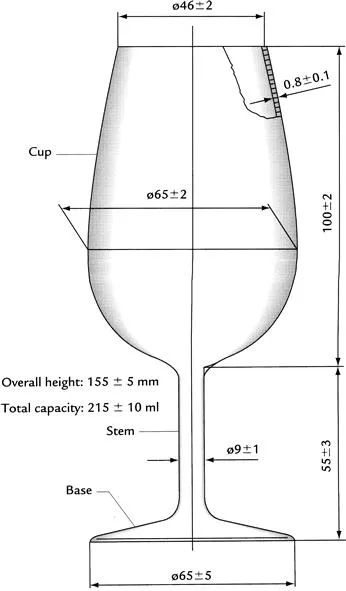
Figure 1.2 International Standards Organization (ISO) wine tasting glass. Dimensions are in mm
(courtesy of International Standards Organization, Geneva, Switzerland).
Appearance
Except for rare situations, in which color must not influence assessment, the visual characteristics of a wine are the first to be judged. To improve light transmission, the glass is tilted against a bright, white background (35° to 45° angle). This produces a curved edge of varying depths through which the wine’s appearance can be better assessed.
Visual stimuli often give a sense of pleasure and anticipation of the sensations to follow. The appearance may hint at flavor attributes as well as potential faults. An example of the influence of wine coloration on perceived quality is illustrated in Fig. 2.6. It is also well known that a deep red color increases perceived quality, even when assessed by seasoned judges. Thus, visual clues must be assessed with caution to avoid unfair prejudgment of the wine.
Clarity
All wine should be brilliantly clear. The haziness often obvious in barrel samples is of little concern. It is eliminated before bottling. Cloudiness in bottled wine is another issue. It is always considered unacceptable, despite its seldom affecting the wine’s taste or aromatic character. Because most sources of cloudiness are understood and controllable, the presence of haziness in commercial wine is uncommon. The major exception may involve some well-aged red wines that eventually “throw” sediment. However, careful decanting can avoid resuspending this material.
Color
The two most significant features of a wine’s color are its hue and depth. Hue denotes its shade or tint, whereas depth refers to the relative brightness and intensity of the color. Both aspects can provide clues to features such as grape maturity, duration of skin contact, fermentation cooperage, and wine age. Immature white grapes yield almost colorless wines, whereas fully to overmature grapes may generate yellowish wines. Increased maturity often enhances the potential color intensity of red wine. The extent to which these tendencies are realized largely depends on the duration of maceration (skin contact). Maturation in oak cooperage enhances age-related color changes, but temporarily augments color depth. During aging, golden tints in white wines increase, whereas red wines lose color density. Eventually, all wines take on tawny brown shades.
Because many factors affect wine color, it is often inappropriate to be too dogmatic about the significance of any particular shade. Only if the wine’s origin, style, and age are known, may color indicate its “correctness.” An atypical color can be a sign of several faults. The less known about a particular wine, the less significant color becomes in assessing quality. If color is too likely to be prejudicial, visual clues can be hidden by techniques such as using black glasses.
Tilting the glass has the advantage of creating a gradation of wine depths. Viewed against a bright background, the variation in depth creates a range of hues and density attributes. Pridmore et al. (2005) give a detailed discussion of these phenomena. The rim of the wine provides one of the better measures of a wine’s relative age. A purplish to mauve hue is an indicator of youth in a red wine. A brickish tint along the rim is often the first sign of aging. By contrast, observing wine down from the top is the best means of judging relative color depth.
The most difficult task associated with color assessment is expressing one’s impressions meaningfully in words. There is no accepted terminology for wine colors. Color terms are seldom used consistently or recorded in an effective manner. Some tasters place a drop of the wine on the tasting sheet. Although of comparative value, it does not even temporarily preserve an accurate record of the wine’s color.
Until a practical standard is available, use of a few simple terms is probably preferable. Terms such as purple, ruby, red, brick, and tawny; and straw, yellow, gold, and amber; combined with qualifiers such as pale, light, medium, and dark can express the standard range of red and white wine colors, respectively. These terms are fairly self-explanatory and provide an element of effective communication.
Viscosity
Wine viscosity refers to its resistance to flow. Factors such as the sugar, glycerol, and alcohol content affect this property. Typically, though, perceptible differences in viscosity are detectable only in dessert or highly alcoholic wines. Because these differences are minor and of diverse origin, they are of little diagnostic value. Viscosity is ignored by most professional tasters.
Spritz
Spritz refers to the bubbles that may form, usually along the sides and bottom of a glass, or the slight effervescence seen or detected in the mouth. Active and continuous bubbling is generally found only in sparkling wines. In the latter case, the size, number, and duration of the bubbles are important quality features.
Slight effervescence is typically a consequence of early bottling, before the excess, dissolved, carbon dioxide in newly fermented wine has had a chance to escape. Infrequently, a slight spritz may result from the occurrence of malolactic fermentation after bottling. Historically, spritz was commonly associated with microbial spoilage. Because this is now rare, a slight spritz is generally of insignificance.
Tears
Tears (rivulets, legs) develop and flow down the sides of the glass following swirling. They are little more than a crude indicator of a wine’s alcohol content. Other than for the intrigue or visual amusement they may inspire, tears are sensory trivia.
Odor
When one is assessing a wine’s fragrance, several characteristics are assessed. They include its quality, intensity, and temporal attributes. Quality refers to how the odor is described, usually in terms of other aromatic objects (e.g., rose, apple, truffle), classes of objects (e.g., flowers, fruit, vegetables), experiences (grandmother’s pumpkin pie, East Indian store, barnyard), or emotional responses (elegant, subtle, perfumed). Intensity refers to the relative magnitude of the odor. Temporal aspects refer to how the fragrance changes with time, both in quality and intensity.
Orthonasal (in-glass) Odor
Tasters are often counseled to smell the wine before swirling. This exposes the senses to the wine’s most volatile aromatics. When one is comparing several wines, it is often more convenient to position oneself over the glasses than raise each glass to one’s nose. Repeat assessment over several minutes provides the taster with an opportunity to assess one of a wine’s most ethereal attributes—development, how the fragrance changes over the course of the tasting.
The second and more important phase of olfactory assessment follows swirling of the wine. Although simple, effectively swirling usually requires practice. Until comfortable with the process, start by slowly rotating the base of the glass on a level surface. Most of the action involves a cyclical arm movement at the shoulder, while the wrist remains stationary. Holding the glass by the stem provides a good grip and permits vigorous swirling. As one becomes familiar with the process, start shifting to swirling by wrist action. Onc...
Table of contents
- Cover image
- Title page
- Table of Contents
- Copyright
- Dedication
- Preface
- Acknowledgments
- About the Author
- Chapter 1. Introduction
- Chapter 2. Visual Perceptions
- Chapter 3. Olfactory Sensations
- Chapter 4. Taste and Mouth-Feel Sensations
- Chapter 5. Quantitative (Technical) Wine Assessment
- Chapter 6. Qualitative Wine Assessment
- Chapter 7. Styles and Types of Wine
- Chapter 8. Nature and Origins of Wine Quality
- Chapter 9. Wine and Food Combination
- Glossary
- Index
- Colour Plate
Trusted by 375,005 students
Access to over 1.5 million titles for a fair monthly price.
Study more efficiently using our study tools.
Frequently asked questions
Yes, you can cancel anytime from the Subscription tab in your account settings on the Perlego website. Your subscription will stay active until the end of your current billing period. Learn how to cancel your subscription
No, books cannot be downloaded as external files, such as PDFs, for use outside of Perlego. However, you can download books within the Perlego app for offline reading on mobile or tablet. Learn how to download books offline
Perlego offers two plans: Essential and Complete
- Essential is ideal for learners and professionals who enjoy exploring a wide range of subjects. Access the Essential Library with 800,000+ trusted titles and best-sellers across business, personal growth, and the humanities. Includes unlimited reading time and Standard Read Aloud voice.
- Complete: Perfect for advanced learners and researchers needing full, unrestricted access. Unlock 1.5M+ books across hundreds of subjects, including academic and specialized titles. The Complete Plan also includes advanced features like Premium Read Aloud and Research Assistant.
We are an online textbook subscription service, where you can get access to an entire online library for less than the price of a single book per month. With over 1.5 million books across 990+ topics, we’ve got you covered! Learn about our mission
Look out for the read-aloud symbol on your next book to see if you can listen to it. The read-aloud tool reads text aloud for you, highlighting the text as it is being read. You can pause it, speed it up and slow it down. Learn more about Read Aloud
Yes! You can use the Perlego app on both iOS and Android devices to read anytime, anywhere — even offline. Perfect for commutes or when you’re on the go.
Please note we cannot support devices running on iOS 13 and Android 7 or earlier. Learn more about using the app
Please note we cannot support devices running on iOS 13 and Android 7 or earlier. Learn more about using the app
Yes, you can access Wine Tasting by Ronald S. Jackson in PDF and/or ePUB format, as well as other popular books in Technology & Engineering & Food Science. We have over 1.5 million books available in our catalogue for you to explore.