- 372 pages
- English
- ePUB (mobile friendly)
- Available on iOS & Android
eBook - ePub
About this book
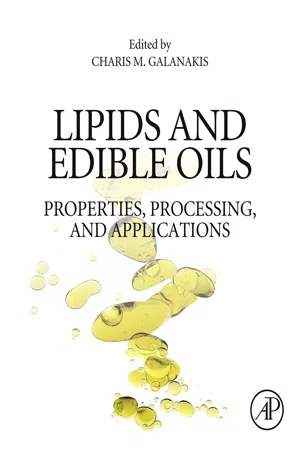
Lipids and Edible Oils: Properties, Processing and Applications covers the most relevant topics of lipids and edible oils, especially their properties, processing and applications. Over the last years, researchers have investigated lipid bioavailability, authentication, stability and oxidation during processing and storage, hence the development of food and non-food applications of lipids and edible oils has attracted great interest. The book explores lipid oxidation in foods, the application of lipids as nano-carriers of food bioactive compounds, and their bioavailability, metabolism and nutritional genomics. Regarding edible oils, the book thoroughly explores their triacylglycerols content, biodiesel and energy production from vegetable oils, refining and lifecycle assessment.
Written by a team of interdisciplinary experts that research lipids and edible oils, the book is intended for food scientists, technologists, engineers and chemists working in the whole food science field.
- Thoroughly explores the technological properties of lipids and edible oils
- Includes food processing by-products and microalgae as a source of lipids and edible oils
- Reviews novelties in edible oil products and processing, including refining techniques, biorefinery and value creation processing waste
Information
Subtopic
Sciences de l'alimentationChapter 1
Lipids and nutrition security
Tonderayi M. Matsungoa; Linda P. Sizibab a Institute of Food, Nutrition and Family Sciences, University of Zimbabwe, Harare, Zimbabwe
b Centre of Excellence for Nutrition, North West University, Potchefstroom, South Africa
b Centre of Excellence for Nutrition, North West University, Potchefstroom, South Africa
Abstract
Rapid urbanization and nutrition transition result in increased energy-dense diets, characterized by high levels of refined sugars, salt, and other additives, increased saturated fat intake (mainly from animal source foods), and reduced intakes of complex carbohydrates, fiber, fruits, and vegetables. Most attention on healthy eating is focused on fats and lipids. Lipids are a heterogeneous group of compounds, including fats, oils, steroids, waxes, and related compounds. They are concentrated sources of energy as well as structural components of cell membranes. In addition, dietary fats have crucial physiological functions. The general recommendation is to replace dietary saturated fatty acid and trans-fat acids with polyunsaturated fatty acids, particularly omega3 fatty acids. This approach reduces the risk of cardiovascular diseases, type 2 diabetes mellitus, and certain types of cancers. There is therefore a need to refine and update the manufacturing processes to ensure safe, healthier, and environmentally friendly fats and oils. Ultimately, this will result in the changing of consumer perception of fats and oils and improve availability and consumption of these healthy fats and oils. Therefore, this chapter discusses the significance of health-related fatty acids, socio-economic aspects governing their presence in food and consumption, and how all these factors have a bearing on achieving the goal of human health, well-being as well as food and nutrition security.
Keywords
Triglycerides; Phospholipids; Sterols; Arachidonic acid; Nutrition transition; Coronary heart disease
1.1 Introduction and background
The term fats or lipids refers to the class of nutrients which consist of triglycerides (fats and oils), phospholipids (PLs), and sterols (Whitney and Rolfes, 2018). In human nutrition, the most important lipids are triglycerides or triacylglycerols (TAGs) (~ 95% of dietary fats) (Barasi, 2003). In addition, there are fat-soluble vitamins in the diet and body tissues. If an individual consumes an average fat intake of 100 g per day, 90–95 g will be triglycerides; 4–8 g PLs; 1 g glycolipids, and 350–450 mg will be cholesterol (Barasi, 2003).
Triglycerides are the building blocks of most fats in the body with chemical structure built on a glycerol backbone to which three fatty acids (FAs) are attached (Whitney and Rolfes, 2018). In addition, since fats consist of three FAs and a glycerol molecule, they are also called TAGs or triglycerides. However, during fat digestion, triglycerides can be broken down (de-esterification) to diglycerides and monoglycerides (Burdge and Calder, 2015). During metabolism, the triglycerides can be resynthesized (re-esterification) in the body when required. These two processes create a huge diversity of triglycerides which are needed for several functional processes in the body (Barasi, 2003; Calder, 2015).
The nutrition situation in low to middle income countries is characterized by the co-existence of stunting, deficiencies of vitamin A, iron and zinc, and an emerging problem of obesity (Min et al., 2018). According to the World Health Organization, the proportion of non-communicable diseases (NCD) burden is foreseen to increase to 57% in 2020 (WHO, 2013b). Poor diets and physical inactivity are part of the leading risk factors. Rising incomes and urbanization are driving a global dietary transition in which traditional diets are replaced by diets higher in refined sugars, refined fats, oils, and meats (Tilman and Clark, 2014). However, evidence presented in the Global Burden of Disease Study (the 2013 analysis published in Lancet 2015), highlights that interventions to address malnutrition must target all its forms in a multisectoral and holistic manner. The current food systems are not helping consumers to make healthy and affordable food choices necessary to achieve optimal nutrition outcomes (Blay-Palmer et al., 2016; Haddad et al., 2016). As such food systems approach through nutrition sensitive and sustainable agriculture can address issues of food security as well as the dietary diversity aspects.
Global evidence shows that as household incomes increase this often correlates with higher consumption of energy-dense foods with low nutritional value and lower consumption of coarse grains, legumes, and vegetables, generally accompanied by a simultaneous shift toward sedentary lifestyles (Popkin et al., 2012). These poor dietary patterns increase the risk of developing chronic diseases. The consumer education and awareness on healthy eating can be achieved through the implementation of evidence-based food-based dietary guidelines (FBDGs) (WHO, 2009).
The WHO's five keys to a healthy diet: (1) breastfeed babies and young children, (2) eat a variety of foods, (3) eat plenty of vegetables and fruit, (4) eat moderate amounts of fats and oils, and (5) eat less salt and sugars are somewhat globally agreed summary of what constitutes a healthy diet based on scientific reviews and evidence (WHO, 2015). In some countries, country-specific guidelines for both adults and children have been developed. In general, for adults there is deliberate emphasi...
Table of contents
- Cover image
- Title page
- Table of Contents
- Copyright
- Contributors
- Preface
- Chapter 1: Lipids and nutrition security
- Chapter 2: Bioavailability and metabolism of dietary lipids
- Chapter 3: Nutrigenomics of lipid supplementation in ruminants and pigs
- Chapter 4: Valorization of lipid by-products
- Chapter 5: Microalgae as a source of edible oils
- Chapter 6: Refining of edible oils
- Chapter 7: Lipid oxidation in food
- Chapter 8: Structured lipids: Synthesis, health effects, and nutraceutical applications
- Chapter 9: Structured lipids intended for infant nutrition
- Index
Trusted by 375,005 students
Access to over 1.5 million titles for a fair monthly price.
Study more efficiently using our study tools.
Frequently asked questions
Yes, you can cancel anytime from the Subscription tab in your account settings on the Perlego website. Your subscription will stay active until the end of your current billing period. Learn how to cancel your subscription
No, books cannot be downloaded as external files, such as PDFs, for use outside of Perlego. However, you can download books within the Perlego app for offline reading on mobile or tablet. Learn how to download books offline
Perlego offers two plans: Essential and Complete
- Essential is ideal for learners and professionals who enjoy exploring a wide range of subjects. Access the Essential Library with 800,000+ trusted titles and best-sellers across business, personal growth, and the humanities. Includes unlimited reading time and Standard Read Aloud voice.
- Complete: Perfect for advanced learners and researchers needing full, unrestricted access. Unlock 1.5M+ books across hundreds of subjects, including academic and specialized titles. The Complete Plan also includes advanced features like Premium Read Aloud and Research Assistant.
We are an online textbook subscription service, where you can get access to an entire online library for less than the price of a single book per month. With over 1.5 million books across 990+ topics, we’ve got you covered! Learn about our mission
Look out for the read-aloud symbol on your next book to see if you can listen to it. The read-aloud tool reads text aloud for you, highlighting the text as it is being read. You can pause it, speed it up and slow it down. Learn more about Read Aloud
Yes! You can use the Perlego app on both iOS and Android devices to read anytime, anywhere — even offline. Perfect for commutes or when you’re on the go.
Please note we cannot support devices running on iOS 13 and Android 7 or earlier. Learn more about using the app
Please note we cannot support devices running on iOS 13 and Android 7 or earlier. Learn more about using the app
Yes, you can access Lipids and Edible Oils by Charis M. Galanakis in PDF and/or ePUB format, as well as other popular books in Technologie et ingénierie & Sciences de l'alimentation. We have over 1.5 million books available in our catalogue for you to explore.