eBook - ePub
Radiochemistry and Nuclear Chemistry
- 866 pages
- English
- ePUB (mobile friendly)
- Available on iOS & Android
eBook - ePub
Radiochemistry and Nuclear Chemistry
About this book
Radiochemistry or nuclear chemistry is the study of radiation from an atomic and molecular perspective, including elemental transformation and reaction effects, as well as physical, health and medical properties.
This revised edition of one of the earliest and best-known books on the subject has been updated to bring into teaching the latest developments in research and the current hot topics in the field. To further enhance the functionality of this text, the authors have added numerous teaching aids, examples in MathCAD with variable quantities and options, hotlinks to relevant text sections from the book, and online self-grading tests.
- New edition of a well-known, respected text in the specialized field of nuclear/radiochemistry
- Includes an interactive website with testing and evaluation modules based on exercises in the book
- Suitable for both radiochemistry and nuclear chemistry courses
Information
Topic
Physical SciencesSubtopic
Physical & Theoretical ChemistryChapter 1
Origin of Nuclear Science
Abstract
The science of the radioactive elements and radioactivity in general is rather young compared to its maturity. In 1895 W. Roentgen was working with the discharge of electricity in evacuated glass tubes. Incidentally the evacuated glass tubes were sealed by Bank of England sealing wax and had metal plates in each end. The metal plates were connected either to a battery or an induction coil. Through the flow of electrons through the tube a glow emerged from the negative plate and stretched to the positive plate. If a circular anode was sealed into the middle of the tube the glow (cathode rays) could be projected through the circle and into the other end of the tube. If the beam of cathode rays were energetic enough the glass would glow (fluorescence). These glass tubes were given different names depending on inventor, e.g. Hittorf tubes (after Johann Hittorf) or Crookes tubes (after William Crookes). Roentgens experiments were performed using a Hittorf tube.
Keywords
Radioactive elements; X-rays; Polonium; Radioactive decay; Periodic table; Nuclear power
Chapter Outline
1.1. Radioactive Elements
1.2. Radioactive Decay
1.3. Discovery of Isotopes
1.4. Atomic Models
1.5. Nuclear Power
1.6. Literature
1.1 Radioactive Elements
The science of the radioactive elements and radioactivity in general is rather young compared to its maturity. In 1895 W. Roentgen was working with the discharge of electricity in evacuated glass tubes. Incidentally the evacuated glass tubes were sealed by Bank of England sealing wax and had metal plates in each end. The metal plates were connected either to a battery or an induction coil. Through the flow of electrons through the tube a glow emerged from the negative plate and stretched to the positive plate. If a circular anode was sealed into the middle of the tube the glow (cathode rays) could be projected through the circle and into the other end of the tube. If the beam of cathode rays were energetic enough the glass would glow (fluorescence). These glass tubes were given different names depending on inventor, e.g. Hittorf tubes (after Johann Hittorf) or Crookes tubes (after William Crookes). Roentgens experiments were performed using a Hittorf tube.
During one experiment the cathode ray tube was covered in dark cardboard and the laboratory was dark. Then a screen having a surface coating of barium-platinum-cyanide started to glow. It continued even after moving it further away from the cathode ray tube. It was also noticed that when Roentgens hand partly obscured the screen the bones in the nad was visible on the screen. A new, long range, penetrating radiation was found. The name X-ray was given to this radiation. Learning about this, H. Becquerel, who had been interested in the fluorescent spectra of minerals, immediately decided to investigate the possibility that the fluorescence observed in some salts when exposed to sunlight also caused emission of X-rays. Crystals of potassium uranyl sulfate were placed on top of photographic plates, which had been wrapped in black paper, and the assembly was exposed to the sunlight. After development of some of the photographic plates, Becquerel concluded (erroneously) from the presence of black spots under the crystals that fluorescence in the crystals led to the emission of X-rays, which penetrated the wrapping paper. However, Becquerel soon found that the radiation causing the blackening was not “a transformation of solar energy” because it was found to occur even with assemblies that had not been exposed to light; the uranyl salt obviously produced radiation spontaneously. This radiation, which was first called uranium rays (or Becquerel rays) but later termed radioactive radiation (or simply radioactivity)1, was similar to X-rays in that it ionized air, as observed through the discharge of electroscopes.
Marie Curie subsequently showed that all uranium and thorium compounds produced ionizing radiation independent of the chemical composition of the salts. This was convincing evidence that the radiation was a property of the element uranium or thorium. Moreover, she observed that some uranium minerals such as pitchblende produced more ionizing radiation than pure uranium compounds. She wrote: “this phenomenon leads to the assumption that these minerals contain elements which are more active than uranium”. She and her husband, Pierre Curie, began a careful purification of pitchblende, measuring the amount of radiation in the solution and in the precipitate after each precipitation separation step. These first radiochemical investigations were highly successful: “while carrying out these operations, more active products are obtained. Finally, we obtained a substance whose activity was 400 times larger than that of uranium. We therefore believe that the substance that we have isolated from pitchblende is a hitherto unknown metal. If the existence of this metal can be affirmed, we suggest the name polonium.” It was in the publication reporting the discovery of polonium in 1898 that the word radioactive was used for the first time. It may be noted that the same element was simultaneously and independently discovered by W. Marckwald who called it “radiotellurium”.
In the same year the Curies, together with G. Bemont, isolated another radioactive substance for which they suggested the name radium. In order to prove that polonium and radium were in fact two new elements, large amounts of pitchblende were processed, and in 1902 M. Curie announced that she had been able to isolate about 0.1 g of pure radium chloride from more than one ton of pitchblende waste. The determination of the atomic weight of radium and the measurement of its emission spectrum provided the final proof that a new element had been isolated.
1.2 Radioactive Decay
While investigating the radiochemical properties of uranium, W. Crookes and Becquerel made an important discovery. Precipitating a carbonate salt from a solution containing uranyl ions, they discovered that while the uranium remained in the supernatant liquid in the form of the soluble uranyl carbonate complex, the radioactivity originally associated with the uranium was now present in the precipitate, which contained no uranium. Moreover, the radioactivity of the precipitate slowly decreased with time, whereas the supernatant liquid showed a growth of radioactivity during the same period (Fig. 1.1). We know now that this measurement of radioactivity was concerned with only beta- and gamma-radiations, and not with the alpha-radiation which is emitted directly by uranium.
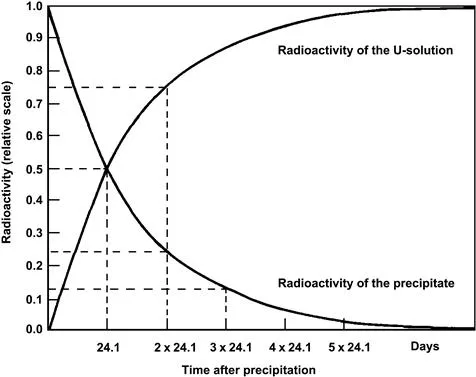
Figure 1.1 Measured change in radioactivity from carbonate precipitate and supernatant uranium solution, i.e. the separation of daughter element UX (Th) from parent radioelement uranium.
Similar results were obtained by E. Rutherford and F. Soddy when investigating the radioactivity of thorium. Later Rutherford and F. E. Dorn found that radioactive gases (emanation) could be separated from salts of uranium and thorium. After separation of the gas from the salt, the radioactivity of the gas decreased with time, while new radioactivity grew in the salt in a manner similar to that shown in Fig. 1.1. The rate of increase with time of the radioactivity in the salt was found to be completely independent of chemical processes, temperature, etc. Rutherford and Soddy concluded from these observations that radioactivity was due to changes within the atoms themselves. They proposed that, when radioactive decay occurred, the atoms of the original elements (e.g. of U or of Th) were transformed into atoms of new elements.
The radioactive elements were called radioelements. Lacking names for these radioelements, letters such as X, Y, Z, A, B, etc., were added to the symbol for the primary (i.e. parent) element. Thus, UX was produced from the radioactive decay of uranium, ThX from that of thorium, etc. These new radioelements (UX, ThX, etc.) had chemical properties that were different from the original elements, and could be separated from them through chemical processes such as precipitation, volatilization, electrolytic deposition, etc. The radioactive daughter elements decayed further to form still other elements, symbolized as UY, ThA, etc. A typical decay chain could be written: Ra → Rn → RaA → RaB → , etc.; see Fig. 1.2.
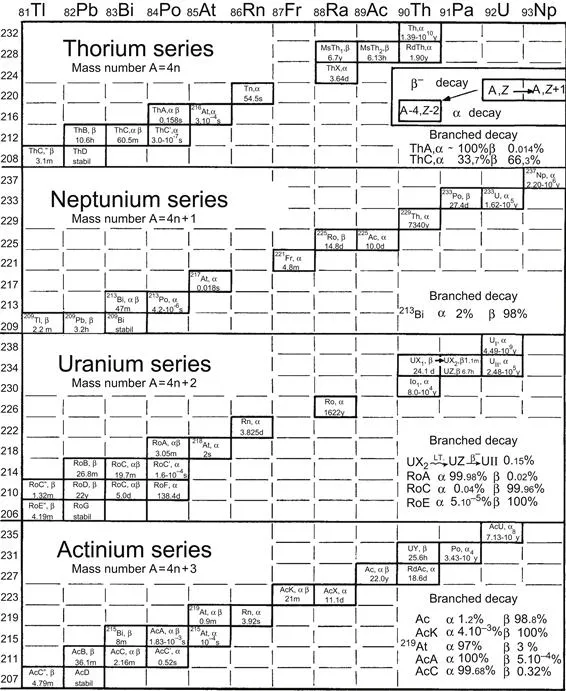
Figure 1.2 The three naturally occurring radioactive decay series and the man-made neptunium series. Although 239Pu (which is the parent to the actinium series) and 244Pu (which is the parent to the thorium series) have been discovered in nature, the decay series shown here begin with the most abundant long-lived nuclides.
A careful study of the radiation emitted from these radioactive elements demonstrated that it consisted of three components which were given the designation alpha (α), beta (β), and gamma (γ). Alpha-radiation was shown to be identical to helium ions, whereas beta-radiation was identical to elec...
Table of contents
- Cover image
- Title page
- Table of Contents
- Copyright
- Foreword to the 4th Edition
- Chapter 1. Origin of Nuclear Science
- Chapter 2. Elementary Particles
- Chapter 3. Nuclei, Isotopes and Isotope Separation
- Chapter 4. Nuclear Mass Stability
- Chapter 5. Unstable Nuclei and Radioactive Decay
- Chapter 6. Nuclear Structure
- Chapter 7. Absorption of Nuclear Radiation
- Chapter 8. Radiation Effects on Matter
- Chapter 9. Detection and Measurement Techniques
- Chapter 10. Energetics of Nuclear Reactions
- Chapter 11. Mechanisms and Models of Nuclear Reactions
- Chapter 12. The Origin of the Universe and Nucleosynthesis
- Chapter 13. Cosmic Radiation and Radioelements in Nature
- Chapter 14. The Actinide and Transactinide Elements
- Chapter 15. Radiation Biology and Radiation Protection
- Chapter 16. Particle Accelerators
- Chapter 17. Production of Radionuclides
- Chapter 18. Uses of Radioactive Tracers
- Chapter 19. Principles of Nuclear Power
- Chapter 20. Nuclear Power Reactors
- Chapter 21. The Nuclear Fuel Cycle
- Chapter 22. Behavior of Radionuclides in the Environment
- Appendix A. Solvent Extraction Separations
- Appendix B. Answers to Exercises
- Appendix C
- Element and Nuclide Index
- Index
Trusted by 375,005 students
Access to over 1.5 million titles for a fair monthly price.
Study more efficiently using our study tools.
Frequently asked questions
Yes, you can cancel anytime from the Subscription tab in your account settings on the Perlego website. Your subscription will stay active until the end of your current billing period. Learn how to cancel your subscription
No, books cannot be downloaded as external files, such as PDFs, for use outside of Perlego. However, you can download books within the Perlego app for offline reading on mobile or tablet. Learn how to download books offline
Perlego offers two plans: Essential and Complete
- Essential is ideal for learners and professionals who enjoy exploring a wide range of subjects. Access the Essential Library with 800,000+ trusted titles and best-sellers across business, personal growth, and the humanities. Includes unlimited reading time and Standard Read Aloud voice.
- Complete: Perfect for advanced learners and researchers needing full, unrestricted access. Unlock 1.5M+ books across hundreds of subjects, including academic and specialized titles. The Complete Plan also includes advanced features like Premium Read Aloud and Research Assistant.
We are an online textbook subscription service, where you can get access to an entire online library for less than the price of a single book per month. With over 1.5 million books across 990+ topics, we’ve got you covered! Learn about our mission
Look out for the read-aloud symbol on your next book to see if you can listen to it. The read-aloud tool reads text aloud for you, highlighting the text as it is being read. You can pause it, speed it up and slow it down. Learn more about Read Aloud
Yes! You can use the Perlego app on both iOS and Android devices to read anytime, anywhere — even offline. Perfect for commutes or when you’re on the go.
Please note we cannot support devices running on iOS 13 and Android 7 or earlier. Learn more about using the app
Please note we cannot support devices running on iOS 13 and Android 7 or earlier. Learn more about using the app
Yes, you can access Radiochemistry and Nuclear Chemistry by Gregory Choppin,Jan-Olov Liljenzin,Jan Rydberg,Christian Ekberg,JAN RYDBERG in PDF and/or ePUB format, as well as other popular books in Physical Sciences & Physical & Theoretical Chemistry. We have over 1.5 million books available in our catalogue for you to explore.