- 562 pages
- English
- ePUB (mobile friendly)
- Available on iOS & Android
eBook - ePub
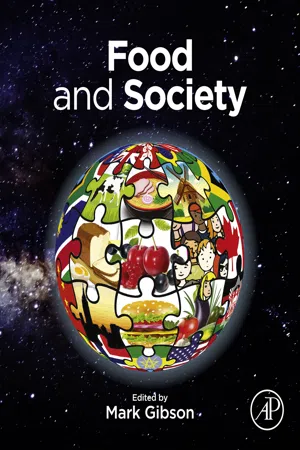
Food and Society
About this book
Food and Society provides a broad spectrum of information to help readers understand how the food industry has evolved from the 20th century to present. It includes information anyone would need to prepare for the future of the food industry, including discussions on the drivers that have, and may, affect food supplies. From a historical perspective, readers will learn about past and present challenges in food trends, nutrition, genetically modified organisms, food security, organic foods, and more. The book offers different perspectives on solutions that have worked in the past, while also helping to anticipate future outcomes in the food supply.
Professionals in the food industry, including food scientists, food engineers, nutritionists and agriculturalists will find the information comprehensive and interesting. In addition, the book could even be used as the basis for the development of course materials for educators who need to prepare students entering the food industry.
- Includes hot topics in food science, such as GMOs, modern agricultural practices and food waste
- Reviews the role of food in society, from consumption, to politics, economics and social trends
- Encompasses food safety, security and public health
- Discusses changing global trends in food preferences
Information
Part One
The historic political, economic and social constructs of food
Part One The Historic Political, Economic and Social Constructs of Food
Tis education forms the common mind,
Just as the twig is bent, the tree's inclined
Alexander Pope
Moral Essays
Chapter 1
Sociopolitical food and nutrition
pre-20th century
Abstract
Populations will only increase if and when they have sufficient basic means to do so. One of these basic needs involves access to a plentiful supply of natural resources such as food and water, not to mention the collective organization and governance of its people. Although the latter is not necessarily quite so obvious, we will look at this aspect in more detail later. In this way, with adequate governance, provisions, time, and a smattering of luck, in due course, social evolution and collective ideology have been shaped and reshaped to define humanity, most often for the better. However, this evolutionary process requires a critical mass of people, the majority of which need to be moving collectively in the same direction for things to get started. Yet, the reality for millennia was that population numbers had remained static at around the 200 million mark. That was, until a certain set of circumstances came together, prevailed and which then collectively encouraged the increase in population figures. Such circumstances included the industrial revolution, the industrialization of agriculture, and an age of enlightenment among others.
Keywords
Agricultural revolution; Chemical revolution; Food; Modern agriculture; Nutrition; Period of enlightenment
Populations will only increase if and when they have sufficient basic means to do so. One of these basic needs involves access to a plentiful supply of natural resources such as food and water, not to mention the collective organization and governance of its people. Although the latter is not necessarily quite so obvious, we will look at this aspect in more detail later. In this way, with adequate governance, provisions, time, and a smattering of luck, in due course, social evolution and collective ideology have been shaped and reshaped to define humanity, most often for the better. However, this evolutionary process requires a critical mass of people, the majority of which need to be moving collectively in the same direction for things to get started. Yet, the reality for millennia was that population numbers had remained static at around the 200 million mark. That was, until a certain set of circumstances came together, prevailed and which then collectively encouraged the increase in population figures. Such circumstances included the industrial revolution, the industrialization of agriculture, and an age of enlightenment among others.
Ever since civilizations first began to participate in sedentary cultivation rather than hunting and gathering, they were naturally inclined to share the fortunes and failures of their labors with the rest of the community (next section). As such a hitherto unknown concept of food security emerged, adapted, and evolved. Such is its importance, though that no book about food and society would be complete without something in the way of explanation of the food security concept. Consequently, this and many other food-related topics are included. In this way, the whole picture of food and society comes together from the macro- to the microenvironment of food.
1.1. The growth of agricultural civilizations
Pinning down the birth of modern humanity is fraught with disagreement and contention. The problem is there are numerous theories, scholarly and otherwise, that try to describe the specific origins of the agricultural evolution and the subsequent impetus that gave rise to the complete transition from hunter-gatherer to the very origins of agriculture as we know it today. Many such theories include the demographic, oasis, evolutionary, or socioeconomic hypotheses among others (Childe, 1936; Sauer, 1952; Binford, 1968; Rindos, 1987; Hayden, 1992, 1995; Weisdorf, 2005; Rosen, 2007). However, such theories aside it was widely understood or at least acknowledged that the genuine origins of farming evolved somewhat simultaneously and somewhat independently around 10,000 years ago at several sites around the world. This change (or growth if one prefers) has been said to have been largely fueled as a direct result of the abundance of freshwater—important and undoubtedly of great overriding geologic influence. This was collectively encouraged as previous bands of mobile hunter-gatherers came to understand the numerous benefits of living a static existence nearby to rivers, springs, and lakes (Miller, 1980; Gopher et al., 2001; Weisdorf, 2005; Guisepi, 2009; UOR, 2009). Consequent growth from this mini agrarian revolution, coined in 1935 by philologist turned archaeologist V. Gordon Childe as the “Neolithic Revolution,” was understood to be pivotal, or the primary mover in “sedentary cultivation.” Directly resulting from such a fundamental change in living styles, Weisdorf (2005) claims that the transition from hunter-gatherer to agriculturalist at this juncture has been universally recognized as one of the most crucial moments in human civili...
Table of contents
- Cover image
- Title page
- Table of Contents
- Copyright
- List of figures
- List of tables
- Table of equations
- Contributors
- Biography
- Foreword
- Preface: What role food?
- Acknowledgments
- Abbreviations
- Part One. The historic political, economic and social constructs of food
- Chapter 1. Sociopolitical food and nutrition: pre-20th century
- Chapter 2. The 20th century: winds of change (1900–45)
- Chapter 3. Food, rights, and politics: the post-war years (1945–60)
- Chapter 4. Mixed blessings: a time of hope and crisis (1960–2000)
- Chapter 5. The 21st century: ideological convergence
- Part Two. Food and...
- Chapter 6. The beginnings of modern development theory
- Chapter 7. Agriculture, forestry, and fisheries
- Chapter 8. Organic food and agriculture
- Chapter 9. From agriculture to the global food chain/system
- Chapter 10. Global food waste
- Chapter 11. The Hunger files: food security
- Chapter 12. Food: natural and environmental considerations
- Chapter 13. Food: population rise and sustainability
- Part Three. Anthropology of food
- Chapter 14. Governance and food
- Chapter 15. Food and social trends
- Chapter 16. Trending foods and beverages
- Chapter 17. Food, culture, and food tourism
- Chapter 18. Feeding the future: challenges and limitations
- Part Four. Food, service, and other deliverables in the hospitality sector
- Chapter 19. The sociology of the chef: a new theoretical proposition from the open professional kitchen
- Chapter 20. Food ingredients
- Chapter 21. The role of information technology in the food industry
- Chapter 22. Food service in hospitality management
- Chapter 23. The power of service quality: front-of-house service skills
- Chapter 24. The financial environment: Culinary math
- Chapter 25. Controlling costs and purchasing food
- Chapter 26. F&B spatial design and functionality
- Part Five. Summary
- Index
Trusted by 375,005 students
Access to over 1.5 million titles for a fair monthly price.
Study more efficiently using our study tools.
Frequently asked questions
Yes, you can cancel anytime from the Subscription tab in your account settings on the Perlego website. Your subscription will stay active until the end of your current billing period. Learn how to cancel your subscription
No, books cannot be downloaded as external files, such as PDFs, for use outside of Perlego. However, you can download books within the Perlego app for offline reading on mobile or tablet. Learn how to download books offline
Perlego offers two plans: Essential and Complete
- Essential is ideal for learners and professionals who enjoy exploring a wide range of subjects. Access the Essential Library with 800,000+ trusted titles and best-sellers across business, personal growth, and the humanities. Includes unlimited reading time and Standard Read Aloud voice.
- Complete: Perfect for advanced learners and researchers needing full, unrestricted access. Unlock 1.5M+ books across hundreds of subjects, including academic and specialized titles. The Complete Plan also includes advanced features like Premium Read Aloud and Research Assistant.
We are an online textbook subscription service, where you can get access to an entire online library for less than the price of a single book per month. With over 1.5 million books across 990+ topics, we’ve got you covered! Learn about our mission
Look out for the read-aloud symbol on your next book to see if you can listen to it. The read-aloud tool reads text aloud for you, highlighting the text as it is being read. You can pause it, speed it up and slow it down. Learn more about Read Aloud
Yes! You can use the Perlego app on both iOS and Android devices to read anytime, anywhere — even offline. Perfect for commutes or when you’re on the go.
Please note we cannot support devices running on iOS 13 and Android 7 or earlier. Learn more about using the app
Please note we cannot support devices running on iOS 13 and Android 7 or earlier. Learn more about using the app
Yes, you can access Food and Society by Mark Gibson in PDF and/or ePUB format, as well as other popular books in Technology & Engineering & Food Science. We have over 1.5 million books available in our catalogue for you to explore.