eBook - ePub
Controlled and Modified Atmospheres for Fresh and Fresh-Cut Produce
- 684 pages
- English
- ePUB (mobile friendly)
- Available on iOS & Android
eBook - ePub
Controlled and Modified Atmospheres for Fresh and Fresh-Cut Produce
About this book
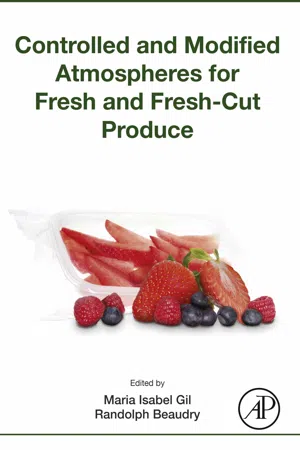
Controlled and Modified Atmospheres for Fresh and Fresh-Cut Produce is the ultimate reference book of CA/MA recommendations for selected commodities. It includes the basic knowledge of physiology and technologies to the current application of recommended CA/MAP conditions for fresh and fresh-cut fruits and vegetables. For each commodity, a summary with requirements and recommendations is presented. The book is divided into three parts, with each focusing on different aspects of CA/MA, including fundamental topics on the physiological and quality effects of CA and MAP for fresh and fresh-cut fruits and vegetables, optimal CA/MAP conditions and recommendations, and optimal conditions for fresh-cut fruits and vegetables.
- Provides guidelines and recommendations of CA/MAP for the fresh produce industry
- Illustrates the benefits and defects caused by CA/MA in full color
- Brings more than 54 fruits and vegetables and their respective summary with the requirements and recommendations of CA/MA conditions
- Includes the optimal CA/MAP conditions and recommendations for selected fresh fruits and vegetables
Information
Part I
Basic principles of CA/MA and future trends
Chapter 1
Biological basis for CA and MA
Mikal E. Saltveit Department of Plant Sciences/Mann Lab, University of California, Davis, CA, United States
Abstract
The physiological basis by which controlled and modified atmospheres (CA and MA) prolong the storage life and maintain the quality of harvested fruits, vegetables, and ornamentals is examined. The beneficial and detrimental effects of reduced oxygen and elevated carbon dioxide atmospheres on the postharvest life of commodities are enumerated. The fundamental physical laws governing gases are reviewed with respect to their contribution to the physiological basis for CA and MA storage. It is emphasized that besides the concentration of gases established external to a commodity in a CA or MA environment, the internal physiologically active concentration of oxygen, carbon dioxide, and ethylene are influenced by a number of factors which include the physical shape of the commodity, the diffusivity of the epidermis and intervening tissue, the metabolic activity of the intervening tissue, and the susceptibility and tolerance of the tissue to these internal concentrations of gases.
Keywords
Aerobic respiration; Anaerobic respiration; Ethylene action; Harvested; MAP; Modified atmosphere packaging; Packaging; Postharvest; Shelf-life; Storage
Plants require aerobic respiration to produce the energy (i.e., ATP) and small organic molecules that are the energy and substrates used for subsequent anabolic reactions needed for continued growth and development (Saltveit, 2016b). Aerobic respiration is comprised of three sequential groups of enzymatically driven reactions: briefly they are glycolysis (conversion of hexoses like glucose to pyruvate), tricarboxylic acid cycle (the TCA cycle converts pyruvate to CO2 with the capture of reducing power in NADH), and electron transport (transfer of electrons from NADP to O2 with the production of ATP). Reduced O2 availability (hypoxia) or a total lack of O2 (anoxia) first leads to a reduced rate of electron transport and tricarboxylic acid cycle activity as NADH accumulates, and later to a metabolic rearrangement (i.e., anaerobic or fermentative respiration) that regenerates NAD+ so that glycolysis can continue to produce an adequate supply of ATP to maintain key metabolic processes. Glycolysis is, in effect, an anaerobic pathway found in the cytoplasm, while the TCA cycle and electron transport are obligate aerobic pathways located in the mitochondria.
Oxygen is the terminal electron acceptor in mitochondrial oxidative phosphorylation (i.e., the production of ATP from NADH by chemiosmosis). In the final step of electron transport, the enzyme cytochrome c oxidase (COX) facilitates transfer of electrons to O2 with the concomitant formation of water. The regeneration of NAD+ from NADH during electron transport is needed for the continued functioning of the glycolytic pathway. In the absence of sufficient O2 for aerobic respiration to continue, the NAD+ regenerated during fermentative respiration allows glycolysis to continue and to extract a small portion of the energy contained in the glucose molecule; only 2 ATPs are produced during anaerobic respiration (i.e., fermentation) in comparison to the 38 ATPs produced during aerobic respiration. However, a 5- to 9-fold increase in the flux through the glycolytic pathway (termed the “Pasteur effect”) compensates for this inefficiency so that ATP production remains at about one-third of that under aerobic conditions (Geigenberger, 2003).
The rate of respiration of many commodities begins to decline as the external oxygen concentration falls below around 10% (v/v) (Fig. 1). The consumption of oxygen and the production of carbon dioxide both decline in a quadratic fashion; slowly at first and then more rapidly as the external oxygen concentration continues to decrease linearly. At very low oxygen levels, the consumption of oxygen approaches zero as there is no oxygen available to consume. In contrast, at an external oxygen concentration below about 2% the production of carbon dioxide starts to increase as respiration in some parts of the commodity shifts from aerobic to anaerobic respiration. As the external oxygen concentration continues to decrease, more and more tissue within the commodity experiences anaerobiosis and the production of carbon dioxide rapidly increases. The cross-over point when the rate of carbon dioxide production from aerobic respiration equals that from anaerobic respiration is called the anaerobic compensation point (ACP). This point is easily identified as it occurs when the production of carbon dioxide abruptly changes from a downward to an upward slope as the oxygen concentration continues to decline. The ACP is useful because it approximates the optimal oxygen concentration that minimizes both respiration and possibility of low oxygen injury.

Inhibition of respiration at low O2 concentrations (e.g., below 8% O2 in the surrounding atmosphere) used in CA and MAP cannot be easily explained by substrate (O2) limitation. The reported Km value for the cytochrome oxidase (COX) enzyme is below 0.1 μM O2 (an O2 concentration in water in equilibrium with 0.011% O2, or 0.04% air saturation), which is more than two orders of magnitude lower than the 270-μM concentration of O2 (equal to 8.5 mg O2/L) found in water saturated with the 20.9% O2 found in air (Drew, 1997). The reduction in respiration at low O2 concentrations maybe independent from the induction of fermentation, which is usually induced at O2 levels close to zero (Geigenberger, 2003).
As the available O2 declines, pyruvate, the end product of glycolysis, may start to accumulate as there is insufficient O2 for the TCA cycle and oxidative phosphorylation to continue to oxidize all the pyruvate produced. To remove this accumulating pyruvate and to regenerate NAD+, pyruvate can be converted...
Table of contents
- Cover image
- Title page
- Table of Contents
- Copyright
- Dedication
- Contributors
- Preface
- Part I: Basic principles of CA/MA and future trends
- Part II: CA/MA requirements and recommendations for fresh and fresh-cut fruits
- Part III: CA/MA requirements and recommendations for fresh and fresh-cut vegetables
- Index
Trusted by 375,005 students
Access to over 1.5 million titles for a fair monthly price.
Study more efficiently using our study tools.
Frequently asked questions
Yes, you can cancel anytime from the Subscription tab in your account settings on the Perlego website. Your subscription will stay active until the end of your current billing period. Learn how to cancel your subscription
No, books cannot be downloaded as external files, such as PDFs, for use outside of Perlego. However, you can download books within the Perlego app for offline reading on mobile or tablet. Learn how to download books offline
Perlego offers two plans: Essential and Complete
- Essential is ideal for learners and professionals who enjoy exploring a wide range of subjects. Access the Essential Library with 800,000+ trusted titles and best-sellers across business, personal growth, and the humanities. Includes unlimited reading time and Standard Read Aloud voice.
- Complete: Perfect for advanced learners and researchers needing full, unrestricted access. Unlock 1.5M+ books across hundreds of subjects, including academic and specialized titles. The Complete Plan also includes advanced features like Premium Read Aloud and Research Assistant.
We are an online textbook subscription service, where you can get access to an entire online library for less than the price of a single book per month. With over 1.5 million books across 990+ topics, we’ve got you covered! Learn about our mission
Look out for the read-aloud symbol on your next book to see if you can listen to it. The read-aloud tool reads text aloud for you, highlighting the text as it is being read. You can pause it, speed it up and slow it down. Learn more about Read Aloud
Yes! You can use the Perlego app on both iOS and Android devices to read anytime, anywhere — even offline. Perfect for commutes or when you’re on the go.
Please note we cannot support devices running on iOS 13 and Android 7 or earlier. Learn more about using the app
Please note we cannot support devices running on iOS 13 and Android 7 or earlier. Learn more about using the app
Yes, you can access Controlled and Modified Atmospheres for Fresh and Fresh-Cut Produce by Maria Isabel Gil,Randolph M. Beaudry in PDF and/or ePUB format, as well as other popular books in Technology & Engineering & Food Science. We have over 1.5 million books available in our catalogue for you to explore.