- 288 pages
- English
- ePUB (mobile friendly)
- Available on iOS & Android
eBook - ePub
Urban Fuel Poverty
About this book
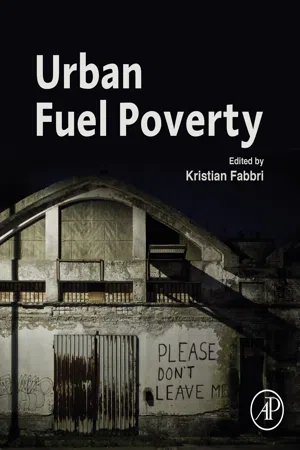
Urban Fuel Poverty describes key approaches to defining and alleviating fuel poverty in cities using a multidisciplinary perspective and multiple case studies. It provides empirical knowledge on the levels and intensities of energy poverty in urban areas, along with new theoretical perspectives in conceptualizing the multidimensionality of energy poverty, with special focus given to the urban environment. Chapters discuss what energy poverty is in terms of taxonomy, stakeholders and affected parties, addressing the role of the economy and energy bills, the role of climate and city factors, the role of buildings, and the health and psychological impact on fuel poverty.
The book addresses how to measure energy poverty, how to map it, and how to draw conclusions based on illness and social indicators. Finally, it explores measures to 'fight' fuel poverty, including policy and governance actions, building efficiency improvements and city planning.
- Bridges interdisciplinary divides between policy and economy, cities and buildings, and health and society
- Addresses the physical performance of urban fuel poverty and their effect on thermal comfort and human health
- Provides strategies and policies to mitigate energy and fuel poverty
Information
Part 1
What is energy fuel poverty
Chapter 1
Fuel poverty definition
from a conceptual review to a more comprehensive definition
Victoria Pellicer-Sifres 1 , 2 1 Fundació Las Naves (València) 2 Ingenio (CSIC – Universitat Politècnica de València)
Abstract
While the concern for energy poverty has recently been gaining attention in the spheres of academia, politics, and social indignation; the debate on the definition is still open and being revised. This chapter argues that the act of defining energy poverty implicitly implies a political positioning, and it aims to offer elements of reflection as a first step toward a definition more aligned with people's needs and aspirations. To this end, the chapter is divided into three sections. In the first, a review of the concepts of energy/fuel poverty is offered. The second section offers, from a critical perspective, a wider reflection on the use of the terms, on the meanings behind each definition, and on the absence —in the energy poverty debate— of the voices of the people who are affected. The third and final section of the chapter concludes with a suggestion of an alternative and more inclusive definition.
Keywords
Energy poverty; Fuel poverty; Definition; Causes; Consequences
1.1. Introduction: the importance of definition
The concern for energy poverty has recently been gaining attention in the spheres of academia, politics, and social indignation throughout the various countries of Europe (Bouzarovski, 2014). To a greater or lesser extent, all these spheres look at, and take as a reference, the work that has been carried out for more than 25 years in the United Kingdom, where the phenomenon of fuel—or energy—poverty has been researched from different angles. A wide range of research has been undertaken to reflect on the definition of fuel poverty (Moore, 2012; Thomson et al., 2016), its measurement (Hills, 2012; Liddell et al., 2012), the impact on people's daily lives (Anderson et al., 2012; Brunner et al., 2012), and policies to combat it (Bouzarovski et al., 2012; Middlemiss et al., 2018).
The debate on this definition is still open and being revised. In fact, according to Thomson et al. (2016: 9), just four of the twenty-eight EU countries currently have an official definition of fuel poverty (the United Kingdom, France, the Republic of Ireland, and more recently, Slovakia), nor does the European Union have its own definition.
Be that as it may, the fact is that awareness of energy poverty is growing rapidly across Europe. Consequently, the issue is being increasingly integrated within the activities of the European Union, as evidenced by the new European energy legislative framework “Clean Energy for All Europeans package”, published in 2018. Furthermore, another example of this trend was the launch of the European Union Energy Poverty Observatory, in January 2018 (EPOV, 2018), which stands out as an important action to encourage knowledge sharing and collaboration between policymakers, practitioners and academics in this field all over Europe.
Thus, it could be considered that the present time is a key moment to firmly position the concept of energy poverty in European political agendas, especially in those countries that have recently “awakened” and have demonstrated a willingness to combat energy poverty. At the same time, it is important to undertake this endeavor with a conscious reflection about which terms are used and about what information is provided in this definition, since, as Day et al. (2016: 261) highlight:
Different definitions of energy poverty draw on different understandings of its causes, and thereby point to different sites of intervention.
Defining is adopting a position, explicitly or implicitly, on which is our interpretation of the phenomenon that we are explaining. Defining means, therefore, prioritizing. It entails focusing on just some specific threats from the multiple characteristics that constitute the nature of that phenomenon. When highlighting particular characteristics, others remain hidden. Thus, in the author's point of view, the act of defining energy poverty implicitly implies a political positioning. This chapter aims to offer elements of reflection regarding all of this.
To this end, the chapter is divided into three sections. In the first, a review of the concepts of energy/fuel poverty is offered. As Thomson et al. (2016) mention, there is inconsistent use of the terminology, with the terms ‘energy poverty’ and ‘fuel poverty’ often being used interchangeably, although they can be treated as distinct terms. In this first part, the chapter opts to use both terms interchangeably, making no distinction between the terms ‘energy’ and ‘fuel’, given the widespread acceptance of both. The second section of the chapter offers, from a critical perspective, a wider reflection on the use of the terms. This is structured into three parts: a reflection on the terms used, a reflection on the meanings behind each definition, and a reflection on the absence—in the energy poverty debate—of the voices of the people who are affected. The third and final section of the chapter concludes with a suggestion of an alternative and more inclusive definition.
1.2. A review of conceptualisations of energy poverty: exploring definitions, causes and consequences
This section presents how energy poverty is being defined, what are recognized...
Table of contents
- Cover image
- Title page
- Table of Contents
- Copyright
- Contributors
- Biography
- Preface
- Acknowledgments
- Part 1. What is energy fuel poverty
- Part 2. How to measure fuel poverty
- Part 3. How to act to tackle it
- Index
Trusted by 375,005 students
Access to over 1.5 million titles for a fair monthly price.
Study more efficiently using our study tools.
Frequently asked questions
Yes, you can cancel anytime from the Subscription tab in your account settings on the Perlego website. Your subscription will stay active until the end of your current billing period. Learn how to cancel your subscription
No, books cannot be downloaded as external files, such as PDFs, for use outside of Perlego. However, you can download books within the Perlego app for offline reading on mobile or tablet. Learn how to download books offline
Perlego offers two plans: Essential and Complete
- Essential is ideal for learners and professionals who enjoy exploring a wide range of subjects. Access the Essential Library with 800,000+ trusted titles and best-sellers across business, personal growth, and the humanities. Includes unlimited reading time and Standard Read Aloud voice.
- Complete: Perfect for advanced learners and researchers needing full, unrestricted access. Unlock 1.5M+ books across hundreds of subjects, including academic and specialized titles. The Complete Plan also includes advanced features like Premium Read Aloud and Research Assistant.
We are an online textbook subscription service, where you can get access to an entire online library for less than the price of a single book per month. With over 1.5 million books across 990+ topics, we’ve got you covered! Learn about our mission
Look out for the read-aloud symbol on your next book to see if you can listen to it. The read-aloud tool reads text aloud for you, highlighting the text as it is being read. You can pause it, speed it up and slow it down. Learn more about Read Aloud
Yes! You can use the Perlego app on both iOS and Android devices to read anytime, anywhere — even offline. Perfect for commutes or when you’re on the go.
Please note we cannot support devices running on iOS 13 and Android 7 or earlier. Learn more about using the app
Please note we cannot support devices running on iOS 13 and Android 7 or earlier. Learn more about using the app
Yes, you can access Urban Fuel Poverty by Kristian Fabbri in PDF and/or ePUB format, as well as other popular books in Social Sciences & Human Geography. We have over 1.5 million books available in our catalogue for you to explore.