eBook - ePub
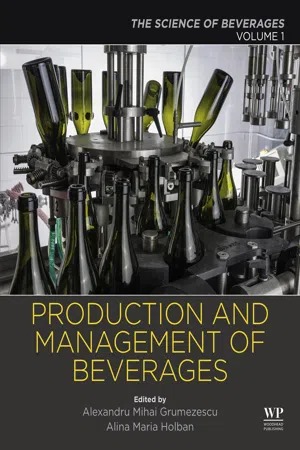
Production and Management of Beverages
Volume 1. The Science of Beverages
- 504 pages
- English
- ePUB (mobile friendly)
- Available on iOS & Android
eBook - ePub
Production and Management of Beverages
Volume 1. The Science of Beverages
About this book
Production and Management of Beverages, Volume One in the Science of Beverages series, introduces the broad world of beverage science, providing an overview of the emerging trends in the industry and the potential solutions to challenges such as sustainability and waste. Fundamental information on production and processing technologies, safety, quality control, and nutrition are covered for a wide range of beverage types, including both alcoholic and nonalcoholic beverages, fermented beverages, cocoa and other powder based beverages and more. This is an essential resource for food scientists, technologists, chemists, engineers, microbiologists and students entering into this field.
- Describes different approaches to waste management and eco-innovative solutions for the wine and beer industry
- Offers information on ingredient traceability to ensure food safety and quality
- Provides overall coverage of hot topics and scientific principles in the production and management of beverages for sustainable industry
Information
1
Managing Metabolic Health Impact of Fructose-Containing Beverages
Ana Djordjevic; Nataša Veličković Institute for Biological Research “Siniša Stanković,” Department of Biochemistry, University of Belgrade, Belgrade, Serbia
Abstract
Fructose has been a part of human diet for centuries, but in the last 50 years the consumption of fructose-sweetened soft drinks has risen significantly and it was associated with prevalence of obesity and metabolic syndrome. Fructose overconsumption leads to enhanced de novo lipogenesis and triglyceride synthesis in the liver, resulting ultimately in the ectopic lipid deposition and hepatosteatosis. However, apart from liver, dietary fructose may also contribute to the development of metabolic syndrome through deregulation of metabolic pathways in the hypothalamus-adipose tissue axis.
In this chapter we summarize the findings on the rat animal model fed with different concentrations of fructose (10% and 60% solutions). The results showed that lower concentration of liquid fructose aggravates hepatic lipid metabolism, while higher fructose load leads to dyslipidemia, visceral adiposity, and leptin resistance, which could be a critical component of the obesity-promoting vicious cycle that results in extreme forms of untreatable obesity.
Keywords
Fructose; Diet; Metabolism; Health; Liver; Adipose tissue; Obesity; Brain
1.1 Historical Perspectives of Sugar Consumption
Sugars have been a part of human diet for centuries. However, our ancestors were hunters and gatherers whose diet was mainly high in protein, moderate in fat, and low in carbohydrates. The main sources of sugars at that time were wild berries, fruits, vegetables, and nuts, which contained different mono- and disaccharides such as glucose, sucrose, and fructose. Sometimes the human diet was supplemented with honey, which consisted mainly of variable amounts of glucose and fructose. After the hunting and gathering period, early agricultures started to grow cereals such as rice, wheat, and corn, while later on they grew potatoes as a rich source of glucose after digestion hydrolysis. With the development of civilization, the main sweetener in many human diets was honey, but it was available only for the wealthy. More intense consumption of sugar coincides with the domestication and production of two important agricultures: sugarcane and sugar beet. Sugarcane was domesticated around 8000 BC in New Guinea and gradually spread to Asia, China, and India, while sugar beet was domesticated around 2000 BC by the Greeks and Romans for both food and medicinal uses (White et al., 2015). Although the history of sugar consumption lasts for almost 10,000 years, the milestone for its worldwide availability was colonial expansion during the last two centuries. The colonial trade secured sugar availability at low cost and further increased its consumption through food industrialization. It was also tightly linked with increased consumption of a variety of sweetened beverages in the 19th century and with sodas at the beginning of the 20th century. The sugar-sweetened beverages generally include soft drinks, fruit drinks, sports drinks, sweetened tea and coffee, rice drinks, sugared milk drinks, and nonalcoholic wines or malt beverages. Their increased intake was related to a high availability in the market and larger portion sizes, leading to the dramatic rise in consumption. Over the last 50 years sugar-sweetened beverages comprised more than 40% of the human diet (Marriott et al., 2009). These beverages have recently received a great deal of attention, because they are the largest source of calories and added sugars for both children and adults in the United States (Malik et al., 2010a).
Importantly, the main source of sugar in beverages is high fructose corn syrup (HFCS), introduced in the food industry in the 1960s as a liquid alternative to sucrose and a partial remedy. The actual fructose content in HFCS could range from 42% to 55%, and the taste and sweetness of 55% HFCS is equivalent to that of sucrose. After the initial introduction its usage underwent rapid growth during the 1980s, because of its high sweetening power, its liquid form that offered handling advantages during production, and its composition, which holds more stability over sucrose especially in acidic beverages. Furthermore, HFCS has the ability to confer a long shelf life and low production cost (Hanover and White, 1993). As previously mentioned, the critical step in sugar overconsumption was related to its introduction to the carbonated-beverage industry. From that point on, fructose became the predominant sweetener in soft drinks (Walker et al., 2014) and by the 1990s, it was well established as a stable and cheap domestic sweetener in the United States, with only sucrose being used more than it (White, 2008).
1.2 Fructose-Enriched Diet and the Obesity Epidemic
In the 1960s, fructose has been shown to have positive effects in the treatment of insulin-dependent diabetes because it does not need insulin to be metabolized. Fructose feeding had no influence on fasting blood glucose and is excreted through the urine (Pelkonen et al., 1972) and, therefore, it was described as a “useful therapeutic agent” for stabilizing blood glucose in diabetic patients (Lambertz et al., 2017). Today, the clinical importance of this sugar is the matter of debate, since it is now recognized as a risk factor for the development of obesity and several metabolic disturbances. Namely, the introduction of corn syrup sweeteners (which nowadays represents over 20% of total daily carbohydrate intake) coincided with a rising obesity epidemic (Bray et al., 2004). As previously stated, increased consumption of a high-caloric modern Western diet rich in sugars, trans-fats, omega-6 fatty acids, and branched-chain amino acids was accused of contributing to the epidemic of metabolic syndrome. The association between nutrition and health was proposed two decades ago when both physicians and scientists found correlation between dietary fat and rising prevalence of obesity (Golay and Bobbioni, 1997). Accordingly, a low-fat diet was introduced and intensively promoted, but surprisingly, this has not reflected in a decline in obesity. Soon after, new evidence suggested that refined sugars substantially contributed to obesity and metabolic diseases (Malik et al., 2010b). Both clinical studies and research on animal models were conducted in order to understand whether dietary fructose intake in beverages pose a significant health risk. Indeed, most of the studies from the first decade of 21st century showed the correlation between a high fructose diet and dyslipidemia in humans (Tappy and Le, 2010), while animal studies indicated that dietary fructose can lead to obesity, insulin resistance, dyslipidemia, high blood pressure, and type 2 diabetes (Jurgens et al., 2005). The general opinion has been that dietary fructose is less satiating and more lipogenic than other sugars. In particular, fructose was identified as a sugar affecting lipid metabolism by rising plasma triglycerides (TGs) and fasting plasma free fatty acids (FFAs). Although fructose consumption through beverages constituted a considerable amount of total daily energy intake, its global annual consumption remained constant or even declined over the last 5 years, while obesity rates seem to increase independent of the changes in beverage intake (Welsh et al., 2011; Ogden et al., 2012). Thus, an important question emerges: is fructose consumption the only culprit for the obesity epidemics and what are the underlying molecular mechanisms of its metabolic effects?
The evidence for negative effects of fructose consumption leading to obesity and related metabolic disorders could be classified into three main categories: (i) data derived from animal models of sugar overfeeding-induced obesity, a...
Table of contents
- Cover image
- Title page
- Table of Contents
- Copyright
- Contributors
- Series Preface
- Preface
- 1: Managing Metabolic Health Impact of Fructose-Containing Beverages
- 2: Technology and Nutritional Value of Powdered Drinks
- 3: Fortification in Beverages
- 4: Management of Plant-Derived Beverages of North-East India: A Traditional Approach
- 5: Fruit Agroindustrial Wastes for Preparing Beverages for Medicinal Purposes by Supercritical Fluid Extraction Technology: Andes Berry (Rubus glaucus benth) Case
- 6: Tracing Fruits and Vegetables from Farm to Fork: Questions of Novelty and Efficiency
- 7: Hydrodynamic Cavitation-Assisted Processing of Vegetable Beverages: Review and the Case of Beer-Brewing
- 8: Kombucha Drink: Production, Quality, and Safety Aspects
- 9: Molle Beer Production in the Ayacucho Valley, Peru
- 10: Profiling Beer Consumers for Brewery Management
- 11: Sugarcane Spirits (Cachaça) Quality Assurance and Traceability: An Analytical Perspective
- 12: Wine Consumption in a Certain Territory. Which Factors May Have Impact on It?
- 13: Alcoholic Beverage Production in Indochina: Local Wisdom, Safety, Quality, and Legal Control
- 14: Production of Fermented Beverages: Shedding Light on Indian Culture and Traditions
- 15: Industry 4.0: The Smart Factory of the Future in Beverage Industry
- Index
Trusted by 375,005 students
Access to over 1.5 million titles for a fair monthly price.
Study more efficiently using our study tools.
Frequently asked questions
Yes, you can cancel anytime from the Subscription tab in your account settings on the Perlego website. Your subscription will stay active until the end of your current billing period. Learn how to cancel your subscription
No, books cannot be downloaded as external files, such as PDFs, for use outside of Perlego. However, you can download books within the Perlego app for offline reading on mobile or tablet. Learn how to download books offline
Perlego offers two plans: Essential and Complete
- Essential is ideal for learners and professionals who enjoy exploring a wide range of subjects. Access the Essential Library with 800,000+ trusted titles and best-sellers across business, personal growth, and the humanities. Includes unlimited reading time and Standard Read Aloud voice.
- Complete: Perfect for advanced learners and researchers needing full, unrestricted access. Unlock 1.5M+ books across hundreds of subjects, including academic and specialized titles. The Complete Plan also includes advanced features like Premium Read Aloud and Research Assistant.
We are an online textbook subscription service, where you can get access to an entire online library for less than the price of a single book per month. With over 1.5 million books across 990+ topics, we’ve got you covered! Learn about our mission
Look out for the read-aloud symbol on your next book to see if you can listen to it. The read-aloud tool reads text aloud for you, highlighting the text as it is being read. You can pause it, speed it up and slow it down. Learn more about Read Aloud
Yes! You can use the Perlego app on both iOS and Android devices to read anytime, anywhere — even offline. Perfect for commutes or when you’re on the go.
Please note we cannot support devices running on iOS 13 and Android 7 or earlier. Learn more about using the app
Please note we cannot support devices running on iOS 13 and Android 7 or earlier. Learn more about using the app
Yes, you can access Production and Management of Beverages by Alexandru Grumezescu,Alina Maria Holban in PDF and/or ePUB format, as well as other popular books in Technology & Engineering & Food Science. We have over 1.5 million books available in our catalogue for you to explore.