eBook - ePub
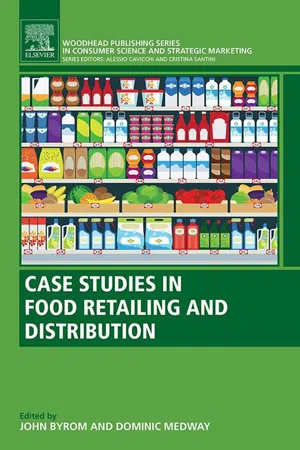
Case Studies in Food Retailing and Distribution
- 322 pages
- English
- ePUB (mobile friendly)
- Available on iOS & Android
eBook - ePub
Case Studies in Food Retailing and Distribution
About this book
Case Studies in Food Retailing and Distribution aims to close the gap between academic researchers and industry professionals through the presentation of 'real world' scenarios and the application of field-based research. The book provides contemporary explorations of food retailing and consumption from various contexts around the globe.
Using a case study lens, successful examples of practice are provided and areas for further theoretical investigation are offered.
Coverage includes:
- the impact of retail concentration and the ongoing relevance of independent retailing
- how social forces impact upon food retailing and consumption
- trends in organic food retailing and distribution
- discussion of how wellbeing and sustainability have impacted the sector
- perspectives on the future of food retailing and distribution
This book is a volume in the Consumer Science and Strategic Marketing series.
- Addresses business problems in in food retail and distribution
- Includes pricing and supply chain management
- Discusses food retailing in urban and rural settings
- Covers both global distribution and entry in developing nations
- Features real-world case studies that demonstrate what does and does not
Information
Subtopic
Scienze dell'alimentazione1
Community building strategies of independent cooperative food retailers
Morven G. McEachern1 and Gary Warnaby2, 1Huddersfield Business School, University of Huddersfield, United Kingdom, 2Institute of Place Management, Manchester Metropolitan University, United Kingdom
Abstract
Academic literature on food retailing has tended to focus on the larger retail multiples, with less attention paid to the small independent retailer. Of the few studies which focus on independent food retailers, academic interest has concentrated on rural retailing. This has left a significant gap in academic inquiry relating to the community-based retail aspects of urban food retailing. This chapter provides a unique insight into the urban independent cooperative food retailer and their complex links between community, place, and social relations. Through a contrasting case-type approach, we extend the concept of community retailing from a sole focus of the local immediate community, to include also a community of values and a supply chain community, thus suggesting a much broader, more diffuse spatiality and ethicality beyond that of the immediate locale.
Keywords
Community; retailing; cooperatives; values; independent retailers; food
Acknowledgment
This study was funded by The Academy of Marketing Research Initiative Fund (2015–16).
1.1 Introduction
The UK retail marketplace has faced continual change and disruption (Fernie, Fernie, & Moore, 2015). However, academic literature discussing these developments in the context of food retailing has tended to focus on the larger retail multiples (e.g., Burt & Sparks, 2003; Clarke, 2000; Wrigley, 1994), ignoring the fact that many small independent retailers outperform larger companies in terms of sales growth (Goodfellow, 2014). Where attention has fallen on independent food retailers, it has often been in a rural context (e.g., Byrom, Medway, & Warnaby, 2001; Byrom, Medway, & Warnaby, 2003), typically highlighting their social role(s). This has left a significant gap in academic inquiry relating to the community-based retail aspects of urban food retailing, which we explore from the perspective of independent cooperative retailers. Thus, a unique insight into the urban independent cooperative food retailer and their complex links between community, place, and social relations are advanced here. This chapter first considers the empirical literature surrounding independent food retailers and their respective communities, before illustrating our key findings and conclusions.
1.2 The independent retailer: Problems and prospects
The major focus of the limited literature on the small independent retailer, to date, relates to the perceived disadvantages of this retail form vis-à-vis its multiple retailer counterparts (see Clarke & Banga, 2011). Smith and Sparks (2000) summarize the problems and difficulties faced by small retailers in terms of:
- • Inadequacies in the trading environment—i.e., competition from multiple retailers, economic and social change to the detriment of the small retailer, and locational difficulties in terms of spatial marginalization.
- • Inadequacies in the retail form—i.e., a less efficient and effective operating cost base than larger formats, lack of availability of investment capital, supply problems (e.g., lack of economies of scale etc.); all of which compound the above changes in the trading environment.
- • Inadequacies in management—i.e., limited expertise in, and knowledge of, management techniques.
Consequently, a major focus of existing research has been on reasons for their decline (see Coca-Stefaniak, Hallsworth, Parker, Bainbridge, & Yuste, 2005), and how it might be arrested, either through policy intervention (see Clarke & Banga, 2011; Kirby, 1981) or strategic action on the part of retailers themselves (see Megicks, 2001; Megicks & Warnaby, 2008). However, much of this research has a rural (and isolated), rather than urban, context; for example, in terms of investigating how the drawbacks of operating in peripheral areas and regions can be overcome (see Byrom et al., 2001, 2003; Jussila, Lotvonen, & Tykkyläinen, 1992). Later work on their community role (see Calderwood & Davies, 2012, 2013) reflects the fact that small retailers are more likely to be located in more rural areas.
In light of such difficulties, the continuance of small independent retailers may depend on their ability to perform various roles. Smith and Sparks (2000) posit that these include:
- • Consumer supply of products and services—which may occur in a variety of contexts, ranging from isolated areas, where small independents may be the only shops available, and thus used for all purchases; to circumstances where the small shop is a “destination” shop, arising from a particular product/service specialism.
- • Diversity, “color,” and choice—arising from such specialism, and the fact that small retailers might offer an alternative, nonstandard format and customer offer in contrast to the homogeneity of a retail landscape dominated by multiple retailers.
- • Dynamism and local adaption—arising from the fact that small independents are often a source of retail innovation. Smith and Sparks note that the ease of entry/exit in this sector can create volatility and dynamism; the latter aspect manifest in better understanding of local markets and appreciation of customer requirements.
- • Economic linkages with other businesses—via the supply chains that provide the products sold by small retailers. Smith and Sparks stress that such linkages also arise from the fact that small retailers also consume a range of other products/services (including public services such as refuse collection etc.), which are more likely to be locally oriented.
- • Employment generation and maintenance—especially self-employment, as the small shop may be a seed-bed for entrepreneurship.
A key factor is the extent to which small independent retailers can develop distinctive competence, which might enable them to achieve some degree of competitive advantage (or merely survive). Small independent retailer strategies have been investigated in detail by Megicks (2001), who identifies five generic competitive strategy types:
- • Buying group merchants—i.e., members of larger buying groups who act as traditional merchants, assembling and merchandising stock lines and delivering them with a service level tailored to the needs of their identified customer base.
- • Full-service strategists—i.e., demonstrating a strong customer focus and growing through diversifying activities into new products/markets, as well as service improvements. They are more proactive in marketing activities.
- • Specialist vendors—i.e., conventional retailers of specialist goods, with a strong emphasis on merchandising and providing high levels of service and unique, quality products.
- • Indistinct traders—i.e., “distinguished by a lack of distinction” (p. 323), lacking real initiative, and not particularly active in pursuing growth opportunities.
- • Free-standing merchants—i.e., similar to buying group merchants in strategic orientation and modus operandi, but not part of buying groups, and therefore more autonomous.
This literature emphasizes the importance of market orientation (see Megicks & Warnaby, 2008), which resonates with some issues identified above, in that effectively responding to a more detailed understanding of the needs of a locally oriented customer base may be a source of competitive advantage. Byrom et al. (2003) imply that such local embeddedness and the consequent knowledge gained could be a source of both market-and product-led strategic expansion strategies. However, resonating with Megicks’ grouping of “indistinct traders,” Byrom et al., also identify a strategy of “strategic stasis,” whereby the primary aim is to maintain the status quo in terms of customer base, turnover, and profit (perhaps reflecting the extent of the difficulties facing these retailers, as outlined above).
1.3 The independent retailer and their role in the local community
Given the importance of local knowledge and adaptation to the small independent retailer, and their widely acknowledged “social” role (Calderwood & Davies, 2012; Clarke & Banga, 2011; Smith & Sparks, 2000), could the community-run or small cooperative shop be an independent retail form more able to mitigate the negative impact of trends that have led to the decline of the small independent retailer more generally? Arguably, the retail cooperative movement provides a sustainable retail format for small food retailers, and one which can be pursued either as a retailers’ buying group, retailers’ cooperative, and/or a retailers’ cooperative retail chain (Kennedy, 2016). However, much research around retail cooperation as a strategy for independent retailers ignores the importance of the community-led, “social” role advocated by Clarke and Banga (2011) and Smith and Sparks (2000). This is despite the fact that the retail sector cannot be fully understood without reflecting upon the “interrelated systems of which it is a part” (McArthur, Weaven, & Dant, 2016, p. 281). That is to say, the place providing a spatial context, and the community relations inherent within, is paramount to the retailer’s success.
Smith and Sparks (2000, p. 208) note, “an independent small shop may also provide a sense of community or identity both for a place and for its inhabitants”. Aside from the exceptions listed above (albeit their social focus revolves around a rural location), few retail studies acknowledge this observation and consequently, community aspects have generally been treated as an “exogenous part of the environment” where in fact, the community should be recognized as being “completely endogenous to the enterprise” (Peredo and Chrisman, 2006, p. 310). Clarke and Banga (2011) explore this social role of the small retailer further, identifying four key aspects:
- • A “hub” for communities—by providing an arena for social interaction, thereby helping to meet a variety of social, sustainability, and ethical needs (Megicks, 2007), through the facilitation of relationship-building, and creating emotional connections in a friendly environment.
- • Vital for the disadvantaged and soc...
Table of contents
- Cover image
- Title page
- Table of Contents
- Copyright
- Contributor biographies
- Series Preface
- The changing nature of food retailing and distribution: Using one case to understand many
- 1. Community building strategies of independent cooperative food retailers
- 2. Disrupting the giants: How independent grocers respond to the supermarket duopoly in Tasmania, Australia
- 3. The effect of concentration of retail power on the specialist knowledge of retail staff in the food and beverage sector: A case study of wine retail
- 4. TazeDirekt.com: Branding charm or operational basics?
- 5. Factors influencing consumers’ supermarket visitation in developing economies: The case of Ghana
- 6. The home as a consumption space: Promoting social eating
- 7. Supply chain analysis of farm-to-restaurant sales: A comparative study in Vancouver and Christchurch
- 8. The new institutional economics (NIE) approach to geographical indication (GI) supply chains: A case study from Turkey
- 9. Patanjali Ayurved Limited: Driving the ayurvedic food product market
- 10. Organic innovation: The growing importance of private label products in the United States
- 11. Food retailing: Malaysian retailers’ perception of and attitude toward organic certification
- 12. Inclusive food distribution networks in subsistence markets
- 13. Food, health, and data: Developing transformative food retailing
- 14. Building consumer trust and satisfaction through sustainable business practices with organic supermarkets: The case of Alnatura
- 15. Spices of the future: Forecasting the future of food retailing and distribution with patent analysis techniques
- 16. (No) time to cook: Promoting meal-kits to the time-poor consumer
- 17. Supermarkets, television cooking shows, and integrated advertising: New approaches to strategic marketing and consumer engagement
- 18. Premium private labels (PPLs): From food products to concept stores
- Index
Trusted by 375,005 students
Access to over 1.5 million titles for a fair monthly price.
Study more efficiently using our study tools.
Frequently asked questions
Yes, you can cancel anytime from the Subscription tab in your account settings on the Perlego website. Your subscription will stay active until the end of your current billing period. Learn how to cancel your subscription
No, books cannot be downloaded as external files, such as PDFs, for use outside of Perlego. However, you can download books within the Perlego app for offline reading on mobile or tablet. Learn how to download books offline
Perlego offers two plans: Essential and Complete
- Essential is ideal for learners and professionals who enjoy exploring a wide range of subjects. Access the Essential Library with 800,000+ trusted titles and best-sellers across business, personal growth, and the humanities. Includes unlimited reading time and Standard Read Aloud voice.
- Complete: Perfect for advanced learners and researchers needing full, unrestricted access. Unlock 1.5M+ books across hundreds of subjects, including academic and specialized titles. The Complete Plan also includes advanced features like Premium Read Aloud and Research Assistant.
We are an online textbook subscription service, where you can get access to an entire online library for less than the price of a single book per month. With over 1.5 million books across 990+ topics, we’ve got you covered! Learn about our mission
Look out for the read-aloud symbol on your next book to see if you can listen to it. The read-aloud tool reads text aloud for you, highlighting the text as it is being read. You can pause it, speed it up and slow it down. Learn more about Read Aloud
Yes! You can use the Perlego app on both iOS and Android devices to read anytime, anywhere — even offline. Perfect for commutes or when you’re on the go.
Please note we cannot support devices running on iOS 13 and Android 7 or earlier. Learn more about using the app
Please note we cannot support devices running on iOS 13 and Android 7 or earlier. Learn more about using the app
Yes, you can access Case Studies in Food Retailing and Distribution by John Byrom,Dominic Medway, Alessio Cavicchi,Cristina Santini in PDF and/or ePUB format, as well as other popular books in Tecnologia e ingegneria & Scienze dell'alimentazione. We have over 1.5 million books available in our catalogue for you to explore.