eBook - ePub
Palm Oil
Production, Processing, Characterization, and Uses
- 852 pages
- English
- ePUB (mobile friendly)
- Available on iOS & Android
eBook - ePub
Palm Oil
Production, Processing, Characterization, and Uses
About this book
Palm Oil: Production, Processing, Characterization, and Uses serves as a rich source of information on the production, processing, characterization and utilization of palm oil and its components. It also includes several topics related to oil palm genomics, tissue culture and genetic engineering of oil palm. Physical, chemical and polymorphic properties of palm oil and its components as well as the measurement and maintenance of palm oil quality are included and may be of interest to researchers and food manufacturers. General uses of palm oil/kernel oil and their fractions in food, nutritional and oleochemical products are discussed as well as the potential use of palm oil as an alternative to trans fats. Some attention is also given to palm biomass, bioenergy, biofuels, waste management, and sustainability.
- Presents several chapters related to oil palm genetics, including oil palm genomics, tissue culture and genetic engineering.
- Includes contributions from more than 80 well-known scientists and researchers in the field.
- In addition to chapters on food uses of palm oil, the book contains nonfood applications such as use as a feedstock for wood-based products or for bioenergy.
- Covers key aspects important to the sustainable development of palm oil.
Information
1
A Brief History of the Oil Palm
Ian E. Henson, 7 Richmond Dale, Clifton, Bristol BS8 2UB, UK
Introduction
The African oil palm (Elaeis guineensis Jacq.) has been utilized by mankind as a source of oil and other products for thousands of years. In the last 50 years or so there has been a phenomenal expansion in its cultivation throughout the tropics, such that palm oil is now a major commodity of world trade, and the oil palm is a leading source of vegetable oil. This chapter traces the history of the African oil palm and its relatives in terms of its origins, evolution, distribution, and utilization; reviews the growth of the palm oil industry; and examines the progress made in enhancing production through selective breeding, improved cultivation practices and exploitation of optimum environments that together have resulted in progressive and substantial yield increases in this most productive of all oil-bearing crops.
History is often largely a matter of conjecture to the extent that it led Henry Ford (1916) to describe it as “more or less bunk”. Certainly there is a need for careful interpretation of past records and available evidence, but this often generates opposing views and ideas. In the case of the African oil palm, Elaeis guineensis, and its relatives, while there is much documented evidence concerning its development as a major crop, there are nevertheless a number of uncertainties regarding its origins and distribution.
Perhaps the most comprehensive account of oil palm history is found in the classic work, The Oil Palm. It is now in its 4th edition, the first three of which are by Hartley and appeared in 1967, 1977, and 1988; and the fourth, by Corley & Tinker, was published in 2003. In these volumes one finds detailed reviews of the origins of the African and American oil palms, their spread, and the development of the oil palm industry in various parts of the tropics. No attempt will be made here to emulate these exhaustive and seminal treatments of the subject, which the reader needing further information is advised to consult. Rather, an attempt is made to summarize the more prominent events and developments in the history of the oil palm and highlight points of uncertainty that remain such as those concerning origins, taxonomic relationships, and geographical dispersal.
Taxonomy, Origins and Distribution of Oil Palms
Taxonomy and Classification
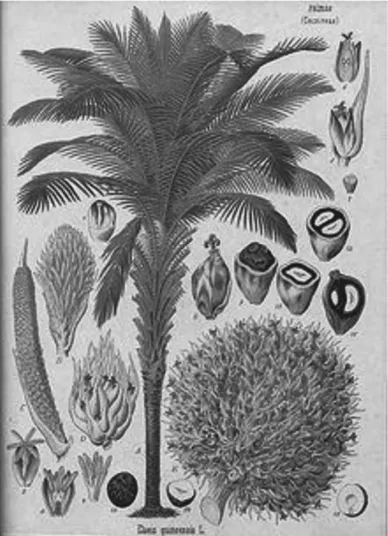
Three species of palm are currently accepted as belonging to the genus Elaeis, which is one of a number of genera within the sub-family Arecoideae of the family Arecaceae (formerly known as Palmaceae) (Box 1.1). The major oil palm of commerce, the African oil palm (E. guineensis Jacq.) (Fig. 1.1), was formally named as such by Jacquin in 1763 based on specimens collected in Martinique. The naming and classification of the species has been retained since that time, despite numerous synonyms having been proposed (Schultes, 1990). Its origin on the Guinea coast of West Africa had been attested to as early as the late 16th century (Lobelius, 1570, 1576, 1581).
The classification of the remaining species of Elaeis has proved more contentious. The American oil palm, now known as E. oleifera (HBK), Cortes has been considered variously as being either (1) a form of E. guineensis, (2) a separate species within the genus Elaeis, or (3) a member of the genus Corozo [Described by Bailey (1940) as being “transferred” from the earlier Alfonsia oleifera of Humbolt, Bonpland, and Kunth (HBK) (Hartley, 1977)]. Its formal description by Cortes as E. oleifera dates from 1897.
E. oleifera was initially known as E. melanococca and considered to be a form of E. guineensis (Corl...
Table of contents
- Cover image
- Title page
- Table of Contents
- Copyright
- Preface
- Chapter 1: A Brief History of the Oil Palm
- Chapter 2: Breeding and Genetics of the Oil Palm
- Chapter 3: Oil Palm Genomics
- Chapter 4: Tissue Culture and Genetic Engineering of Oil Palm
- Chapter 5: Ripening, Harvesting, and Transport of Oil Palm Bunches
- Chapter 6: Effect of Pests and Diseases on Oil Palm Yield
- Chapter 7: The Economics of Malaysian Palm Oil Production, Marketing, and Utilization
- Chapter 8: Palm and Palm Kernel Oil Production and Processing in Malaysia and Indonesia
- Chapter 9: Palm and Palm Kernel Oil Production and Processing in Brazil
- Chapter 10: Palm and Palm Kernel Oil Production and Processing in Nigeria
- Chapter 11: Oil Recovery from Palm Fruits and Palm Kernel
- Chapter 12: Palm Oil and Palm Kernel Oil Refining and Fractionation Technology
- Chapter 13: The Physicochemical Properties of Palm Oil and Its Components
- Chapter 14: Polymorphic Properties of Palm Oil and Its Major Component Triacyglycerols
- Chapter 15: Measurement and Maintenance of Palm Oil Quality
- Chapter 16: Minor Constituents of Palm Oil: Characterization, Processing, and Application
- Chapter 17: Enzymatic and Chemical Modification of Palm Oil, Palm Kernel Oil, and Its Fractions
- Chapter 18: Health and Nutritional Properties of Palm Oil and Its Components
- Chapter 19: Food Uses of Palm Oil and Its Components
- Chapter 20: Palm Oleochemicals in Non-food Applications
- Chapter 21: Oil Palm Biomass for Various Wood-based Products
- Chapter 22: Oil Palm as Bioenergy Feedstock
- Chapter 23: Waste and Environmental Management in the Malaysian Palm Oil Industry
- Chapter 24: Traceability of RSPO-certified Sustainable Palm Oil
- Chapter 25: Sustainable Development of Palm Oil Industry
- Editors and Contributors
- Index
Trusted by 375,005 students
Access to over 1.5 million titles for a fair monthly price.
Study more efficiently using our study tools.
Frequently asked questions
Yes, you can cancel anytime from the Subscription tab in your account settings on the Perlego website. Your subscription will stay active until the end of your current billing period. Learn how to cancel your subscription
No, books cannot be downloaded as external files, such as PDFs, for use outside of Perlego. However, you can download books within the Perlego app for offline reading on mobile or tablet. Learn how to download books offline
Perlego offers two plans: Essential and Complete
- Essential is ideal for learners and professionals who enjoy exploring a wide range of subjects. Access the Essential Library with 800,000+ trusted titles and best-sellers across business, personal growth, and the humanities. Includes unlimited reading time and Standard Read Aloud voice.
- Complete: Perfect for advanced learners and researchers needing full, unrestricted access. Unlock 1.5M+ books across hundreds of subjects, including academic and specialized titles. The Complete Plan also includes advanced features like Premium Read Aloud and Research Assistant.
We are an online textbook subscription service, where you can get access to an entire online library for less than the price of a single book per month. With over 1.5 million books across 990+ topics, we’ve got you covered! Learn about our mission
Look out for the read-aloud symbol on your next book to see if you can listen to it. The read-aloud tool reads text aloud for you, highlighting the text as it is being read. You can pause it, speed it up and slow it down. Learn more about Read Aloud
Yes! You can use the Perlego app on both iOS and Android devices to read anytime, anywhere — even offline. Perfect for commutes or when you’re on the go.
Please note we cannot support devices running on iOS 13 and Android 7 or earlier. Learn more about using the app
Please note we cannot support devices running on iOS 13 and Android 7 or earlier. Learn more about using the app
Yes, you can access Palm Oil by Oi-Ming Lai,Chin-Ping Tan,Casimir C. Akoh in PDF and/or ePUB format, as well as other popular books in Technology & Engineering & Agribusiness. We have over 1.5 million books available in our catalogue for you to explore.