eBook - ePub
Environmental Nutrition
Connecting Health and Nutrition with Environmentally Sustainable Diets
- 354 pages
- English
- ePUB (mobile friendly)
- Available on iOS & Android
eBook - ePub
Environmental Nutrition
Connecting Health and Nutrition with Environmentally Sustainable Diets
About this book
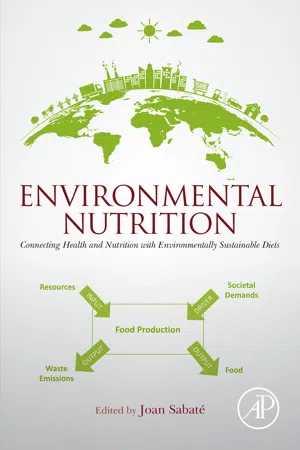
Environmental Nutrition: Connecting Health and Nutrition with Environmentally Sustainable Diets explores the connection between diet, environmental sustainability and human health. Current food systems are a major contributor to our most pressing health and environmental issues, including climate change, water scarcity, food insecurity and chronic diseases. This book not only seeks to increase our understanding of the interrelatedness of these major global issues, but also aids in the creation of new solutions. Sections discuss the diet, the health and environment trilemma, food systems and their trends, environmental nutrition as an all-encompassing discipline, and the environmental nutrition model.
- Demonstrates how the food system, the environment and human health are inter-related
- Explores how dietary patterns impact food production and agriculture choices
- Identifies the imbalance between current food production relative to demand
- Addresses how the current food system negatively impacts the environment
- Provides practical solutions to how diets can be both healthy and sustainable
Trusted by 375,005 students
Access to over 1.5 million titles for a fair monthly price.
Study more efficiently using our study tools.
Information
Part 1
Introduction
Chapter 1
The diet, health, and environment trilemma
Irana W. Hawkins
Abstract
During the past century, human activity has stressed and pushed the limits of the natural environment while food systems and food choices became a major contributor to environmental degradation and poor health outcomes. This chapter will discuss the nexus and challenges posed as diet, the environment and human health intersect. First, the excessive use of natural resources that are consumed before they can be naturally replenished within a year’s time will be discussed. An overview of our planetary boundaries will follow where an emphasis is placed on the role of industrialized agriculture in biodiversity loss, land use changes, water and energy use, and nitrogen and phosphorus pollution. Next, the role of food systems and the burden of diet-related chronic diseases will be delineated that includes obesity, type 2 diabetes, cardiovascular diseases, cancer, and antibiotic resistance.
Keywords
Industrialized food system; Diet-environment-health trilemma; Undernutrition; Diet-related chronic diseases; Biodiversity; Ecological overshoot
Introduction
During the past century, human activity has stressed and pushed the limits of the natural environment while food systems and food choices became a major contributor to environmental degradation and poor health outcomes. The industrialized food system along with food choices—whether they are intentional or a consequence of policies or food environments—critically and simultaneously impact the health and well-being of individuals and the natural environment. Hence, the term “diet-environment-health trilemma” has been used to draw attention to the quandaries created by these seemingly disparate entities (Tilman and Clark, 2014).
Though the industrialized food system has contributed more calories for consumption over time (World Health Organization [WHO] and Food and Agriculture Organization [FAO], 2002), 800 million people suffer from undernutrition (United Nations Systems Standing Committee on Nutrition [UNSSCN], 2017). One hundred and fifty-nine (159) million children in the world under 5 years of age have stunted growth patterns, while 50 million are wasted (UNSSCN, 2017). Conversely, nearly 2 billion people on the planet are overweight and 500 million are obese (UNSSCN, 2017). Globally, heart disease and stroke—both diet-related chronic diseases—are the leading causes of mortality (WHO, 2017a, b, c, d, e). Type 2 diabetes and obesity are chronic diseases that can be prevented and ameliorated with a healthful diet along with physical activity—but have reached epidemic levels (Chen et al., 2012; McMacken and Shah, 2017; The 2015 Global Burden of Disease Collaborators, 2017; Turner-McGrievy et al., 2017).
Eating in excess of one's energy needs not only contributes to obesity and related comorbidities such as type 2 diabetes and hypertension—but also to greenhouse gas emissions and excessive resource use (Walpole et al., 2012; Underwood and Zahran, 2016). The industrialized food system contributes to biodiversity loss, deforestation, the degradation of land and soil, climate change, eutrophication, dead zones, and food insecurity (FAO, 2006). Climate change in turn negatively impacts public health in numerous ways and includes, but is not limited to, the increased intensity, duration, and frequency of wildfires; drought; sea level rise; extreme weather events including extreme heat, extreme precipitation, and flooding; increased vector-borne diseases; degraded water and air quality; increased allergens; and food insecurity (American Public Health Association, 2017). Excessive heat and extreme weather events in turn negatively impact crops, animal agriculture, and fisheries (Melillo et al., 2014).
This chapter will discuss the nexus and challenges posed by the diet-environment-health trilemma. First, the concept of “ecological overshoot,” or the excessive use of natural resources that are consumed before they can be naturally replenished within a year's time will be discussed (World Wildlife Fund for Nature, 2017). An overview of our planetary boundaries will follow where an emphasis is placed on the role of industrialized agriculture in biodiversity loss, land use changes, water and energy use, and nitrogen and phosphorus pollution. Next, the role of food systems and the burden of diet-related chronic diseases will be delineated that includes obesity, type 2 diabetes, cardiovascular diseases, cancer, and antibiotic resistance. Altogether, the diet-environment-health trilemma not only contributes to jeopardizing our “safe operating space on the planet” (Steffen et al., 2015a), but impacts the quality and longevity of human lives too.
The increased use of natural resources
As a species, humans have been successful in the ability to procreate and survive. It took thousands of years for the human population to reach 1 billion—but only 200 years to reach 7 billion (American Museum of Natural History, 2016). The global population stands at 7.6 billion people and is projected to increase to, 9.8 billion by 2050, and 11.2 billion by 2100, respectively (United Nations, 2017). Life expectancy is expected to rise globally from 71 years of age (2014–2015) to 77 by 2045–2050 (United Nations, 2017). It is estimated that there are 83 million more people on the planet every year, with 60% of the world's population living in Asia, followed by 17% in Africa, 10% in Europe, 9% in Latin America and the Caribbean, and 6% in North America and Oceana, respectively (United Nations, 2017). China and India are the most populous countries in the world at 1.4 and 1.3 billion people, respectively (United Nations, 2017). Those living in the least developed countries (48 countries including island nations) comprised 13% of the global population in 2015 and will grow to 20% of the global population by 2050 (United Nations, 2016). The number of persons displaced by conflict continues to rise as an unprecedented 65 million were displaced in 2016 (United Nations High Commissioner for Refugees, 2017).
With a growing population and with populations that face economic strife and tragic hardships, it is critical to protect natural resources and the integrity of the Earth System. Reducing population growth as a strategy to control resource utilization may not offer the expediency necessary to protect ecosystems and natural resources (Bradshaw and Cook, 2014). Therefore, strategies to reduce anthropogenic impact on the natural environment must also include conserving and reducing the use of resources altogether—along with a paradigm shift to renewable energy sources and changes to the industrialized food system (Bradshaw and Cook, 2014; Pelletier and Tyedmers, 2010).
Additionally, where a child is born is important in determining its lifetime contribution to resource consumption and greenhouse gas emissions. The carbon legacy of a child born in the United States (based on average carbon dioxide emissions/equivalents per person per year) is estimated at 4.5 times that of a child born in Japan, 7 times that of a child born in China, 85 times that of a child born in Nigeria, and 168 times that of a child born in Bangladesh (Murtaugh and Schlax, 2009).
Ecological overshoot
It is obvious that humans cannot live without water and food and that our lives are compromised without the resources of the Earth that provide medicines, shelter, and necessary textiles. However, the rate at which humans are excessively using and degrading the Earth's biocapacity is alarming. Over the past 46 years, humanity has been using more resources altogether—and more resources than can be naturally replenished in a year, which has been coined “Earth Overshoot” (Global Footprint Network, 2017a). Unfortunately, “Earth Overshoot Day” happens sooner each year: August 2, 2017; August 4, 2015; August 15, 2007; November 27, 1973; and December 21, 1971 (Global Footprint Network, 2017b). However, comparing dates over time may be less effective than understanding the gravity and totality of the biomass that's being used (Global Footprint Network, 2017b). As supply cannot keep up with demand, humans are outstripping the regenerative biocapacity of natural resources by 50% as a result of increased land use, habitat transformation, habitat fragmentation, destructive agriculture and forestry practices, creating infrastructure, overusing ecosystems, overexploiting species due to hunting and overfishing, introducing invasive species that compete with and eliminate endemic species, and climate change (Galli et al., 2014).
The Anthropocene
The “Anthropocene” is a geological and ecological term used to describe the current era where the Earth System has been domineered by humans such that natural forces have been disturbed to a point of uncertainty—as well as the negative outcomes that will impact future generations (Steffen et al., 2007). The Anthropocene has been divided into two phases: The Industrial Era (1800–1945), and the second stage known as the “Great Acceleration” from 1945 to 2010 (Steffen ...
Table of contents
- Cover image
- Title page
- Table of Contents
- Copyright
- Contributors
- Preface
- Acknowledgments
- Prologue
- Part 1: Introduction
- Part 2: Global Challenges for Environmental Nutrition
- Part 3: Tools and Approaches
- Part 4: Defining Healthy and Sustainable Diets and their Potential to Address Environmental Nutrition Challenges
- Index
Frequently asked questions
Yes, you can cancel anytime from the Subscription tab in your account settings on the Perlego website. Your subscription will stay active until the end of your current billing period. Learn how to cancel your subscription
No, books cannot be downloaded as external files, such as PDFs, for use outside of Perlego. However, you can download books within the Perlego app for offline reading on mobile or tablet. Learn how to download books offline
Perlego offers two plans: Essential and Complete
- Essential is ideal for learners and professionals who enjoy exploring a wide range of subjects. Access the Essential Library with 800,000+ trusted titles and best-sellers across business, personal growth, and the humanities. Includes unlimited reading time and Standard Read Aloud voice.
- Complete: Perfect for advanced learners and researchers needing full, unrestricted access. Unlock 1.5M+ books across hundreds of subjects, including academic and specialized titles. The Complete Plan also includes advanced features like Premium Read Aloud and Research Assistant.
We are an online textbook subscription service, where you can get access to an entire online library for less than the price of a single book per month. With over 1.5 million books across 990+ topics, we’ve got you covered! Learn about our mission
Look out for the read-aloud symbol on your next book to see if you can listen to it. The read-aloud tool reads text aloud for you, highlighting the text as it is being read. You can pause it, speed it up and slow it down. Learn more about Read Aloud
Yes! You can use the Perlego app on both iOS and Android devices to read anytime, anywhere — even offline. Perfect for commutes or when you’re on the go.
Please note we cannot support devices running on iOS 13 and Android 7 or earlier. Learn more about using the app
Please note we cannot support devices running on iOS 13 and Android 7 or earlier. Learn more about using the app
Yes, you can access Environmental Nutrition by Joan Sabate in PDF and/or ePUB format, as well as other popular books in Technology & Engineering & Food Science. We have over 1.5 million books available in our catalogue for you to explore.