eBook - ePub
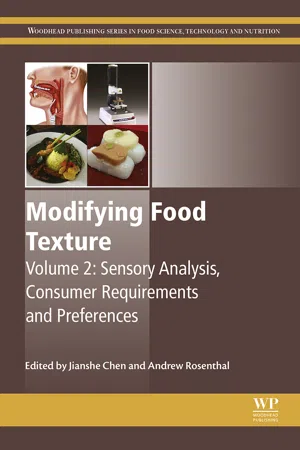
Modifying Food Texture
Volume 2: Sensory Analysis, Consumer Requirements and Preferences
- 300 pages
- English
- ePUB (mobile friendly)
- Available on iOS & Android
eBook - ePub
Modifying Food Texture
Volume 2: Sensory Analysis, Consumer Requirements and Preferences
About this book
Modifying Food Texture, Volume 2: Sensory Analysis, Consumer Requirements and Preferences explores texture as an important aspect of consumer food acceptance and preference, specifically addressing the food textural needs of infants, the elderly, and dysphagia patients.
This volume covers the sensory analysis of texture-modified foods, taking an in-depth look at the product development needs of consumers and exploring the sensory analysis of food texture and the development of texture-modified foods.
- Explores texture as an important aspect of consumer food acceptance and preference
- Addresses the food textural needs of special groups, including infants, the elderly, and dysphagia patients
- Takes an in-depth look at the product development needs of consumers, exploring the sensory analysis of food texture
Information
Part One
Sensory analysis and consumer preference of food texture
1
Vocabularies and terminologies of food texture description and characterisation
F. Hayakawa National Food Research Institute, NARO, Tsukuba, Japan
Abstract
This chapter reviews studies of texture terms/lexicon and discusses issues and problems concerned with texture vocabularies for food texture appreciation. Texture terms can be classified by two kinds of strategies: categories defined by researchers and categories derived from panellists' responses. Both strategies have their pros and cons. Discussion will focus on how texture terms are classified in different languages and on the implications to food manufacturers and consumers in a global market. The chapter will also explore comparison of texture vocabularies among different cultures and languages.
Keywords
Texture terms
Texture lexicon
Descriptive sensory analysis
Cross-cultural comparison
1.1 Introduction
Texture is a sensory property and comprises multi-parameter attributes (Szczesniak, 2002). Thus, it is essential to understand the structure of texture vocabularies and hierarchy of texture terms so that consumers' appreciation of and preference for food texture can be appropriately explored for better food design. Without precise description and understanding of texture features, R&D researchers in food design and formulation will not be able to directly address consumers' texture concerns. Another factor of critical importance to texture terms and hierarchy is their use in instrumental characterisation of food texture. Without appropriate descriptive terms, it will be very difficult to give objectively measured physical parameters a sensory meaning and such measurements will become irrelevant to consumers' perception.
Indeed, vocabularies and terminologies of texture are also important in sensory evaluation. Experimenters or panel leaders dedicate their efforts to selecting and defining appropriate terms as descriptors for precision and validity of their sensory evaluation. In selecting these descriptors, more careful consideration is needed for texture attributes than for flavour because setting a reference sample for a texture attribute may be more difficult than for flavour attributes. For example, we can use sucrose solution as a reference for sweetness. The intensity of reference can be easily controlled by changing its concentration. Since panellists can assess sweetness in reference to the sucrose solution, their disagreement on the nuance of the descriptor is usually small. In contrast, disagreement on the meaning of a texture descriptor sometimes directly increases the dispersion of the data.
Organising descriptive texture words into a texture lexicon is the first and most important step in food texture research. In fact, as noted by Szczesniak (2002), the classification and organisation of texture terms instigated a profiling method of texture applicable to both instrumental measurements (Bourne, 1978) and sensory evaluation (Szczesniak et al., 1963).
Developing texture lexicons and classifying texture terms in various languages has been a concern for texture researchers since Szczesniak and her colleagues published their articles regarding texture terms in the English language (Szczesniak, 1963; Szczesniak and Kleyn, 1963). Comparing texture lexicons among languages is also an important topic for texture studies. However, since any language contains so many nuances, studies in this area are rather complicated. This chapter will review studies of texture terms/lexicon and discuss various issues and problems associated with food texture terms and its classifications.
1.2 Early frameworks for developing texture lexicon
Szczesniak and colleagues provided a framework for classifying and defining texture terms. They first demonstrated that texture was highly recognisable by consumers along with flavour features (Szczesniak and Kleyn, 1963). They conducted a word association test among 100 people using 74 types of food names. The respondents gave the first three words that came to their mind upon hearing the name of a food. The frequency of mentioning texture was high enough even if compared with any other food attribute (e.g., flavour, colour and form). The authors concluded that texture is a discernible characteristic of food and that its recognition equals that of flavour. Later, Szczesniak confirmed the meaningfulness of texture to consumers as a food attribute using two additional word association tests (Szczesniak, 1971;...
Table of contents
- Cover image
- Title page
- Table of Contents
- Copyright
- Contributors
- Woodhead Publishing Series in Food Science, Technology and Nutrition
- Preface
- Part One: Sensory analysis and consumer preference of food texture
- Part Two: Modifying texture for specific consumer groups
- Index
Trusted by 375,005 students
Access to over 1.5 million titles for a fair monthly price.
Study more efficiently using our study tools.
Frequently asked questions
Yes, you can cancel anytime from the Subscription tab in your account settings on the Perlego website. Your subscription will stay active until the end of your current billing period. Learn how to cancel your subscription
No, books cannot be downloaded as external files, such as PDFs, for use outside of Perlego. However, you can download books within the Perlego app for offline reading on mobile or tablet. Learn how to download books offline
Perlego offers two plans: Essential and Complete
- Essential is ideal for learners and professionals who enjoy exploring a wide range of subjects. Access the Essential Library with 800,000+ trusted titles and best-sellers across business, personal growth, and the humanities. Includes unlimited reading time and Standard Read Aloud voice.
- Complete: Perfect for advanced learners and researchers needing full, unrestricted access. Unlock 1.5M+ books across hundreds of subjects, including academic and specialized titles. The Complete Plan also includes advanced features like Premium Read Aloud and Research Assistant.
We are an online textbook subscription service, where you can get access to an entire online library for less than the price of a single book per month. With over 1.5 million books across 990+ topics, we’ve got you covered! Learn about our mission
Look out for the read-aloud symbol on your next book to see if you can listen to it. The read-aloud tool reads text aloud for you, highlighting the text as it is being read. You can pause it, speed it up and slow it down. Learn more about Read Aloud
Yes! You can use the Perlego app on both iOS and Android devices to read anytime, anywhere — even offline. Perfect for commutes or when you’re on the go.
Please note we cannot support devices running on iOS 13 and Android 7 or earlier. Learn more about using the app
Please note we cannot support devices running on iOS 13 and Android 7 or earlier. Learn more about using the app
Yes, you can access Modifying Food Texture by Jianshe Chen,Andrew Rosenthal in PDF and/or ePUB format, as well as other popular books in Technology & Engineering & Food Science. We have over 1.5 million books available in our catalogue for you to explore.