- 260 pages
- English
- ePUB (mobile friendly)
- Available on iOS & Android
eBook - ePub
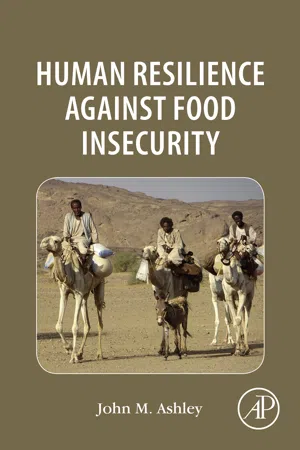
Human Resilience Against Food Insecurity
About this book
Human Resilience against Food Insecurity focuses on the human factors involved in building resilience against food and nutrition insecurity in perpetuity through better managing risks (such as 'better-spacing' of children), diversifying the asset portfolio, behavioral change, and communication strategies for to help achieve these goals. The better the coherence and convergence amongst these human factors that promote sustainable food and nutrition security, the lower the need to rectify their absence through post-facto, unsustainable 'firemen's work' of humanitarian assistance and CMAM clinics.
The book includes references to countries which are not in the lowest of the categories prescribed in the UNDP Human Development reports, also including minority groups in developed countries, such as the hunter-gatherer Inuit communities of Canada, to provide an inclusive view of the issues and concerns relevant to addressing food insecurity.
- Includes a global array of case studies
- Presents stories of success and failure in building resilience against food insecurity with the causative human aspect underlying each
- Addresses the social and cultural anthropological foundation of combatting food and nutrition insecurity
Information
Chapter 1
Introduction
Abstract
The need to improve food and nutrition security for the developing world is what economists and politicians may call a “motherhood statement”, viz. “motherhood is good”. As a concept it is anodyne, inoffensive and non-contentious. Yet to secure gains on the ground, a course needs to be charted through perilous terrain and waterways. This involves surmounting demand-side technical, economic, social, cultural, and political hurdles at grass-roots level, and meaningful engagement with the supply-side vision, understanding and integrity of the people charged with delivering those gains in a sustainable way.
Keywords
Nutrition security; Anodyne; Resilience; Integrity; Political hurdles; Non-contentious
The need to improve food and nutrition security for the developing world is what economists and politicians may call a “motherhood statement”, viz. “motherhood is good”. As a concept it is anodyne, inoffensive and non-contentious. Yet to secure gains on the ground, a course needs to be charted through perilous terrain and waterways. This involves surmounting demand-side technical, economic, social, cultural and political hurdles at grass-roots level, and meaningful engagement with the supply-side vision, understanding and integrity of the people charged with delivering those gains in a sustainable way.
The original title conceived for this book was The Anthropology of Resilience against Food Insecurity in the Developing World. One of the reviewers of the author's initial proposal for this book rightly pointed out that what I had indicated I wanted to say went beyond the scope of anthropology, into allied fields of experience, such as sociology and psychology, so the title should be more generic. This advisory was accepted, and the title was adapted by the publisher to Human Resilience against Food Insecurity.
The current book refers to many learned publications of an anthropological nature that consider resilience in relation to food security. However, this will be done without the theoretical organization, analytical rigor and philosophical detachment for which some readers in academia may wish. Rather, as indicated already in the Foreword, a different approach has been deemed needful, one which the author believes better “connects” the non-specialist reader with the subject matter, as it is actually lived by the marginalized people concerned “in the field”.
Such a rationale resonates with a comparable plea made for poetry in 2015, in an essay by California's Poet Laureate Dana Gioia (2015). He laments the demise of poetry, caused in large part by the college teaching of it being destructively analytical. “For thousands of years”, he says, “poetry was taught badly, and consequently it was immensely popular. Readers loved the vast and variable medium of verse. It wasn't a forbidding category of high literary art; it was the most pleasurable way in which words could be put together”. Gioia yearns for poetry to be made more accessible to the majority, to encourage more enchantment through this storytelling genre, and therefore more readers and writers of it. Such enlightenment can co-habit with the New Criticism, critical methods and literary theory as intellectual disciplines, yet not be pushed aside by them, destroying the actual holistic, intuitive experience of poetry.
“We need to augment methodology with magic”, Gioia continues. “Poetry's existence on the pages of books, even the best-selling books, represented only a fraction of its cultural presence. Poetry flourished at the borders between print and oral culture—places where single poems could be read and then shared aloud”. Referring to the current “disturbing trends” of teaching poetry, he says,
When analytical instruction replaces the physicality, subjectivity, and emotionality of performance, most students fail to make a meaningful connection with poetry. So abstracted and intellectualized, poetry becomes disembodied into poetics—a noble subject but never a popular one. As the audience for poetry continues to contract, there will come a tipping point—perhaps it has already arrived—when the majority of adult readers are academic professionals or graduate students training for those professions. What is the future of an art when the majority of its audience must be paid to participate?
(Gioia, 2015)
Likewise with food security, it should not be explained in terms merely of what, who and where, but also how and why, at the most basic level, that of human performance. The current author explores the anecdotal (the “oral culture”) genre to convey the views of those at grass-roots level to the reader, rather than his writing just a turgid tome replete with specialist jargon which the generalist may find impenetrable. So, for example, instead of the term “degraded agro-pastoralists”, a term from an anthropologist's lexicon, I talk of pastoralists who have settled. As other examples, I do not use the term “agency”, beloved of sociologists and social anthropologists, referring to the actions individuals take to pursue goals (and their ability and willingness to do so), and I seldom use the term “paradigm”, beloved of academics. Then every reader, not just the specific discipline specialists, will know what I'm about.
I much appreciate the travel writings of the Oxford-educated social anthropologist Nigel Barley, who is somewhat of an iconoclast in his field, and in so being has made anthropology accessible to non-anthropologists. In my earlier book I mentioned London's Museum of Mankind in its former home Burlington House, and how the 1976 exhibition I attended there, called “Nomad and City”, blew my mind, with its mock-up of an Arab market place in Sana'a. Before long I was off to Yemen myself. Barley was a curator of that ethnological museum for some years.
When I use the term “anthropology” in this book it means what its Greek roots intend: “the study of humankind”, as wide as that. Barley's book Not a Hazardous Sport is one of my favorite anthropological readings, though it is not on the student reading lists in many anthropological faculties.1 In an interview with Rosie Milne in 2008, Barley said:
As an anthropologist you're always asking questions such as: How different can different peoples be? Are we all reducible to a common humanity? And if so: what is it? Nobody can answer these questions. But I like to use fiction to try to answer anthropological questions. And fiction, I find, gives better answers.
(Daily Telegraph, 2008)
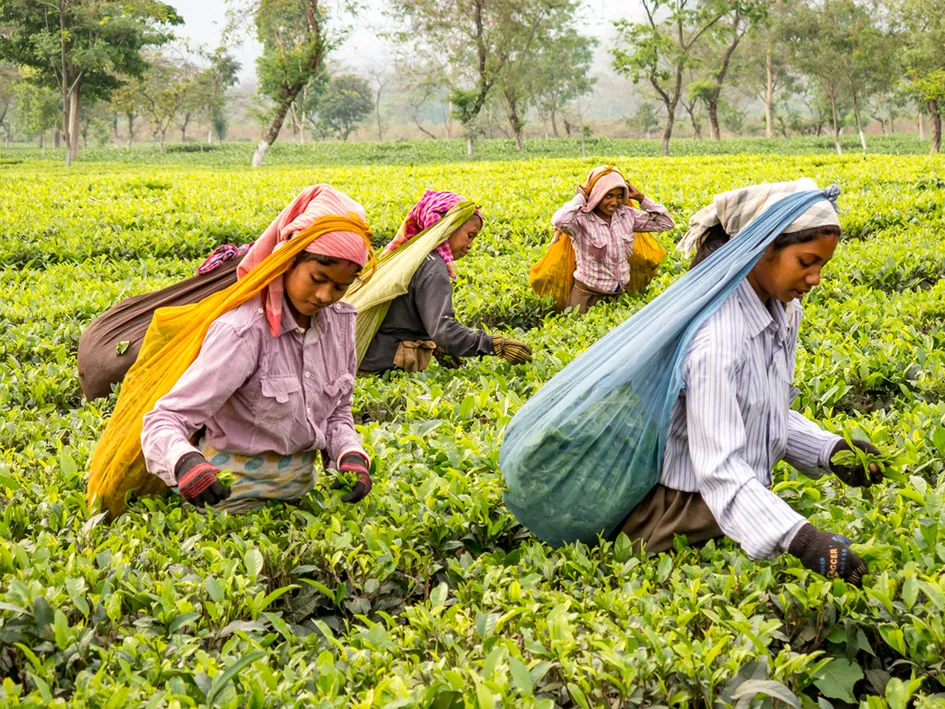
While the current author will not employ fiction in the current book to help deliver such answers (though he will use poetry now and then), the purpose is to identify those answers (and the questions which occasion them) that may encourage a better “joined-up-ness” across the board. Just in case you missed it (!), the intent thereby is to empower better resolution of the many challenges that need to be addressed and overcome, to render vulnerable populations in the developing world more resilient against food and nutrition insecurity. For instance, the income of the millions of tea pickers worldwide is at best only just above the “living wage” level, making them highly vulnerable to the food access component of food security. It is clear that no one organization can improve their economic and social conditions; action is needed across the industry (Oxfam and Ethical Tea Partnership, 2013; Photo 1.1).
Both causes of food insecurity and resilience against it are amenable to mitigation by humankind. Human conflict is one such cause; wise leadership can promote its peaceful resolution. Disputes over land or grazing rights, say, are often an expression of population pressure, which is something that family planning can help address. Climatic extremes (droughts, floods, cyclones, etc.) are being caused/exacerbated by human activities, which can be modified by political will, long-term version, legislation and modified human behavior. And so on—such is the context of this book.
Bear with me when you note that the examples I give do not all have food security directly mentioned, in what some readers may find too discursive a style. Yet most actions we take each day are related directly or indirectly to food security. Bringing resilience to communities may require lateral thinking, and wider consideration of how this may best be achieved. Annex 1 is particularly discursive and tongue-in-cheek, but it does culminate in the lady concerned adopting a food security strategy which rewards her with long-term resilience. Occasionally the reader might note a ray of humor to leaven the presentation, this being the author's survival strategy to get through the story of privation and hopelessness among the world's poorest people, whose own stories are seldom writ, other than in their faces and body language (Photos 1.2 and 1.3). It is hoped that this book might lead to a certain redress of their condition.
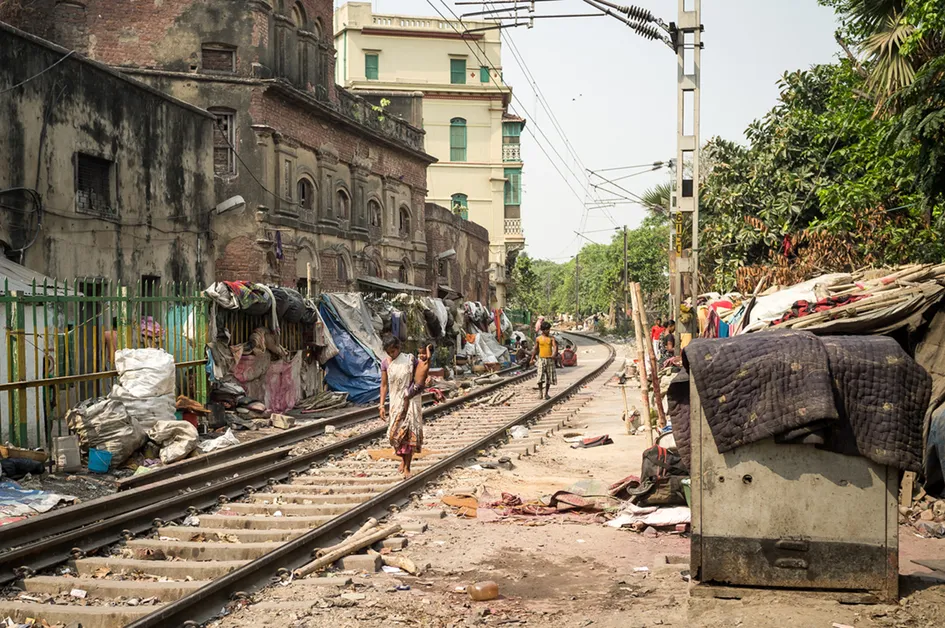
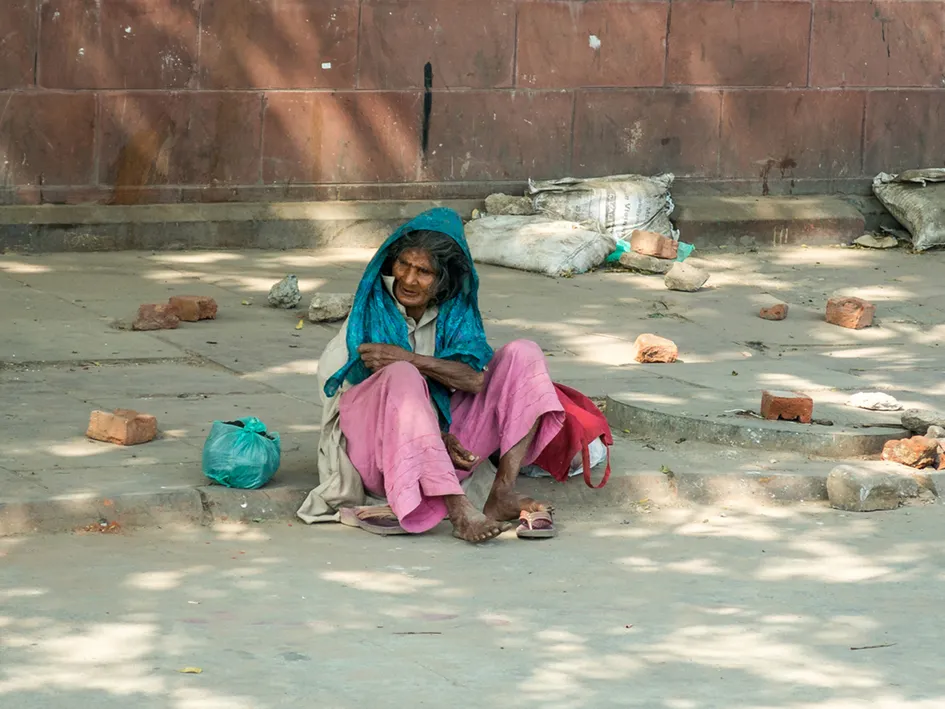
Table of contents
- Cover image
- Title page
- Table of Contents
- Copyright
- Dedication
- Acronyms
- About the Author
- Acknowledgments
- Foreword
- Chapter 1: Introduction
- Chapter 2: A Summary of “Food Security in the Developing World”
- Chapter 3: Understanding Vulnerability to, and Resilience Against, Food Insecurity
- Chapter 4: The Anthropological Basis of Human Development
- Chapter 5: The Starting Point of a Development Intervention
- Chapter 6: Identifying and Prioritizing the Challenges Confronting Food Security Resilience for All
- Chapter 7: Building the Change Management Team and Approach
- Chapter 8: Importance of Local Knowledge in Building Resilience
- Chapter 9: Lateral Thinking
- Chapter 10: The Role of Champions
- Chapter 11: Case Studies
- Chapter 12: Conclusions
- Annex 1: Goats and Nightclubs of the Levant
- Index
Trusted by 375,005 students
Access to over 1.5 million titles for a fair monthly price.
Study more efficiently using our study tools.
Frequently asked questions
Yes, you can cancel anytime from the Subscription tab in your account settings on the Perlego website. Your subscription will stay active until the end of your current billing period. Learn how to cancel your subscription
No, books cannot be downloaded as external files, such as PDFs, for use outside of Perlego. However, you can download books within the Perlego app for offline reading on mobile or tablet. Learn how to download books offline
Perlego offers two plans: Essential and Complete
- Essential is ideal for learners and professionals who enjoy exploring a wide range of subjects. Access the Essential Library with 800,000+ trusted titles and best-sellers across business, personal growth, and the humanities. Includes unlimited reading time and Standard Read Aloud voice.
- Complete: Perfect for advanced learners and researchers needing full, unrestricted access. Unlock 1.5M+ books across hundreds of subjects, including academic and specialized titles. The Complete Plan also includes advanced features like Premium Read Aloud and Research Assistant.
We are an online textbook subscription service, where you can get access to an entire online library for less than the price of a single book per month. With over 1.5 million books across 990+ topics, we’ve got you covered! Learn about our mission
Look out for the read-aloud symbol on your next book to see if you can listen to it. The read-aloud tool reads text aloud for you, highlighting the text as it is being read. You can pause it, speed it up and slow it down. Learn more about Read Aloud
Yes! You can use the Perlego app on both iOS and Android devices to read anytime, anywhere — even offline. Perfect for commutes or when you’re on the go.
Please note we cannot support devices running on iOS 13 and Android 7 or earlier. Learn more about using the app
Please note we cannot support devices running on iOS 13 and Android 7 or earlier. Learn more about using the app
Yes, you can access Human Resilience Against Food Insecurity by John Michael Ashley in PDF and/or ePUB format, as well as other popular books in Technology & Engineering & Food Science. We have over 1.5 million books available in our catalogue for you to explore.