eBook - ePub
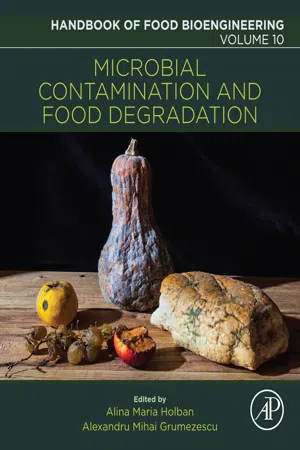
Microbial Contamination and Food Degradation
- 514 pages
- English
- ePUB (mobile friendly)
- Available on iOS & Android
eBook - ePub
Microbial Contamination and Food Degradation
About this book
Microbial Contamination and Food Degradation, Volume 10 in the Handbook of Food Bioengineering series, provides an understanding of the most common microbial agents involved in food contamination and spoilage, and highlights the main detection techniques to help pinpoint the cause of contamination. Microorganisms may cause health-threatening conditions directly by being ingested together with contaminated food, or indirectly by producing harmful toxins and factors that can cause food borne illness. This resource discusses the potential sources of contamination, the latest advances in contamination research and strategies to prevent contamination using key methods of analysis and evaluation.
- Presents modern alternatives for avoiding microbial spoilage and food degradation using preventative and intervention technologies
- Provides key methods for addressing microbial contamination and preventing food borne illness through research and risk assessment analysis
- Includes detailed information on bacterial contamination problems in different environmental environments and the methodologies to help solve those problems
Information
Chapter 1
Food Products and Food Contamination
Katepogu Kamala
Venkobarao Pavan Kumar Rayalaseema University, Kurnool, Andhra Pradesh, India
Abstract
Food contamination is a severe public health problem around the world, resulting in food-borne diseases that affect human beings every year. In this chapter we concentrate on food contamination by microorganisms, chemicals, and physiological factors. Most of the foods serve as the best media for the growth of diverse microorganisms. Microorganisms that grow in foods may cause changes in appearance, flavor, odor, and other features of the foods. The degradative changes produced by microorganisms, such as putrefaction, fermentation, and rancidity, in addition to degradation; microorganisms also synthesize the substances, such as pigments and slimes, which also cause changes in food quality.
Different types of contamination mechanisms are involved in food contamination. Small factors that can cause food-borne illness are storage and cooking temperatures, insufficient hand washing, and animal waste. Microbes can be entered into food from humans who washed their hands not systematically. Most kitchen tools and their surfaces contaminated by raw food products. Replications of pathogens are present in food to cause diseases. In conclusion, this chapter explores the possibilities of food contamination by various methods. This chapter discusses elements of a microbial contamination and the need to perform risk assessments, and additional areas of improvement in the preservation of risks.
Keywords
microorganisms
health
pathogens
risk
Food has a vital significance in our lives. It is necessary for our development beginning with the moment when we are conceived. A person consumes on average 30 tons of food during a lifetime, under different versions of diets that vary locally, nationally, and internationally. If we refe to food in general, it is a mixture of chemicals that can be divided into four categories: nutrients, natural toxins, contaminants, and additives. A food is safe when its consumption does not alter or danger the consumer’s health. The concept of food safety has no universally accepted definition. Food security can be defined as all activities that ensure that food does not cause any health problem to consumers. This simple definition covers a wide range of activities from the basic staff hygiene to the most complex technical procedures to remove contaminants from the process or processed foods. The impacts of environment change on food safety used to analyze the Food and Agriculture Organization (FAO) explanation of a food management scheme (FAO/WHO, 2003).
1. Food Contamination
Contamination of food refers to the occurrence of harmful microorganisms and chemicals in food may lead to consumer illness. This chapter addresses food contamination, which can be found under food-borne illness. The impact of contaminants on customer health is often apparent only after many years of processing. Seventy percent of all cases of diarrhea in children may be recognized by the food contamination (Usfar et al., 2010). Contaminants present in foods are often unaffected by thermal processing (unlike most microbiological agents). Contaminants can be classified according to the source of contamination and the mechanism by which they enter the food product. Food contamination is a serious problem affecting many consumers across the world. Although there are efforts to control the problem, it still happens in many restaurants and hotels, as well as private homes. The anonymous pathogenic agents can cause illnesses, hospitalizations, and deaths by the food contamination (Mead et al., 1999). The insecure drinking water and not proper food handling practices causes diarrhea, which is the second most significant cause of child death worldwide (Usfar et al., 2010). Purchased food from the outside is not safer than home-cooked food. The usual protection concern on outside food was an unclean environment, quality of ingredients used, uncovered containers, personal hygiene of the food handlers cooking in used oils (Gavaravarapu et al., 2009).
Food security is built on many mutual principles that insist that operators and their personnel follow to create and provide food in the safest method. It also explains that producing a culture of food safety requirements, the purpose of the most excellent science with the best supervision and communication systems, together with rapid and continual food safety messages using numerous media are required (Powell et al., 2011).
The death of an affected per...
Table of contents
- Cover
- Title page
- Table of Contents
- Copyright
- List of Contributors
- Foreword
- Series Preface
- Preface for Volume 10: Microbial Contamination and Food Degradation
- Chapter 1: Food Products and Food Contamination
- Chapter 2: Microbial Contamination, Prevention, and Early Detection in Food Industry
- Chapter 3: Microbiological Contamination in Foods and Beverages: Consequences and Alternatives in the Era of Microbial Resistance
- Chapter 4: Quorum Sensing as a Mechanism of Microbial Control and Food Safety
- Chapter 5: Food Degradation and Foodborne Diseases: A Microbial Approach
- Chapter 6: Fresh-Cut Fruits: Microbial Degradation and Preservation
- Chapter 7: Occurrence of Natural Toxins in Seafood
- Chapter 8: Biopreservatives as Agents to Prevent Food Spoilage
- Chapter 9: Wine Microbial Spoilage: Advances in Defects Remediation
- Chapter 10: Near-Infrared Spectral Informative Indicators for Meat and Dairy Products, Bacterial Contamination, and Freshness Evaluation
- Chapter 11: Use of Bacterial Growth Curve for Assessing Risk of Microbiological Pathogens in Food Products
- Chapter 12: Biosensors and Express Control of Bacterial Contamination of Different Environmental Objects
- Chapter 13: Mycotoxins in Foods: Mycotoxicoses, Detection, and Management
- Chapter 14: Multiple-Locus Variable-Number of Tandem-Repeats Analysis as Subtyping Technique for Food-Borne Pathogens
- Chapter 15: Antimicrobial and Antioxidant Properties of Essential Oils in Food Systems—An Overview
- Index
Trusted by 375,005 students
Access to over 1.5 million titles for a fair monthly price.
Study more efficiently using our study tools.
Frequently asked questions
Yes, you can cancel anytime from the Subscription tab in your account settings on the Perlego website. Your subscription will stay active until the end of your current billing period. Learn how to cancel your subscription
No, books cannot be downloaded as external files, such as PDFs, for use outside of Perlego. However, you can download books within the Perlego app for offline reading on mobile or tablet. Learn how to download books offline
Perlego offers two plans: Essential and Complete
- Essential is ideal for learners and professionals who enjoy exploring a wide range of subjects. Access the Essential Library with 800,000+ trusted titles and best-sellers across business, personal growth, and the humanities. Includes unlimited reading time and Standard Read Aloud voice.
- Complete: Perfect for advanced learners and researchers needing full, unrestricted access. Unlock 1.5M+ books across hundreds of subjects, including academic and specialized titles. The Complete Plan also includes advanced features like Premium Read Aloud and Research Assistant.
We are an online textbook subscription service, where you can get access to an entire online library for less than the price of a single book per month. With over 1.5 million books across 990+ topics, we’ve got you covered! Learn about our mission
Look out for the read-aloud symbol on your next book to see if you can listen to it. The read-aloud tool reads text aloud for you, highlighting the text as it is being read. You can pause it, speed it up and slow it down. Learn more about Read Aloud
Yes! You can use the Perlego app on both iOS and Android devices to read anytime, anywhere — even offline. Perfect for commutes or when you’re on the go.
Please note we cannot support devices running on iOS 13 and Android 7 or earlier. Learn more about using the app
Please note we cannot support devices running on iOS 13 and Android 7 or earlier. Learn more about using the app
Yes, you can access Microbial Contamination and Food Degradation by Alexandru Mihai Grumezescu,Alina Maria Holban in PDF and/or ePUB format, as well as other popular books in Technology & Engineering & Food Science. We have over 1.5 million books available in our catalogue for you to explore.