- 705 pages
- English
- ePUB (mobile friendly)
- Available on iOS & Android
eBook - ePub
About this book
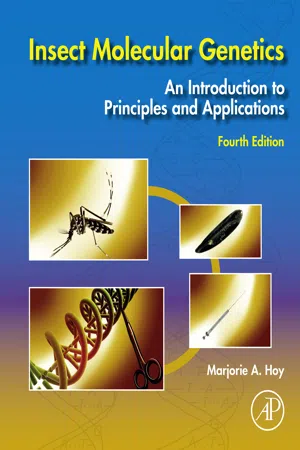
Insect Molecular Genetics: An Introduction to Principles and Applications is intended to be an introduction for those without significant training in molecular genetic because knowledge of these methods and their uses is essential to scientists and regulatory officials - even if you never become an insect molecular geneticist.
Information
Part I
Genes and Genome Organization in Eukaryotes
Chapter 1
DNA, Gene Structure and DNA Replication
Abstract
This chapter covers the structure and make-up of Deoxyribonucleic acid (DNA), the various forms DNA can take, its replication via mitosis or meiosis, and the role of DNA in transmitting genetic information. The importance of the double helix structure of DNA is discussed. It goes on to cover the structure of RNA and the ways RNA relates to and differs from DNA. The chapter includes a brief discussion of the history of the study of genetics, the establishment of the “Central Dogma,” and subsequent challenges to that dogma. The section on genes covers the structure, effects, and organization of genes, and the difficulties of defining the nature of genes. The chapter goes on to discuss the fidelity of DNA replication, DNA repair, and mutations in the genome.
Keywords
DNA; RNA; Gene; Replication; Genetic
1.1 Overview
Arthropod genes are made of DNA and are located in chromosomes that consist of proteins, RNA, and DNA. DNA is a polymer of nucleotides. Each nucleotide consists of a pentose sugar, one of four nitrogenous bases, and a phosphoric acid component. DNA consists of two complementary strands in a helix form. Pairing of the nitrogenous bases adenine (A) with thymine (T), and cytosine (C) with guanine (G) on the two complementary strands occurs by hydrogen bonding. A pairs with T by two hydrogen bonds, and C pairs with G by three. DNA has chemically distinct 5′ and 3′ ends and the two strands are antiparallel, with one running in the 5′ to 3′ direction and the other in the 3′ to 5′ direction. The antiparallel orientation of the two strands creates a problem when DNA is duplicated or replicated during mitosis or meiosis.
Genetic information in protein-coding genes is determined by the sequence of nitrogenous bases (A, T, G, C) in one of the strands, with a three-base (triplet) codon designating an amino acid. The genetic code is degenerate, which means that more than one codon specifies most amino acids. The genetic information is expressed when DNA is transcribed into pre-messenger RNA, which is processed into messenger RNA, which then is translated into polypeptides. Most insect genes have intervening noncoding sequences (introns) that must be removed from the mRNA molecule before translation into the protein can occur.
Efficient and accurate replication of DNA must occur at each cell division or the cell or organism may not survive. DNA replication is semiconservative, which means that one of the nucleotide strands of each new DNA molecule is new and the other is old. The new DNA strand is complementary to the parental (or template) strand. DNA replication occurs in one direction only, from the 5′ to the 3′ end of the strand, and thus replication takes place differently on the two antiparallel strands. Replication on the “leading strand” can occur in the 5′ to 3′ direction in a continuous manner. DNA replication on the “lagging strand” occurs in short segments (Okazaki fragments) because the DNA runs in the 3′ to 5′ direction. Subsequently, the Okazaki fragments must be ligated together. Replication of DNA in chromosomes begins at multiple sites called origins of replication along the chromosome, and involves a number of enzymes and proteins. Although DNA replication is usually highly accurate, errors in DNA replication, or mutations, can result from duplications, deletions, inversions, and translocations of nucleotides, which may affect the functioning of the resultant polypeptide. New combinations of genes can occur through recombination during meiosis.
1.2 DNA is the Hereditary Material: A Brief History
Gregor Johann Mendel founded modern genetics in 1866 by publishing his studies on inheritance in garden peas. He confirmed that hereditary traits were transmitted from generation to generation and proposed the Principles of Segregation and Independent Assortment, which will be discussed further in the description of meiosis and mitosis in Chapter 4. His work, however, was not widely known until 1900, when Hugo de Vries, Carl Correns, and Erich von Tschermak rediscovered these laws of inheritance. Mendel described traits in peas that were “dominant” or “recessive,” and showed that peas could be selected for different traits and were inherited in a stable manner.
The discovery that DNA (deoxyribonucleic acid) is the hereditary material was first determined using a bacterium that causes pneumonia (Streptococcus pneumoniae) (Griffiths, 1928). Prior to this, scientists speculated that the hereditary material might be composed of proteins or RNA. Proteins were considered the most likely hereditary material because they were more variable (having 20 amino acids that could serve as the genetic code) than DNA. Furthermore, proteins are present in the nucleus in amounts nearly equal to DNA. DNA, by contrast, seemed to have only four types of structure (consisting of adenine, thymine, cytosine, or guanine) that could serve as the genetic code. Griffiths (1928) found that nonvirulent forms of S. pneumoniae could be “transformed” to virulent forms by combining heat-treated virulent bacteria with nonvirulent bacteria. The reverse was true and led to the conclusion that the virulence traits were heritable and capable of surviving mild heat treatment. Subsequently Avery et al. (1944) conducted experiments in which the “transforming principle” had characteristics of DNA, and the transforming factors did not test positive for proteins or RNA. Avery et al. (1944) showed that enzymes that degrade proteins or RNA did not degrade the “transforming principle” but that enzymes that could degrade DNA did. Hershey and Chas...
Table of contents
- Cover image
- Title page
- Table of Contents
- Copyright
- About the Author
- Preface to the Fourth Edition
- Preface to the Third Edition
- Preface to the Second Edition
- Preface to the First Edition
- Acknowledgments
- Part I: Genes and Genome Organization in Eukaryotes
- Part II: Molecular Genetic Techniques
- Part III: Applications in Entomology
- Glossary
- Index
Trusted by 375,005 students
Access to over 1.5 million titles for a fair monthly price.
Study more efficiently using our study tools.
Frequently asked questions
Yes, you can cancel anytime from the Subscription tab in your account settings on the Perlego website. Your subscription will stay active until the end of your current billing period. Learn how to cancel your subscription
No, books cannot be downloaded as external files, such as PDFs, for use outside of Perlego. However, you can download books within the Perlego app for offline reading on mobile or tablet. Learn how to download books offline
Perlego offers two plans: Essential and Complete
- Essential is ideal for learners and professionals who enjoy exploring a wide range of subjects. Access the Essential Library with 800,000+ trusted titles and best-sellers across business, personal growth, and the humanities. Includes unlimited reading time and Standard Read Aloud voice.
- Complete: Perfect for advanced learners and researchers needing full, unrestricted access. Unlock 1.5M+ books across hundreds of subjects, including academic and specialized titles. The Complete Plan also includes advanced features like Premium Read Aloud and Research Assistant.
We are an online textbook subscription service, where you can get access to an entire online library for less than the price of a single book per month. With over 1.5 million books across 990+ topics, we’ve got you covered! Learn about our mission
Look out for the read-aloud symbol on your next book to see if you can listen to it. The read-aloud tool reads text aloud for you, highlighting the text as it is being read. You can pause it, speed it up and slow it down. Learn more about Read Aloud
Yes! You can use the Perlego app on both iOS and Android devices to read anytime, anywhere — even offline. Perfect for commutes or when you’re on the go.
Please note we cannot support devices running on iOS 13 and Android 7 or earlier. Learn more about using the app
Please note we cannot support devices running on iOS 13 and Android 7 or earlier. Learn more about using the app
Yes, you can access Insect Molecular Genetics by Marjorie A. Hoy in PDF and/or ePUB format, as well as other popular books in Biological Sciences & Entomology. We have over 1.5 million books available in our catalogue for you to explore.