- 688 pages
- English
- ePUB (mobile friendly)
- Available on iOS & Android
eBook - ePub
About this book
The key requirements for chilled food products are good quality and microbiological safety at the point of consumption. The first edition of Chilled foods quickly established itself as the standard work on these issues. This major new edition strengthens that reputation, with extensively revised and expanded coverage (including more than ten new chapters) and significant participation from those in the chilled food industry to increase the publication's relevance to practitioners.
The introduction discusses key trends and influences in the chilled foods market. Part one explores the critical importance of raw material selection and packaging materials in final product quality, with expanded coverage of particular ingredients such as fish, cheese and poultry and a new contribution on chilled food packaging materials and technologies. Part two focuses on technologies and processes in the supply chain, with entirely new chapters on refrigeration, storage and transport and non-microbial hazards such as allergens, among others. Alongside are updated chapters on the important topics of hygienic design, cleaning and disinfection and temperature monitoring and measurement. Part three covers microbiological hazards, with new chapters on predictive microbiology and conventional and rapid analytical microbiology. The final part contains three new chapters devoted to essential issues in safety and quality management, such as shelf-life, quality and consumer acceptability. A wholly updated chapter on legislation and criteria completes the volume.
Extensively revised and expanded, the third edition of Chilled foods is an essential reference for professionals involved in the manufacture of chilled food products.
- Reviews key trends and influences in the chilled food market
- Explores the importance of raw material selection and packaging materials in final product quality
- Discusses technologies and processes in the supply chain, focusing on refrigeration, storage and transport
Information
1
Introduction to chilled foods
M. Brown, mhb Consulting, UK
Publisher Summary
The chilled food market has moved on and change has come in many areas–in product demands and in the sourcing of ingredients and products, and to a lesser extent in the technology available. The industry has changed from being a developing industry to a mature one and its focus is on consolidation, cost-cutting and innovation. Consumers have also moved on in their expectations, which not only include convenience and quality, but also environmental and ethical considerations. Products continue to evolve, meeting consumers’ changing needs and lifestyles. This has caused the market to segment, so that its products now span the three major consumer trends—health, convenience and indulgence or gourmet. It is also segmented in another dimension with products targeting specific consumer groups, such as the elderly, single-person families and notably children. Chilled foods have been available since the 1960s and continue to be a success story, currently representing about 10% of all UK retail foods by value. Consumers view the chilled cabinet as providing convenience and quality and suppliers have managed to generate and maintain this perception through rapidly changing portfolios of products whose branding and presentation reinforce it. The UK chilled foods industry has continually built consumer trust, based on its approach to food safety and quality and continuous innovation leading to a wide, and changing, choice of products. Assurance of the microbiological safety of chilled foods remains a key requirement and it has driven product design and the management of the supply chain. Many areas of technology are used to make safe products and achieve product shelf-life.
1.1 Background
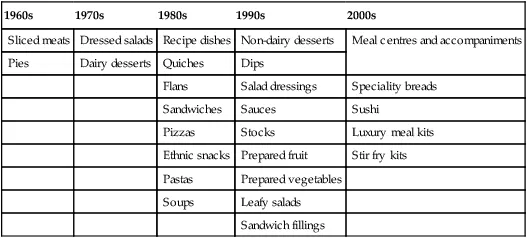
The chilled food market has moved on since the last edition of this book; change has come in many areas – in product demands and in the sourcing of ingredients and products, and to a lesser extent in the technology available. The industry has changed from being a developing industry to a mature one and its focus is on consolidation, cost-cutting and innovation. Consumers have also moved on in their expectations, which now not only include convenience and quality, but also environmental and ethical considerations. Products continue to evolve (see Table 1.1), meeting consumers’ changing needs and life-styles. This has caused the market to segment, so that its products now span the three major consumer trends – health, convenience and indulgence or gourmet. It is also segmented in another dimension with products targeting specific consumer groups such as the elderly, single-person families and notably children.
Table 1.1
Development of the chilled food market (CFA, 2006)
| 1960s | 1970s | 1980s | 1990s | 2000s |
| Sliced meats | Dressed salads | Recipe dishes | Non-dairy desserts | Meal centres and accompaniments |
| Pies | Dairy desserts | Quiches | Dips | |
| Flans | Salad dressings | Speciality breads | ||
| Sandwiches | Sauces | Sushi | ||
| Pizzas | Stocks | Luxury meal kits | ||
| Ethnic snacks | Prepared fruit | Stir fry kits | ||
| Pastas | Prepared vegetables | |||
| Soups | Leafy salads | |||
| Sandwich fillings |
Chilled foods have been available since the 1960s and continue to be a success story, currently representing about 10% of all UK retail foods by value. The UK chilled prepared foods market in 2007 had a retail sales value of £9.11bn, a rise of 4.4% on 2006. Cheese was the largest sector of the market in 2007, followed by yoghurts and chilled desserts and ready meals (http://biz.yahoo.com/bw/080218/20080218005208.html?v=1). Chilled recipe dishes and sandwiches are the largest and most innovative sectors in the UK. Recipe dishes and ready meals have grown from an estimated £173 million in 1988 to over £1750 million in 2005, based on an estimated 12 000 different dishes based on recipes originating from all over the world. The sandwich market is estimated at £3bn annually. The European chilled prepared food market was worth over €14.62bn in 2005 and meals accounted for about 60% by value (http://www.just-food.com/article.aspx?id=97917). Sales were expected to increase by almost 4% to €15.15bn during 2006, rising to more than €18bn by 2010 (LFI, 2006).
Consumers view the chilled cabinet as providing convenience and quality, and suppliers have managed to generate and maintain this perception through rapidly changing portfolios of products whose branding and presentation reinforce it. The UK chilled foods industry has continually built consumer trust, based on its approach to food safety and quality and continuous innovation leading to a wide, and changing, choice of products. Assurance of the microbiological safety of chilled foods remains a key requirement and it has driven product design and the management of the supply chain.
Many areas of technology are used to make safe products and achieve product shelf-life. Apart from their culinary effects, these technologies have three purposes:
• to prevent microbial contamination (e.g. primary packaging; hygienic manufacturing facilities and cleaning procedures)
• to restrict microbial growth (e.g. chilled distribution and storage; intrinsic preservation systems)
• to remove (e.g. by washing) or kill (e.g. by heat treatment or fermentation) micro-organisms.
Depending on the type of product, some or all of these objectives have to be achieved within the constraints imposed by the product character and the technology available.
1.2 UK-produced chilled foods
The UK is a major market for chilled foods. Consumer demand has kept it growing, which has in turn supported the expansion of manufacturing facilities, ingredient suppliers and specialist logistics companies providing transport, storage and delivery into large distribution centres and then onward to retail outlets within very short time scales (within 24 h) at accurately controlled temperatures.
In the 1960s, the main chilled foodstuffs were meat and dairy products, such as pre-sliced meat, traditional pies and dairy desserts. Very often these were distributed direct from the manufacturer to retail outlets by fleets of vans. Within twenty years the variety has grown to include ready meals or recipe dishes, prepared salads, dressings, sauces and soups, prepared fruit, speciality breads and sandwiches. Retail outlets have become larger and fewer, and distribution is by specialist logistics networks with efficient and uninterrupted cold chains ensuring the quality, shelf-life and microbiological safety of unpreserved products.
The 1990s and 2000s, UK consumers are considered cash-rich and time-poor, with increasing numbers of working meal-providers and people living alone. Shoppers have changed purchasing, dining and social habits. The demand for foods that are still within shelf-life when shopping is done weekly, minimize time spent on the preparation, and offer good quality and some variety accounts for the popularity of chilled recipe dishes (http://www.ukinvest.gov.uk/Trends/14/zh-TW.html). There are thought to be several reasons for retailers’ success in meeting this need, including wide choice and frequent changes to product ranges, authenticity or ethnicity of dishes and ingredients, and availability of exotic or difficult recipes that are difficult, or time-consuming, to cook successfully. Because of international travel, dining-out and strong media interest in cookery, the attraction of regional and ethnic food is stronger than ever. A growing willingness by consumers to experiment with novel flavours and ingredients has encouraged the development of new ingredients and regional or speciality products.
How products are sold has changed; the retailer own-label brands are prominent because retailers have been successful in developing top quality images for their brands, based on innovation and quality. These now account for 95% of the chilled food market and this provides a rich source of income to food manufacturers who can meet their quality and cost requirements. UK chilled food manufacturing is dominated by high volume producers (typical factory about 7000 m2, producing up to 2 million units per week (http://www.themanufacturer.com/uk/profile) with a wide range of products, pack sizes and presentations. In the UK, Chilled Food association (CFA) member companies employ over 56 000 people (including over 1000 scientists), equivalent to 11% of the total food industry workforce. Even within the manufacturers there is increasing outsourcing of production and support services (e.g. analytical services). Predominantly, outsourcing is done to companies that specialize in the key technologies (e.g. heat treatment and packaging) and/or have sufficient capacity to respond quickly to changes in demand. Currently, there are two main trends in chilled food retailing. Firstly, retailer consolidation and, secondly, changes to the types of outlet provided by retailers, so that many large retailers now span the whole range from superstores down to small express stores, which affects the type of service manufacturers and especially logistics providers have to supply.
Factories and systems are technically sophisticated because of the need for low-cost manufacture under hygienic conditions and the demands of customers (e.g. major retailers) and consumers for high quality and a robust approach to food safety, high standards of supply chain management, and quality management systems that enforce specified controls effectively (see CFA, 2006). The chilled prepared foods market includes a number of large food groups, such as Dairy Crest Group plc, Geest plc (Bakkavor Invest), Greencore Group plc, Northern Foods plc, Uniq plc, and Young’s Bluecrest Seafood Ltd (see membership of CFA: http://www.chilledfood.org/Content/Our_members.asp).
There is environmental/sustainability pressure to reduce product packaging (see http://www.igd.com/cir.asp?menuid=149&cirid=2354), but any reductions in pack strength or pack type still need to retain the important protective and preservation functions of primary packaging. This layer has to contain the product without leakage, ensure the shelf-life (e.g. prevent moisture migration or contain a modified atmosphere) and provide an attractive presentation format that is suitable for distribution and storage, re-heating and serving (e.g. by microwave or conventional oven) or multi-use. For safety reasons, packs must remain dimensionally stable and temperature-stable during distribution and pre- and post-heating, and this imposes restrictions on the types and quantity of material that can be used. As most products are distributed on pallets and handled in automated systems, secondary (e.g. sleeves or cartons) and tertiary (boxes or overwrapping) packaging also play important roles in protecting the integrity of the primary pack, especially from crushing or puncturing.
1.3 Market and growth drivers
Dairy (e.g. cheese, yoghurts and chilled desserts) remains the largest sector of the chilled food market in size, followed by chilled meats and chilled composite products (e.g. recipe dishes, pizzas, soups and sandwiches). These products can be ready-to-eat, ready-to-re-heat or ready-to-cook, and include multiple components, e.g. fish, meat, dairy, egg and vegetables. Changes in the requirements of EU hygiene legislation in 2004 (covering manufacturing requirements) from individual Directives for each commodity or component and setting out often different requirements, to a single Hygiene Regulation giving over-arching principles with Appendices for each commodity, has made manufacture of composite products easier. The single Regulation (EC) 852/2004 on the hygiene of foodstuffs has removed existing conflicts and anomalies in manufacturing and layout requirements from the Directives. There are also two supplementary Regulations; EC: 853/2004 laying down specific hygiene rules for food of animal origin and EC: 854/2004 laying down specific ru...
Table of contents
- Cover image
- Title page
- Table of Contents
- Related titles
- Copyright
- Contributor contact details
- Preface
- Chapter 1: Introduction to chilled foods
- Part I: Raw materials and products
- Part II: Technologies and processes in the supply chain
- Part III: Microbiological hazards
- Part IV: Safety and quality management
- Index
Trusted by 375,005 students
Access to over 1.5 million titles for a fair monthly price.
Study more efficiently using our study tools.
Frequently asked questions
Yes, you can cancel anytime from the Subscription tab in your account settings on the Perlego website. Your subscription will stay active until the end of your current billing period. Learn how to cancel your subscription
No, books cannot be downloaded as external files, such as PDFs, for use outside of Perlego. However, you can download books within the Perlego app for offline reading on mobile or tablet. Learn how to download books offline
Perlego offers two plans: Essential and Complete
- Essential is ideal for learners and professionals who enjoy exploring a wide range of subjects. Access the Essential Library with 800,000+ trusted titles and best-sellers across business, personal growth, and the humanities. Includes unlimited reading time and Standard Read Aloud voice.
- Complete: Perfect for advanced learners and researchers needing full, unrestricted access. Unlock 1.5M+ books across hundreds of subjects, including academic and specialized titles. The Complete Plan also includes advanced features like Premium Read Aloud and Research Assistant.
We are an online textbook subscription service, where you can get access to an entire online library for less than the price of a single book per month. With over 1.5 million books across 990+ topics, we’ve got you covered! Learn about our mission
Look out for the read-aloud symbol on your next book to see if you can listen to it. The read-aloud tool reads text aloud for you, highlighting the text as it is being read. You can pause it, speed it up and slow it down. Learn more about Read Aloud
Yes! You can use the Perlego app on both iOS and Android devices to read anytime, anywhere — even offline. Perfect for commutes or when you’re on the go.
Please note we cannot support devices running on iOS 13 and Android 7 or earlier. Learn more about using the app
Please note we cannot support devices running on iOS 13 and Android 7 or earlier. Learn more about using the app
Yes, you can access Chilled Foods by M. Brown in PDF and/or ePUB format, as well as other popular books in Technology & Engineering & Food Science. We have over 1.5 million books available in our catalogue for you to explore.