- English
- ePUB (mobile friendly)
- Available on iOS & Android
eBook - ePub
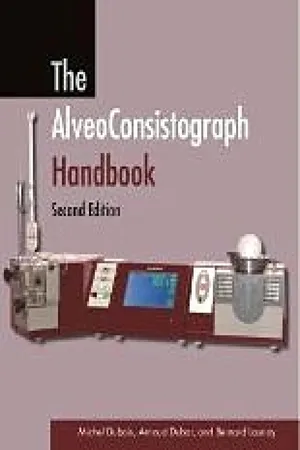
AlveoConsistograph Handbook
About this book
The AlveoConsistograph helps you to classify, control, and select wheat and flour and to optimize their blending for specific rheological properties. It measures the effects of improvers, ingredients, and other additives, resulting in better control of dough on the production line and more consistent end-product quality.
The AlveoConsistograph Handbook, Second Edition provides an understanding of the technical data generated by the instrument and gives timely application examples. It explains the workings of the Chopin Consistograph and provides deep insight into its coupling with the Chopin Alveograph. As the first revision of this resource in 20 years, this new edition explains major modifications and improvements of the alveograph through new and completely revised chapters.
A new chapter on the Consistograph, the component used to determine the water absorption capacity of flour, includes test procedures, applications, differences from other devices, maintenance, and troubleshooting. Another new chapter discusses the debate surrounding the testing of samples using either constant water content or constant consistency methods. This chapter gives useful insight into the adapted hydrated alveograph protocol and its benefits for users of flour that will be part of formulations when gluten quality and performance is crucial. It covers the controversial subject in depth, along with the technical basis for the development of the debate, and compares the uses of both methods on the same wheat.
In addition to wheat flour, the book provides guidance for using the alveograph on additional products, such as durum wheat semolina and durum pasta. All the chapters have been rewritten to include the latest practices and will help users gain a better understanding of how this important technology is used in today's food labs.
This large-format, easy-to-read handbook includes two helpful appendixes: The first lists the main parts of the alveograph, and the second lists selected references concerning the alveograph. The AlveoConsistograph Handbook will provide users all along the cereal chain with up-to-date information that helps them to get the most out of their daily use of this important technology. The book will be especially useful for food scientists in the baking industry, quality control laboratories, suppliers of enzymes and additives, breeders, grain scientists involved with grain storage, and grain exporters
- Description of different types of alveographs
- Theory of the alveograph
- Description of the alveograph procedure
- Modification of the alveograph procedure
- Interpretation of alveograph results
- Factors influencing the alveograph
- Alveograph calibration
- Description of the consistograph
- Adapted hydration method for the alveograph
- Troubleshooting
Trusted by 375,005 students
Access to over 1.5 million titles for a fair monthly price.
Study more efficiently using our study tools.
Information
Part I
The Chopin Alveograph—Constant-Hydration Method
CHAPTER 1
The Chopin Alveograph
In 1905, Hungarian scientist Jenö von Hankoczy designed an apparatus that became known as “Hankoczy’s gluten tester” (Hankoczy 1920). The apparatus provided a means for pressing moist, crude gluten into a thin sheet between two plates that each had a round opening 2 cm in diameter in the middle. The plates, with gluten pressed in between, then were mounted in a device that joined the lower plate to a vessel into which air could be compressed, while the upper plate joined another vessel from which air would be displaced. Air in the lower vessel was compressed by introducing mercury from a bulb elevated to a height that provided enough pressure to stretch the gluten. The gluten expanded into a bubble through the round opening in the upper plate. A simple gasometer measured the air displaced from the upper vessel by the expansion of the gluten bubble. Thus, the maximum volume of the bubble before it burst could be measured.
Hankoczy later improved this instrument so that the pressure of the air in the lower vessel also could be measured, thus improving the precision of the evaluation of the “strength” of the gluten sample. A later version of this testing device allowed a disk of dough to be stretched instead of a disk of gluten. Because the importance of temperature in the rheological testing of doughs had not yet been recognized, none of these early instruments had any temperature control.
In the 1920s, Marcel Chopin became interested in the possibility of using dough-testing instruments in place of baking tests to assess the baking quality of French wheats. With no prior knowledge of Hankoczy’s developments, he attempted to develop a test that would simulate, as closely as possible, the process that dough undergoes in bread baking.
Chopin’s approach was based on the then-current concept of the physical condition of developed dough and its changes during the bread-baking process. He considered the dough coming out of a mixer to be in a more-or-less compact state that then was transformed into thin membranes during fermentation and baking. These membranes solidified or were set by heat in the oven and divided bread into innumerable cells filled with gas. If the loaf was well developed, the membranes were thought to have been stretched to the limit of their ability to withstand the mechanical forces set up during baking. The more easily the dough could be drawn into a thin sheet, the more complete would be the development of the loaf.
Based on this model, Chopin designed an extensimeter to measure the plasticity of materials, especially wheat flour dough (Chopin 1921). Four years later, Bailey and Le Vesconte (1924) published an English version of the original French description of this extensimeter. The extensimeter was designed to measure 1) the “tenacity” of the dough, estimated by the effort necessary to force a uniform cylinder of dough to take a definite form in a fixed period of time, and 2) the ability of the...
Table of contents
- Cover image
- Title page
- Table of Contents
- Copyright
- Dedication
- Preface to the Second Edition
- Preface to the First Edition
- Part I: The Chopin Alveograph—Constant-Hydration Method
- Part II: Recent Modifications of the Chopin Alveograph
- Part III: Supplementary Information
- APPENDIX 1: Main Alveograph Parts
- APPENDIX 2: Selected References Concerning the Alveograph
- Index
Frequently asked questions
Yes, you can cancel anytime from the Subscription tab in your account settings on the Perlego website. Your subscription will stay active until the end of your current billing period. Learn how to cancel your subscription
No, books cannot be downloaded as external files, such as PDFs, for use outside of Perlego. However, you can download books within the Perlego app for offline reading on mobile or tablet. Learn how to download books offline
We are an online textbook subscription service, where you can get access to an entire online library for less than the price of a single book per month. With over 1.5 million books across 990+ topics, we’ve got you covered! Learn about our mission
Look out for the read-aloud symbol on your next book to see if you can listen to it. The read-aloud tool reads text aloud for you, highlighting the text as it is being read. You can pause it, speed it up and slow it down. Learn more about Read Aloud
Yes! You can use the Perlego app on both iOS and Android devices to read anytime, anywhere — even offline. Perfect for commutes or when you’re on the go.
Please note we cannot support devices running on iOS 13 and Android 7 or earlier. Learn more about using the app
Please note we cannot support devices running on iOS 13 and Android 7 or earlier. Learn more about using the app
Yes, you can access AlveoConsistograph Handbook by Michel Dubois,Arnaud Dubat,Bernard Launay in PDF and/or ePUB format, as well as other popular books in Technologie et ingénierie & Sciences de l'alimentation. We have over 1.5 million books available in our catalogue for you to explore.