eBook - ePub
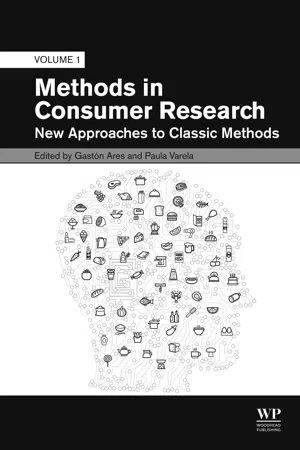
Methods in Consumer Research, Volume 1
New Approaches to Classic Methods
- 582 pages
- English
- ePUB (mobile friendly)
- Available on iOS & Android
eBook - ePub
About this book
Methods for Consumer Research, Volume One: New Approaches to Classic Methods brings together world leading experts in global consumer research who provide a fully comprehensive state-of-the-art coverage of advances in the classical methods of consumer science. The book touches on the latest developments in qualitative techniques, including coverage of both focus groups and social media, while also focusing on liking, a fundamental principle of consumer science, consumer segmentation, and the influence of extrinsic product characteristics, such as packaging and presentation on consumer liking.
In conjunction with the second volume, which covers alternative approaches and special applications, this book is an invaluable reference for academics working in the fields of in-sensory and consumer science, psychology, marketing and nutrition. And, with examples of the methodology being applied throughout, it serves as a practical guide to research and development managers in both food and non-food companies.
- Presents a fully comprehensive coverage of the latest developments in the classical methodologies of consumer research
- Provides examples of successful application of the methodologies presented
- Includes focus groups and social media discussions
- Encompasses consumer segmentation, with a focus on psychographics and genetics
Information
Subtopic
Food SciencePart I
Introduction
Chapter 1
Recent Advances in Consumer Science
Paula Varela1, and Gastón Ares2 1Nofima AS, Ås, Norway 2Universidad de la República, Montevideo, Uruguay
Abstract
This chapter reviews the most relevant advancements in consumer science, from a methodological perspective, starting from a historical standpoint and highlighting the main areas of development and discussing the whys. Among the topics reviewed are the shift from standardized sensory description to consumer-based feedback; going beyond hedonics toward more complex, interdisciplinary food choice models that take into account context, situation, consumer attitudes and values; the growing interest in emotional research; and the study of the extended eating experience (food behavior, well-being). Also covered are methodological advancements in qualitative and quantitative consumer research, adapting methods from psychology and behavioral economics, and the use of nondirected and implicit methods, as well as considering heuristics in food choice. The chapter also reviews the importance of planning specific studies and applications with special populations from a socioeconomic perspective and from a cognitive perspective. Based on the recent advancements, the future and remaining challenges in consumer science are discussed as concluding remarks. As this is the introductory chapter, we detail the chapters that look in depth into the different areas of consumer science in the two volumes of the present book.
Keywords
Advances; Consumers; Future perspectives; Methods
1. Consumer Science: A Historical Perspective
Sensory and consumer science emerged in the early half of the 20th century, mostly as a support tool to product development, to study perceptual reactions to ingredients, chemicals, and product modifications (Moskowitz, 2017). From its inception, scientists strived to make sensory science robust and valid by standardizing procedures and strengthening the ties to statistical sciences.
Sensory science rapidly grew in the second half of the 1990s, paralleling the growth of the food industry (Lawless & Heymann, 2010). The main methodological developments during those years were related to inferring differences between products, with the triangle test as one of the most popular methods (Helm & Trolle, 1946; Peryam & Swartz, 1950), as well as to describing the sensory qualities of products via various profiling methods, with quantitative descriptive analysis probably the most widespread method (Stone, Sidel, Oliver, Woolsey, & Singleton, 1974; Szczesniak, Loew, & Skinner, 1975). In addition, sensory scientists were also interested in understanding consumer perception, and started measuring consumer acceptability, or degree of liking. For this purpose, the 9-point hedonic scale, a cornerstone of our field, was developed (Jones, Peryam, & Thurstone, 1955; Peryam & Pilgrim, 1957). The end of the 20th century was all about “self-affirmation as a scientific discipline,” with the widespread dissemination of procedures for standardization, checking panel performance, and establishing correlations between chemical, instrumental, and sensory measurements. Moskowitz (2017) argues, in his opinion piece on trained and consumer panels, that descriptive analysis might have been an “inbuilt historical phase unavoidable in intellectual history.”
Sensory scientists thought that consumers could provide information only about how much they liked/disliked a product, so sensory information was obtained from trained assessors (Lawless & Heymann, 2010). When preference mapping emerged (Carroll, 1972; Horsfield & Taylor, 1976; MacFie, 2007), it provided researchers, particularly from industrial research and design, with a great tool for product optimization by linking trained panel data to consumer appreciation. However, research showed that consumers were able to accurately evaluate the sensory characteristics of products (Ares & Varela, 2017), which prompted the development of new methodological approaches based on consumer perception. Product development research started, slowly but increasingly faster, to use optimization techniques based on consumer input, such as “just-about-right” scales (Popper, 2014), the ideal profile method (Worch, Lê, Punter, & Pagès, 2013), or “check-all-that-apply”-based optimization (Ares, Dauber, Fernández, Giménez, & Varela, 2014; Plaehn, 2012). Davide Giacalone, in Chapter 7, Product Performance Optimization, gives a thorough overview of the recent advances in the use of consumer-based methodologies for product development and optimization.
Going back to the historical perspective, most of the developments that occurred in consumer science during the late 1990s were related to trying to answer innumerable questions about how consumers perceive products, how they choose, and why they prefer what they prefer. However, hedonic perception remained the focus of consumer research, and the sensory characteristics of products continued to play a key role in the field. In this regard, Chapter 2, Complexity of Consumer Perception, by Ep Koster and Jos Mojet, provides an overview of when consumer researchers started questioning the focus on this structuralist, static view of sensory properties as a driver of all consumer perceptions, as well as why and how they started to look into additional variables underlying food choice.
1.1. Understanding Perception
Understanding perception has had a key role in the historical development of sensory and consumer science. Different areas of knowledge have focused on different aspects of perception. Psychophysics was developed in the late 19th century and can be regarded as a precursor of experimental psychology. These two areas of knowledge provided the basis for many of the consumer methods that are used today. Interestingly, psychophysics and sensory evaluation developed very much in parallel, sharing many techniques: one studying the person and the other focusing on the product (Lawless & Heymann, 2010). Anatomy, physiology, and genetics followed perception from a functional perspective, looking further than physical bases and going into functional consequences, such as adaptation, suppression, chemosensory integration, and multimodal interaction. Research in this field opened the door to understanding how some individuals live in a particularly intense taste world: perceiving more intense tastes, feeling more burn from pungent foods, being more sensitive to creaminess, and also experiencing more intense oral pain (Bartoshuk, 2000). Although the concept of “different taste worlds” produced by genetic variation was first introduced by Blakeslee and Fox in 1932, the development of psychophysical tools in the last half of the 20th century allowed the discovery of supertasters and their relation to genetic variation. Chapter 16, Oral Processing: Implications for Consumer Choice and Preferences by Lina Engelen, and Chapter 17, Consumer Segmentation Based on Genetic Variation in Taste and Smell by Mari Sandell, Ulla Hoppu, and Oskar Laaksonen, give an updated look into the physiological and genetic bases of consumer perception and preferences. These individual differences in perception have been increasingly recognized as more than noise in the data, and they have been recognized as drivers of food behaviors. In this sense, Chapter 10, Affect-Based Discrimination Methods by John Prescott, reports that consumers probably select foods partly based on their individual phenotypes and discusses the importance of acknowledging this in consumer testing. Prescott focuses on discrimination methods that have been adapted for studying affective-based decision-making, such as rejection threshold and the authen...
Table of contents
- Cover image
- Title page
- Table of Contents
- Related Titles
- Copyright
- List of Contributors
- Preface
- Part I. Introduction
- Part II. Qualitative Techniques
- Part III. Liking and Beyond
- Part IV. Consumer Segmentation
- Part V. Influence of Extrinsic Product Characteristics
- Index
Trusted by 375,005 students
Access to over 1.5 million titles for a fair monthly price.
Study more efficiently using our study tools.
Frequently asked questions
Yes, you can cancel anytime from the Subscription tab in your account settings on the Perlego website. Your subscription will stay active until the end of your current billing period. Learn how to cancel your subscription
No, books cannot be downloaded as external files, such as PDFs, for use outside of Perlego. However, you can download books within the Perlego app for offline reading on mobile or tablet. Learn how to download books offline
Perlego offers two plans: Essential and Complete
- Essential is ideal for learners and professionals who enjoy exploring a wide range of subjects. Access the Essential Library with 800,000+ trusted titles and best-sellers across business, personal growth, and the humanities. Includes unlimited reading time and Standard Read Aloud voice.
- Complete: Perfect for advanced learners and researchers needing full, unrestricted access. Unlock 1.5M+ books across hundreds of subjects, including academic and specialized titles. The Complete Plan also includes advanced features like Premium Read Aloud and Research Assistant.
We are an online textbook subscription service, where you can get access to an entire online library for less than the price of a single book per month. With over 1.5 million books across 990+ topics, we’ve got you covered! Learn about our mission
Look out for the read-aloud symbol on your next book to see if you can listen to it. The read-aloud tool reads text aloud for you, highlighting the text as it is being read. You can pause it, speed it up and slow it down. Learn more about Read Aloud
Yes! You can use the Perlego app on both iOS and Android devices to read anytime, anywhere — even offline. Perfect for commutes or when you’re on the go.
Please note we cannot support devices running on iOS 13 and Android 7 or earlier. Learn more about using the app
Please note we cannot support devices running on iOS 13 and Android 7 or earlier. Learn more about using the app
Yes, you can access Methods in Consumer Research, Volume 1 by Gaston Ares,Paula Varela in PDF and/or ePUB format, as well as other popular books in Technology & Engineering & Food Science. We have over 1.5 million books available in our catalogue for you to explore.