- 612 pages
- English
- ePUB (mobile friendly)
- Available on iOS & Android
eBook - ePub
Food Control and Biosecurity
About this book
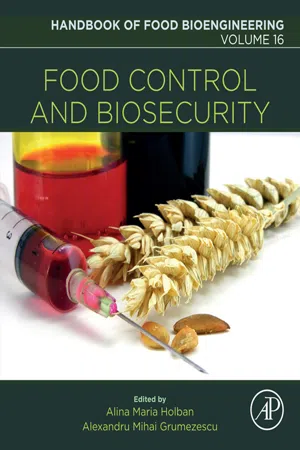
Food Control and Biosecurity, Volume Sixteen, the latest release in the Handbook of Food Bioengineering series, is an essential resource for anyone in the food industry who needs to understand safety and quality control to prevent or reduce the spread of foodborne diseases. The book covers information from exporter to transporter, importer and retailer, and offers valuable tools to measure food quality while also addressing government standards and regulations for food production, processing and consumption. The book presents cutting-edge methods for detecting hazardous compounds within foods, including carcinogenic chemicals. Other related topics addressing food insecurity and food defense are also discussed.
- Identifies the latest import/export regulations related to food control and biosecurity
- Provides detection and analysis methods to ensure a safe food supply
- Presents risk assessment tools and prevention strategies for food safety and process control
Information
Chapter 1
Introduction in Food Safety, Biosecurity and Hazard Control
Coralia Bleotu***
Mariana Carmen Chifiriuc**
Razvan Socolov†
Demetra Socolov†
* Stefan S. Nicolau Institute of Virology, Bucharest, Romania
** Research Institute of the University of Bucharest, Bucharest, Romania
† Grigore T. Popa University of Medicine and Pharmacy, Iasi, Romania
* Stefan S. Nicolau Institute of Virology, Bucharest, Romania
** Research Institute of the University of Bucharest, Bucharest, Romania
† Grigore T. Popa University of Medicine and Pharmacy, Iasi, Romania
Abstract
For human consumption, unprocessed, partially processed, or processed food, as well as genetically modified or engineered food must respect food safety regulations, which must be applied along the entire food chain, from raw materials to preservation and processing. The purpose of this chapter is to present main food hazards and the different methods and technologies used to limit or eliminate them along the food chain.
Keywords
food safety
microbial contamination
raw food
food processing
food additives
1. Introduction
Food for human consumption, unprocessed, partially processed, or processed food, as well as genetically modified or engineered food, must be subjected to the necessary hygiene rules during production, processing, storage, distribution, and preparation.
Food safety is a scientific discipline describing handling, preparation, and storage of food in order to prevent food-induced illnesses, such as infections, intoxication, and allergies. Food safety refers to all hazards, whether chronic or acute, that may cause problems ranging from flu-like symptoms to serious illness—even death.
Food hazards can be: (1) biological: harmful bacteria (such as Salmonella sp., Campylobacter sp., Listeria sp., Escherichia coli, etc.), viruses (genus Enterovirus, genus Hepatovirus, genus Rotavirus, family Adenoviridae, genus Arenavirus, genus Flavivirus, genus Hantavirus, Aichi virus, etc.) transmissible via foods that cause food poisoning or foodborne human infections, parasites (Cryptosporidium parvum, Giardia duodenalis or intestinalis, Taenias pp., Toxoplasma gondii, Trichinella spiralis, Entamoeba histolytica, En. coli) (Adley, 2006; Benedict et al., 2016; Herrmann and Cliver, 1968; Vasickova et al., 2005); (2) chemical: food additives, pesticides/agricultural products, veterinary drugs, mycotoxins (aflatoxin, deoxynivalenol—vomitoxin), ochratoxin A, fumonisin, patulin), natural toxins (glycoalkaloids and other natural toxins), environmental contaminants (arsenic, cadmium, lead, mercury), marine toxins (decomposition and microscopic marine algae), processing-induced chemicals (acrylamide, ethyl carbamate or urethane), furan (causing unpleasant tastes in food and acute and chronic toxic effects) (Safefood 360, 2013); (3) physical: jewelry, hair and fingernails, insects, plasters, broken glass, string, bits of equipment, bits of shell or bone, pest droppings, dust, and dirt (causing nausea, choking, cuts inside the mouth, and broken teeth); and (4) allergenic: nuts, sesame seeds, milk, eggs, seafood (fish, crustaceans, and shellfish), soy, wheat, sulfites, and mustard (causing mild to moderate allergic reactions or anaphylactic shock).
Biosafety represents all measures taken to reduce or eliminate potential risks that may arise as a consequence of using spoiled, infested, or genetically modified food, which could ha...
Table of contents
- Cover
- Title page
- Table of Contents
- Copyright
- List of Contributors
- Foreword
- Series Preface
- Preface for Volume 16: Food Control and Biosecurity
- Chapter 1: Introduction in Food Safety, Biosecurity and Hazard Control
- Chapter 2: Potential Hazards and Biosecurity Aspects Associated on Food Safety
- Chapter 3: Tools in Improving Quality Assurance and Food Control
- Chapter 4: Chemometrics Applied to Food Control
- Chapter 5: Food Defense
- Chapter 6: Detection of Biogenic Amines: Quality and Toxicity Indicators in Food of Animal Origin
- Chapter 7: Aptameric Sensing in Food Safety
- Chapter 8: Advanced Infrared Spectroscopic Technologies for Natural Product Quality Control
- Chapter 9: Strategies to Reduce the Formation of Carcinogenic Chemicals in Dry Cured Meat Products
- Chapter 10: Detection of Irradiated Food and Evaluation of the Given Dose by Electron Spin Resonance, Thermoluminescence, and Gas Chromatographic/Mass Spectrometric Analysis
- Chapter 11: Passive Sampling to Monitor Hazardous Compounds in Water: A Tool for the Risk Assessment of Consuming Aquatic Food
- Chapter 12: Quality Control of Plant-Based Foods in Terms of Nutritional Values: Influence of Pesticides Residue and Endogenous Compounds
- Chapter 13: Drying Drop Technology in Wine and Hard Drinks Quality Control
- Chapter 14: Biosecurity Strategies for Backyard Poultry: A Controlled Way for Safe Food Production
- Chapter 15: Antibacterial Effects and Modes of Action of the Activated Lactoperoxidase System (LPS), of CO2 and N2 Gas as Food-Grade Approaches to Control Bovine Raw Milk–Associated Bacteria
- Chapter 16: Foods, Food Additives, and Generally Regarded as Safe (GRAS) Food Assessments
- Index
Trusted by 375,005 students
Access to over 1.5 million titles for a fair monthly price.
Study more efficiently using our study tools.
Frequently asked questions
Yes, you can cancel anytime from the Subscription tab in your account settings on the Perlego website. Your subscription will stay active until the end of your current billing period. Learn how to cancel your subscription
No, books cannot be downloaded as external files, such as PDFs, for use outside of Perlego. However, you can download books within the Perlego app for offline reading on mobile or tablet. Learn how to download books offline
Perlego offers two plans: Essential and Complete
- Essential is ideal for learners and professionals who enjoy exploring a wide range of subjects. Access the Essential Library with 800,000+ trusted titles and best-sellers across business, personal growth, and the humanities. Includes unlimited reading time and Standard Read Aloud voice.
- Complete: Perfect for advanced learners and researchers needing full, unrestricted access. Unlock 1.5M+ books across hundreds of subjects, including academic and specialized titles. The Complete Plan also includes advanced features like Premium Read Aloud and Research Assistant.
We are an online textbook subscription service, where you can get access to an entire online library for less than the price of a single book per month. With over 1.5 million books across 990+ topics, we’ve got you covered! Learn about our mission
Look out for the read-aloud symbol on your next book to see if you can listen to it. The read-aloud tool reads text aloud for you, highlighting the text as it is being read. You can pause it, speed it up and slow it down. Learn more about Read Aloud
Yes! You can use the Perlego app on both iOS and Android devices to read anytime, anywhere — even offline. Perfect for commutes or when you’re on the go.
Please note we cannot support devices running on iOS 13 and Android 7 or earlier. Learn more about using the app
Please note we cannot support devices running on iOS 13 and Android 7 or earlier. Learn more about using the app
Yes, you can access Food Control and Biosecurity by Alexandru Mihai Grumezescu,Alina Maria Holban in PDF and/or ePUB format, as well as other popular books in Technology & Engineering & Food Science. We have over 1.5 million books available in our catalogue for you to explore.