- 280 pages
- English
- ePUB (mobile friendly)
- Available on iOS & Android
eBook - ePub
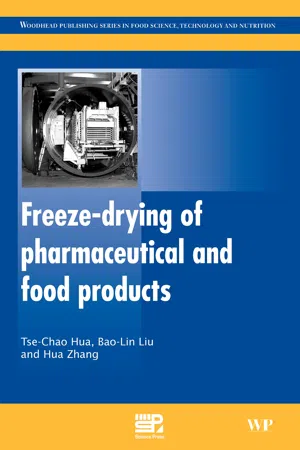
Freeze-Drying of Pharmaceutical and Food Products
About this book
Freeze-drying is an important preservation technique for heat-sensitive pharmaceuticals and foods. Products are first frozen, then dried in a vacuum at low temperature by sublimation and desorption, rather than by the application of heat. The resulting items can be stored at room temperature for long periods. This informative text addresses both principles and practice in this area.The first chapter introduces freeze-drying. The authors then review the fundamentals of the technique, heat-mass transfer analyses, modelling of the drying process and the equipment employed. Further chapters focus on freeze-drying of food, freeze-drying of pharmaceuticals and the protective agents and additives applied. The final chapter covers the important subjects of disinfection, sterilization and process validation.Freeze-drying of pharmaceutical and food products is an essential reference for food, pharmaceutical and refrigeration engineers and scientists with an interest in preservation techniques. It will also be of use to students in these fields.
- Addresses the principles and practices used in this important preservation technique
- Explains the fundamentals of heat-mass transfer analysis, modelling and the equipment used
- Discusses the importance of disinfection, sterilization and process validation
Information
1
Introduction
1.1 Brief history of freeze-drying technology
When washed clothes are put outside in the sun in severely cold winter with temperature below 0 °C, they will be frozen very quickly; however through a period of time, they will be dried, since the moisture frozen in the clothes is sublimated to the air. The drier the air, or the lower the partial pressure of vapor in the atmosphere, the quicker the sublimation drying goes.
The method of freeze-drying food was known a little to the ancient Chinese and Peruvian Incas. In order to store meat longer and to get better flavor, the ancient Chinese put the meat outside in cold winter. The meat was firstly frozen, and then dried. The ancient Incas stored potatoes and other some crops on the mountain heights above Machu Picchu. The cold mountain temperature froze the food and the water inside slowly sublimated under the low pressure of the high altitudes. Freeze-dried food is light and can last longer than other preserved food.
The above phenomena may be taken as examples of “freeze-drying”. However as a part of science and technology, “freeze-drying” is only a matter of recent 80 years.
There were three events which had the milestone significance in the early development in freeze-drying technology:
(1) Earl W. Flosdorf and Stuart Mudd from University of Pennsylvania successfully preserved the human serum by freeze-drying using glass apparatus in 1933[1].
(2) During World War II, the freeze-drying process was developed commercially when it was used to preserve blood plasma and penicillin. Howard Walter Florey and Ernst Boris Chain, the scientists who followed up most successfully on Alexander Fleming’s discovery of penicillin in 1928, devised the method to store the penicillin by freeze-drying in 1938, and made great contribution to clinical application during the World War II. The three scientists were awarded the Nobel Prize for Physiology or Medicine in 1945. Several years later, Charles Merieux (French virologist) made the freeze drying as a regular technology for vaccine preservation.
(3) In 1930, Nestlé’s chairman was approached by the Brazilian Coffee Institute and asked to develop coffee that was soluble in hot water and retaining its flavor. At the time, Brazil had a huge coffee surplus. After seven years of painstaking research at the Nestlé research centre laboratory in Switzerland, scientist Max Mortgenthaler invented freeze-dried coffee and the powdered coffee was first produced in 1938, which led to the development of powdered food products.
These three events impelled the freeze-drying development of the microorganism and food. However the system and apparatus used for freeze drying are not convenient and efficient at that time. Most apparatus are made of fragile glass. The necessary vacuum is produced by a “chemical pump” with ethyl ether, not mechanical vacuum pump. The low temperatures making the materials to be frozen are reached by applying “dry ice” (solid CO2).
Freeze-drying is a method of preservation by refrigeration, heating and vacuum. Firstly the materials are cooled to low temperature, and the water in the material is almost completely frozen. Then the ice inside the materials is heated and sublimated from the solid state directly into the vapor phase during sublimation drying process. The freeze dried materials can be stored at normal temperature in vacuum state. Thus the development of freeze-drying depends on the improvement of refrigeration and vacuum technology.
The mechanical refrigeration based on vapor compression and throttling decreasing temperature was rapidly developed in 1930s. DuPont Company in USA produced a new commercial refrigerant of R-12, trademarked as Freon, in 1931. The rise of mechanical vapor compression refrigeration in 1930s, had greatly promoted the development and application of freeze-drying technology. The technology had its rapid development period in the 1940—1960s, and had main uses in microorganism, coffee and so on in those years.
After the first commercial freeze-dryer came out in 1935, the technology started from the laboratory stage to the industrial production and the product commercialization stage. Under the vigorous impetuses by Flosdorf, Greaves, Henaff and the many others, freezing and drying became a conventional method of preserving blood plasma and the application in the Second World War had saved millions human’s life.
Food freeze-drying studies started in Flosdorf s laboratory in the 1930s. The Britisch Food Department had also conducted the research of food freeze drying in the Scotland Aberdeen pilot plant.
Freeze-drying has become one of the most important processes for the preservation of heat-sensitive pharmaceuticals and foods. Recently the freeze-drying of human living cells is in study’[5].
Along with the promotion of freezing and drying application, theoretical and technological research also prospered in a steady pace. Flosdorf published the first monograph of freeze-drying in 1944. The first and second symposiums on freeze-drying were held in London in 1951 and 1958 respectively. American was the first in the world to establish the GMP (Good Manufacturing Practice) production standard for the freeze-drying of pharmaceutical products in 1963. Many nations also established the production standard afterwards, and a resolution to execute GMP on freeze-diying of pharmaceutical products was passed in WTO in 1969.
Hereafter there was a long period of time during which the freeze-drying technology had little development. Since there were no many demands, the technology was in its primary “rough” stage. As far as to the 1990s, the appearance and development of biological pharmaceutical products proposed many “harsh” demands to the freeze-drying technology, forcing it developing to “delicate” stage. At the same time,”Solution vitrification theory” and “Food polymer science theory” had provided some theoretical foundation to the development of freeze-drying.
Application of freeze-drying in material science is a matter of the recent years. Nanometer technology has risen abruptly on the horizon. Freeze drying has become one of the most important manufacture technology of nanoparticles.
1.2 Basic processes of freeze-drying
Freeze-drying is also called “lyophilization”. The term “lyophilization” was derived from the word “lyophile”, coming from the Greek λυοζ and φιλειν, which means “likes the solvent” (the solvent is water in most cases), describing the great ability of the dry product to rehydrate again[2].
The freeze drying is constituted of the following processes[2—4].
1.2.1 Preparation or pretreatment of the material
For the food materials, it is necessary to do some physical and chemical pretreatments before freeze drying, which includes cleanout, classification, slice up, blanching, sterilization, concentration and others. There are differences for different kinds of food. In most cases, it is not necessary to add additive to the food material.
For the pharmaceutical materials or the living cells, it is necessary to add some additives before freeze-drying in order to keep their activity and get good quality of final products. It is called ‘formulation’ for mixture of pharmaceutical material and additives. The additives are used for stabilizing the formulation or for therapeutic reasons, which can be classified by their functions as lyoprotectant (protectant agent for freeze drying), emulsifier, bulking agent, antioxidant, buffer agent and others. Recently, it is found that some kinds of sugar, such as trehalosedihydrate and sucrose, are efficient lyoprotectants.
1.2.2 Cooling and solidification of the material
The cooling process should be done sufficiently, i.e., not only the free water in the material should be frozen to form crystalline ice completely, but also the other constitutes of the material should be solidified, to form non-crystalline solid (glassy solid). This process is often called a freezing process, actually it is a completed solidification process, while the material should be completely solidified by enough cooling. The solidified material after perfect cooling contains both crystalline solid and non-crystalline hard reticulation structure solid.
The cooling and solidification process is an extremely important process, however it is underestimated in the past. For a perfect cooling process, the final temperature, the temperature of complete solidification, Tcs, should be lower than the eutectic temperature, Te, or the glass transition temperature Tg.
The temperature decreasing rate of the cooling and solidification process is also an important effect. In general, rapid cooling would lead to formation of partial glassy state and prevent excessive dehydration of m...
Table of contents
- Cover image
- Title page
- Table of Contents
- Copyright
- Woodhead Publishing Series in Food Science, Technology and Nutrition
- Preface
- Chapter 1: Introduction
- Chapter 2: Fundamentals of Freeze Drying
- Chapter 3: Heat-Mass Transfer Analyses and Modeling of the Drying Process
- Chapter 4: Equipment for Freeze-drying
- Chapter 5: Freezing-drying of Food
- Chapter 6: Protective Agents and Additives for Freeze-drying of Pharmaceutical Products
- Chapter 7: Freeze Drying of Pharmaceuticals
- Chapter 8: Disinfection, Sterilization and Validation
- References
- Index
Trusted by 375,005 students
Access to over 1.5 million titles for a fair monthly price.
Study more efficiently using our study tools.
Frequently asked questions
Yes, you can cancel anytime from the Subscription tab in your account settings on the Perlego website. Your subscription will stay active until the end of your current billing period. Learn how to cancel your subscription
No, books cannot be downloaded as external files, such as PDFs, for use outside of Perlego. However, you can download books within the Perlego app for offline reading on mobile or tablet. Learn how to download books offline
Perlego offers two plans: Essential and Complete
- Essential is ideal for learners and professionals who enjoy exploring a wide range of subjects. Access the Essential Library with 800,000+ trusted titles and best-sellers across business, personal growth, and the humanities. Includes unlimited reading time and Standard Read Aloud voice.
- Complete: Perfect for advanced learners and researchers needing full, unrestricted access. Unlock 1.5M+ books across hundreds of subjects, including academic and specialized titles. The Complete Plan also includes advanced features like Premium Read Aloud and Research Assistant.
We are an online textbook subscription service, where you can get access to an entire online library for less than the price of a single book per month. With over 1.5 million books across 990+ topics, we’ve got you covered! Learn about our mission
Look out for the read-aloud symbol on your next book to see if you can listen to it. The read-aloud tool reads text aloud for you, highlighting the text as it is being read. You can pause it, speed it up and slow it down. Learn more about Read Aloud
Yes! You can use the Perlego app on both iOS and Android devices to read anytime, anywhere — even offline. Perfect for commutes or when you’re on the go.
Please note we cannot support devices running on iOS 13 and Android 7 or earlier. Learn more about using the app
Please note we cannot support devices running on iOS 13 and Android 7 or earlier. Learn more about using the app
Yes, you can access Freeze-Drying of Pharmaceutical and Food Products by Tse-Chao Hua,Bao-Lin Liu,Haimei Zhang in PDF and/or ePUB format, as well as other popular books in Technology & Engineering & Food Industry. We have over 1.5 million books available in our catalogue for you to explore.