eBook - ePub
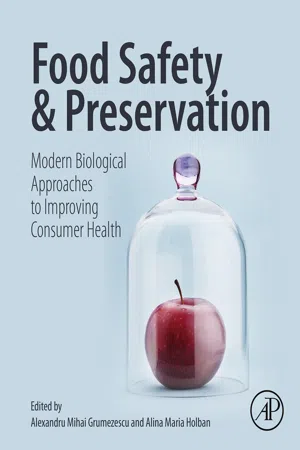
Food Safety and Preservation
Modern Biological Approaches to Improving Consumer Health
- 696 pages
- English
- ePUB (mobile friendly)
- Available on iOS & Android
eBook - ePub
Food Safety and Preservation
Modern Biological Approaches to Improving Consumer Health
About this book
Food Safety and Preservation: Modern Biological Approaches to Improving Consumer Health explores the most recent and investigated hot topics in food safety, microbial contamination, food-borne diseases and advanced preservation methods. It brings together the significant, evidence-based scientific progress of various approaches to improve the safety and quality of foods, also offering solutions to help address food industry challenges. Recent studies and technological advancements in biological control are presented to control foodborne pathogens. In addition, analytical methods for reducing potential biological hazards make this book essential to researchers, scientists, technologists and grad students.
- Covers all aspects of food contamination, from food degradation, to food-borne diseases
- Examines validated, biological control approaches to reduce microbial and chemical contamination
- Includes detailed discussions of risk and safety assessments in food preservation
Information
Chapter 1
A Critical Appraisal of Different Food Safety and Quality Management Tools to Accomplish Food Safety
Siva K. Korada*; Nagendra S. Yarla†; Swathi Putta‡; Avinash S. Hanumakonda*; Dhananjaya B. Lakkappa§; Anupam Bishayee¶; Luciana Scottiǁ; Marcus T. Scottiǁ; Gjumrakch Aliev#,⁎⁎,††; Mohammad A. Kamal‡‡,§§; Da-Yong Lu¶¶; Mukerrem B.Y. Aycanǁǁ; Raffaella Reggi##; Maura Palmery##; Ghulam Ashraf‡‡; Thonas Alexiou§§; Ilaria Peluso*** * National Institute of Food Technology Entrepreneurship and Management (NIFTEM), Sonipat, Haryana, India
† City University of New York Medical School, New York, NY, United States
‡ Andhra University, Vishakhapatnam, India
§ Jain University, Ramanagara, India
¶ Larkin Health Sciences Institute, Miami, FL, United States
ǁ Federal University of Paraiba, João Pessoa, Brazil
# “GALLY” International Biomedical Research Consulting LLC, San Antonio, TX, United States
** University of Atlanta, Johns Creek, GA, United States
†† Institute of Physiologically Active Compounds Russian Academy of Sciences, Chernogolovka, Russia
‡‡ King Abdulaziz University, Jeddah, Saudi Arabia
§§ Novel Global Community Educational Foundation, Hebersham, NSW, Australia
¶¶ Shanghai University, Shanghai, China
ǁǁ University of Erciyes, Kayseri, Turkey
## “La Sapienza” University of Rome, Rome, Italy
*** Research Centre for Food and Nutrition (CREA-AN), Rome, Italy
† City University of New York Medical School, New York, NY, United States
‡ Andhra University, Vishakhapatnam, India
§ Jain University, Ramanagara, India
¶ Larkin Health Sciences Institute, Miami, FL, United States
ǁ Federal University of Paraiba, João Pessoa, Brazil
# “GALLY” International Biomedical Research Consulting LLC, San Antonio, TX, United States
** University of Atlanta, Johns Creek, GA, United States
†† Institute of Physiologically Active Compounds Russian Academy of Sciences, Chernogolovka, Russia
‡‡ King Abdulaziz University, Jeddah, Saudi Arabia
§§ Novel Global Community Educational Foundation, Hebersham, NSW, Australia
¶¶ Shanghai University, Shanghai, China
ǁǁ University of Erciyes, Kayseri, Turkey
## “La Sapienza” University of Rome, Rome, Italy
*** Research Centre for Food and Nutrition (CREA-AN), Rome, Italy
Abstract
Food safety has become an emerging issue these days, because of the consumer concern as well as the regulatory concerns toward quality and safety of food. Physical, chemical, and biological contaminants action are the tri- factorial causes of food spoilage. To minimize or manage the food safety risk, there is a need to design and implement food safety and quality standards and quality assurance systems in food industries in order to produce safe food. Food safety requires very close concern at all stages in the food chain from farm to folk, which involves the harvesting stage to the consumption stage. Expansion of food supply chain takes place from the regional level to the international level, and therefore there must be a mutual understanding needed between government bodies, manufacturers, and customers. This chapter gives a overview picture of different food safety certification schemes and quality management systems & other popular standards to bring out quality products from a food industry in a safe manner.
Keywords
Food safety; Quality management; Hazard; Design and implementation
1.1 Introduction
Food safety always talks about the safe food that should be free from unintentionally added components like contaminants (physical, chemical, and biological contaminants) or intentionally added components like adulterants. Both adulterants and contaminants can make the food unsafe for human consumption and can cause health hazards (Aggarwal, n.d.). Food-borne threats like microbial and chemical contaminants can continuously associate with public health risks and can lead to a decrease in food trade with significant financial losses and social costs.1 Controlling of entry of contaminants into the food chain is a difficult task. It may enter at any point from the harvesting stage to the consumption stage. Several issues are responsible for contaminant/hazard entry into a food production process flow, which include poor sanitary practices, poor handling practices, poor manufacturing practices, poor transportation and storage practices, and usage of contaminated primary commodities like raw materials, the absence of proper control and preventive measures at each and every stage of the food chain, etc.2 Supplying/exporting of poor quality and contaminated food to foreign countries may lead to the cancellation of consignments and it creates a big barrier to trade, reflecting decreases in foreign exchange. In order to facilitate the global trade of Indian products and making their availability in major leading retailer chains, food safety industry standards play a key role in producing the product safely in a consistent manner. In 2006, Food Safety and Standard Authority of India (FSSAI)—a regulatory body under the Ministry of Human Health and Welfare—came into force to implement the science-based standards to provide safe food throughout the food supply chain for customer consumption. Initially India is supported by different sector-based acts. After implementation of FSSAI everything got canceled and was laid on a single platform.3 It is observed that most of the food business operators are not aware of the different standards of demand by the exporting countries and even about our Indian standards. In a survey conducted by FICCI recently it came to be known that nearly 30% of food business operators and industry holders are unaware of compulsory implementation of FSSAI standards to run a business (The Financial Express, 2010). This information is an attempt to create awareness among food business operators, primary producers, manufacturers, and retailers related to the different food safety certification schemes and standards to bring out safe and quality products from a food industry.
1.2 The Emerging Scenario of Contaminants and Residues Related to Food Safety
These days food safety has already become a global concern. Chemical residues and biological contaminants are constantly pushed to cause food safety risks and are also continuously disrupting economic growth and international trade. Food safety regulators all over the globe have shown an increased concern toward antibiotic residues, pesticides, and biological contaminants because of rampant of incidents happened during food exporting. For instance, a recent issue happened to be the ban on import of Indian Alphonso mango in the European Union (EU) temporarily because of pest infestation which resulted in the development of trade barriers for exporters (EU bans Indian Alphonso mangoes, 4 vegetables from May 1, 2014). Another case of ban happened is with the exporting of Indian honey to the EU because of high doses of antibiotic application for the purpose of beekeeping which resulted in high levels of antibiotic residues in honey compared to the set standards. Upon shipment to EU and followed by inspection with those food safety investigators it has been found that the presence of cross-contaminated antibiotics in honey is at higher levels compared to those EU norms. In addition, they also found lead contamination in that respective shipment. Hence, it leads to the cancellation of consignment and now EU is showing no more interest in accepting Indian honeys (Schneider, 2011). Similarly, after the ban of Indian Alphonso mango temporarily by the EU another product under examination for banning by the importers is Indian green chilies by Saudi Arabia. They recently expressed their c...
Table of contents
- Cover image
- Title page
- Table of Contents
- Copyright
- Contributors
- Preface
- Chapter 1: A Critical Appraisal of Different Food Safety and Quality Management Tools to Accomplish Food Safety
- Chapter 2: Food Safety: Benefits of Contamination Control on Consumers’ Health
- Chapter 3: Preemptive and Proactive Strategies for Food Control and Biosecurity
- Chapter 4: Validation of Analytical Methods for the Assessment of Hazards in Food
- Chapter 5: The Detection of Pesticide in Foods Using Electrochemical Sensors
- Chapter 6: Multiway Calibration Approaches for Quality Control of Food Samples
- Chapter 7: Biocontrol as an Efficient Tool for Food Control and Biosecurity
- Chapter 8: Foodborne Diseases and Responsible Agents
- Chapter 9: Challenges in Emerging Food-Borne Diseases
- Chapter 10: Opportunistic Food-Borne Pathogens
- Chapter 11: Food Poisoning and Intoxication: A Global Leading Concern for Human Health
- Chapter 12: Staphylococcal Food Poisoning
- Chapter 13: Campylobacter: An Important Food Safety Issue
- Chapter 14: Food Contamination: From Food Degradation to Food-Borne Diseases
- Chapter 15: A Review on the Implications of Interaction Between Human Pathogenic Bacteria and the Host on Food Quality and Disease
- Chapter 16: Novel Strategies for the Reduction of Microbial Degradation of Foods
- Chapter 17: Relevance and Legal Frame in Novel Food Preservation Approaches for Improving Food Safety and Risks Assessment
- Chapter 18: The Current Approaches and Challenges of Biopreservation
- Chapter 19: Modern Preservation Tools Through Packaging for High Hydrostatic Pressure Processing
- Chapter 20: Natural Food Preservatives Against Microorganisms
- Index
Trusted by 375,005 students
Access to over 1.5 million titles for a fair monthly price.
Study more efficiently using our study tools.
Frequently asked questions
Yes, you can cancel anytime from the Subscription tab in your account settings on the Perlego website. Your subscription will stay active until the end of your current billing period. Learn how to cancel your subscription
No, books cannot be downloaded as external files, such as PDFs, for use outside of Perlego. However, you can download books within the Perlego app for offline reading on mobile or tablet. Learn how to download books offline
Perlego offers two plans: Essential and Complete
- Essential is ideal for learners and professionals who enjoy exploring a wide range of subjects. Access the Essential Library with 800,000+ trusted titles and best-sellers across business, personal growth, and the humanities. Includes unlimited reading time and Standard Read Aloud voice.
- Complete: Perfect for advanced learners and researchers needing full, unrestricted access. Unlock 1.5M+ books across hundreds of subjects, including academic and specialized titles. The Complete Plan also includes advanced features like Premium Read Aloud and Research Assistant.
We are an online textbook subscription service, where you can get access to an entire online library for less than the price of a single book per month. With over 1.5 million books across 990+ topics, we’ve got you covered! Learn about our mission
Look out for the read-aloud symbol on your next book to see if you can listen to it. The read-aloud tool reads text aloud for you, highlighting the text as it is being read. You can pause it, speed it up and slow it down. Learn more about Read Aloud
Yes! You can use the Perlego app on both iOS and Android devices to read anytime, anywhere — even offline. Perfect for commutes or when you’re on the go.
Please note we cannot support devices running on iOS 13 and Android 7 or earlier. Learn more about using the app
Please note we cannot support devices running on iOS 13 and Android 7 or earlier. Learn more about using the app
Yes, you can access Food Safety and Preservation by Alexandru Mihai Grumezescu,Alina Maria Holban in PDF and/or ePUB format, as well as other popular books in Technology & Engineering & Food Science. We have over 1.5 million books available in our catalogue for you to explore.