- 434 pages
- English
- ePUB (mobile friendly)
- Available on iOS & Android
eBook - ePub
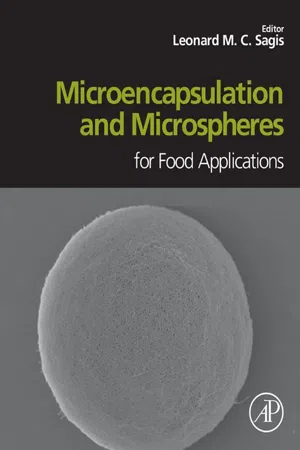
Microencapsulation and Microspheres for Food Applications
About this book
Microencapsulation and Microspheres for Food Applications is a solid reflection on the latest developments, challenges, and opportunities in this highly expanding field. This reference examines the various types of microspheres and microcapsules essential to those who need to develop stable and impermeable products at high acidic conditions. It's also important for the novel design of slow releasing active compound capsules.
Each chapter provides an in-depth account of controlled release technologies, evidence based abstracts, descriptions of chemical and physical principals, and key relevant facts relating to food applications. Written in an accessible manner, the book is a must have resource for scientists, researchers, and engineers.
- Discusses the most current encapsulation technology applied in the food industry, including radiography, computed tomography, magnetic resonance imaging, and dynamic NMR microscopy
- Presents the use of microsphere immunoassay for mycotoxins detection
- Covers a broad range of applications of microcapsules and microspheres, including food shelf-life, pesticides for crop protection, and nanoencapsulated bacteriophage for food safety
Information
Section III
Microencapsulation of Food Components
Outline
Chapter 12
Microencapsulation of Essential Oils Using Spray Drying Technology
Diego Alvarenga Botrel, Regiane Victória de Barros Fernandes and Soraia Vilela Borges, Food Science Department, Federal University of Lavras, Lavras-MG, Brazil
Essential oils are used for flavorings and aromas in foods, cosmetics, and personal hygiene products because of their chemical and functional properties. Moreover, the antimicrobial and anti-oxidant properties of these essential oils are increasingly being studied. These oils contain many components, including secondary metabolites from plants, and are mainly composed of mono- and sesquiterpene hydrocarbons and their oxygenated derivatives, among others. Essential oils are highly susceptible to changes caused by external factors such as light, oxygen, and temperature, in addition to being prone to evaporating. To reduce these effects, the process of microencapsulation has become an alternative. Microencapsulation is a technique where the material of interest is encapsulated in a polymeric matrix, with spray drying being the most commonly used technique. Studies on the drying processes and the search for new formulations and polymer types are trends in this sector.
Keywords
Atomization; carbohydrate; flavor; microparticles; oil retention; polymer
12.1 Introduction
Synthetic flavorings, essential oils, and natural oleoresins are the main aromatic components used by the food industry. Recently, the aroma market has focused on using aromatic substances originating from natural sources to substitute for synthetic aromas. Essential oils are used as flavorings and aromas in foods, cosmetics, and personal hygiene products because of their chemical and functional properties. Moreover, the antimicrobial and anti-oxidant properties of these essential oils are increasingly being studied. Essential oils are liquid products obtained from plants, generally by means of hydrodistillation. These oils contain many components, including secondary metabolites from plants, and are mainly composed of mono- and sesquiterpene hydrocarbons and their oxygenated derivatives, among others. The stability of essential oil components is of great interest, since it is related to quality and consumer acceptance of products. Essential oils are highly susceptible to changes caused by external factors such as light, oxygen, and temperature, in addition to being prone to evaporating. To reduce these effects, the process of microencapsulation has become an alternative. Microencapsulation is a technique in which the material of interest is encapsulated in a polymeric matrix, with spray drying being the most commonly used technique. The choice of polymer type, matrix stability, and feed and drying conditions are variables of interest, with importance for the properties and characteristics of the final product. Studies on the drying processes and the search for new formulations and polymer types are trends in this sector.
12.2 Essential Oils
Essential oils have been widely used worldwide, and their use is increasing because of high demand for pure and natural ingredients in diverse market segments. Essential oils of plant origin are commonly used as flavoring agents in food and drink, perfume, pharmaceuticals, and cosmetic products. In addition to these applications, they present antimicrobial properties that may make them efficient alternatives to the use of antibiotics (which are responsible for the increase in resistant bacteria) and chemical additives (which are potentially carcinogenic).
Considerable quantities of essential oils are produced worldwide to supply these industries. The prices of these products vary and are related to the supply of raw materials, harvest-related issues, climatic factors, and the extraction yield. Around 3000 essential oils have been produced, 300 of which are commercially important. Many factors affect the chemical composition of essential oils, including genetic variation, plant type or variety, plant nutrition, fertilizer application, plant geographic location, climate, seasonal variations, stress during growth or maturation, as well as post-harvest drying and storage. Moreover, the type of plant material used and the extraction method determine the yield and composition of an essential oil, thus influencing its functional properties. For example, an essential oil extracted from different parts of the plant, such as flowers (rose and jasmine), leaves (rosemary and eucalyptus), stems (clove), roots (ginger), fruits (anise), and bark/peel (cinnamon and orange) show different biological and pharmaceutical properties (Raut and Karuppayil, 2014). Essential oils are normally extracted by distillation, cold pressing, or maceration, and their biological or antimicrobial activities are directly correlated with the presence of bioactive volatile components (Calo et al., 2015; Mahmoud and Croteau, 2002).
Because of the various processes and parameters involved, essential oils are complex matrices, consisting of hundreds of compounds with varied structures and functional groups. This chemical diversity may also result from chemical modifications that occur during the extraction process, for example, thermal activation of chemical reactions and the drying of the fresh raw materials (Do et al., 2015). Chemically, essential oils are composed of compounds of terpene, alcohols, acids, esters, epoxides, aldehydes, ketones, and amines (Bakkali et al., 2008; Calo et al., 2015).
The diversity of chemical functions found in essential oils provides for a variety of properties and consequently diverse applications. On the other hand, these compounds may also have undesirable properties, such as allergenicity or toxicity, resulting in safety concerns. For this reason, standards and specifications have been established by national authorities and international organizations to limit and control the use of essential oils (Do et al., 2015).
Due to their hydrophobic nature and density, often lower than water, essential oils are generally lipophilic, soluble in organic solvents, and not miscible with water. Extraction methods may be classified into two categories: conventional/classic methods (hydrodistillation, carrying by steam, extraction by organic solvents, and cold pressing) and advanced/innovative methods (extraction with supercritical fluids, and microwave-assisted). The search for new technologies in recent decades has led to the emergence of newer, more efficient extraction processes, with reduced extraction time and energy consumption, increased extraction yield, and better-quality essential oils (Asbahani et al., 2015).
Essential oils are normally liquid at room temperature and contain volatile and unstable compounds. As such, if unprotected from external factors, they may easily be degraded by oxidation, volatilization, heat, and light. Because essential oils are not soluble in aqueous media, it is often necessary to perform some type of transformation before use (Centini et al., 2007; Szente and Szejtli, 2004; Uekama et al., 1998). The components from essential oils may be protected by applying microencapsulation technologies, thus extending their performance and controlling their release by external means. These methods are usually economically viable, fast, and efficient.
Essential oils, especially those rich in monoterpenes, are generally used as flavoring ingredients (Gharsallaoui et al., 2007). Many investigations have studied various process variables involving microencapsulation by spray drying of essential oils, such as oregano (Botrel et al., 2012), rosemary (Fernandes et al., 2013a,b), mint (Sarkar et al., 2013), and lemon (Janiszewska et al., 2015). Their use in flavoring, however, is limited by the quantity of raw material allowed to be added to the product. The aromas of essential oils may be transmitted in excess to food, which negatively influences consumer acceptance. Moreover, the stability of the flavor components in foods has attracted attention because of its relationship to the quality and acceptability of the food products containing them (Jun-Xia et al., 2011).
All the potential attr...
Table of contents
- Cover image
- Title page
- Table of Contents
- Copyright
- List of Contributors
- Section I: Microcapsules and Microspheres Produced for Application in Food
- Section II: Methods to Analyse Structure, Release Properties, and Stability
- Section III: Microencapsulation of Food Components
- Index
Trusted by 375,005 students
Access to over 1.5 million titles for a fair monthly price.
Study more efficiently using our study tools.
Frequently asked questions
Yes, you can cancel anytime from the Subscription tab in your account settings on the Perlego website. Your subscription will stay active until the end of your current billing period. Learn how to cancel your subscription
No, books cannot be downloaded as external files, such as PDFs, for use outside of Perlego. However, you can download books within the Perlego app for offline reading on mobile or tablet. Learn how to download books offline
Perlego offers two plans: Essential and Complete
- Essential is ideal for learners and professionals who enjoy exploring a wide range of subjects. Access the Essential Library with 800,000+ trusted titles and best-sellers across business, personal growth, and the humanities. Includes unlimited reading time and Standard Read Aloud voice.
- Complete: Perfect for advanced learners and researchers needing full, unrestricted access. Unlock 1.5M+ books across hundreds of subjects, including academic and specialized titles. The Complete Plan also includes advanced features like Premium Read Aloud and Research Assistant.
We are an online textbook subscription service, where you can get access to an entire online library for less than the price of a single book per month. With over 1.5 million books across 990+ topics, we’ve got you covered! Learn about our mission
Look out for the read-aloud symbol on your next book to see if you can listen to it. The read-aloud tool reads text aloud for you, highlighting the text as it is being read. You can pause it, speed it up and slow it down. Learn more about Read Aloud
Yes! You can use the Perlego app on both iOS and Android devices to read anytime, anywhere — even offline. Perfect for commutes or when you’re on the go.
Please note we cannot support devices running on iOS 13 and Android 7 or earlier. Learn more about using the app
Please note we cannot support devices running on iOS 13 and Android 7 or earlier. Learn more about using the app
Yes, you can access Microencapsulation and Microspheres for Food Applications by Leonard M.C. Sagis in PDF and/or ePUB format, as well as other popular books in Technology & Engineering & Food Science. We have over 1.5 million books available in our catalogue for you to explore.