- 712 pages
- English
- ePUB (mobile friendly)
- Available on iOS & Android
eBook - ePub
About this book
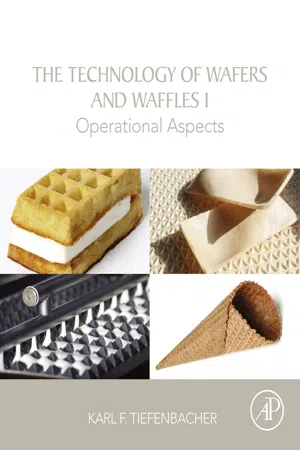
The Technology of Wafers and Waffles: Operational Aspects is the definitive reference book on wafer and waffle technology and manufacture. It covers specific ingredient technology (including water quality, wheat flour, starches, dextrins, oils and fats) and delves extensively into the manufacturing elements and technological themes in wafer manufacturing, including no/low sugar wafers, hygroscopic wafers, fillings and enrobing.
The book explains, in detail, operating procedures such as mixing, baking, filling, cooling, cutting and packaging for every type of wafer: flat and shaped wafers for making biscuits, ice cream cones, cups, wafer reels, wafer sticks (flute wafers) and biscuit wafers. It also explores the various types of European (Belgian) waffles and North American frozen waffles.
- Serves as a complete reference book on wafer and waffle technology and manufacturing, the first of its kind
- Covers specific ingredient technology such as water quality, wheat flour, starches, dextrins, oils and fats for wafer and waffles
- Explores wafer and waffle product types, development, ingredients, manufacturing and quality assurance
- Explains the scientific background of wafer and waffle baking
- Informs both artisan and industrial bakers about many related areas of bakery product manufacturing
Information
Chapter One
Introduction
Abstract
The chapter provides definitions for wafers and waffles and a description of the various products in the market. Some historical information discussed the origin of contemporary wafers and waffles.
Keywords
Definition; History; Terminology; Wafer; Waffle
1.1 Terminology and Definitions in Wafers and Waffles
1.1.1 Wafers
1.1.1.1 Two Meanings
The word wafer in food technology has two meanings
(1) Light, thin and crisp food items baked from batters.
(2) Thin, crisp cookies (biscuits)—a term primarily used in the United States.
Within the book we exclusively talk about the first mentioned wafers—the light, thin and crisp food items baked from batters.
1.1.1.2 The Characteristics of Wafers
Most wafers bake in hot metal moulds and are available in sheets, hollow figures, wafer cones or with different intricate shapes. Flute wafers (wafer sticks) bake on hot metal drums. Characteristic features are the following:
a. Wafers are very thin biscuits with an overall thickness of about 2.5 mm (range from less than 1 to 5 mm) and they quite frequently have the typical narrowly spaced wafer pattern on both sides. Wafer paper is a similar product baked in sheets of less than 1 mm thickness without any pattern.
b. Wafers show precisely formed, smooth surfaces. These have details such as reedings or logos grooved into the baking moulds.
c. Wafers are of a delicate, crisp and light texture. The specific gravity of flat and hollow wafers is 0.2 g/cm3 or less. In the cross section you see a highly aerated matrix, primarily composed of gelatinized starch.
d. The crispness of wafers is a result of the low residual moisture after baking, typically in the range of 1%–2%. The starch-protein matrix is in the glassy state. Wafers are quite hygroscopic and require high moisture barrier packaging. The crisp texture is lost at about 6%–7% moisture content.
1.1.1.3 The Two Basic Types of Wafers
1. No/low sugar wafers
Those contain zero to a few percent of sucrose or other sugars on a flour base. Typical products are flat and hollow wafer sheets and moulded wafer cones and cups—all of them baked in closed moulds under pressure with substantial steam leavening. With sheet wafer processing after baking, the wafer typically is sandwiched to form wafer biscuits with sweet fillings, and the wafer biscuit may then be enrobed with chocolate.
Those contain zero to a few percent of sucrose or other sugars on a flour base. Typical products are flat and hollow wafer sheets and moulded wafer cones and cups—all of them baked in closed moulds under pressure with substantial steam leavening. With sheet wafer processing after baking, the wafer typically is sandwiched to form wafer biscuits with sweet fillings, and the wafer biscuit may then be enrobed with chocolate.
2. Sugar wafers
More than 10% of sugars on a flour base result in some plasticity of the freshly baked hot wafers. At even higher sugar percentages, the wafers are formed into different shapes by rolling, pressing or deep forming; this is possible before the sugar resolidifies during the cooldown. There is a wide range of sugar wafer products:
More than 10% of sugars on a flour base result in some plasticity of the freshly baked hot wafers. At even higher sugar percentages, the wafers are formed into different shapes by rolling, pressing or deep forming; this is possible before the sugar resolidifies during the cooldown. There is a wide range of sugar wafer products:
• Sugar wafer cones: moulded, rolled or rolled and deep-formed into cups.
• Sugar wafer reels.
• Flute wafers (wafer sticks, wafer rolls).
• Fan wafers and fortune cookies.
• Sugar wafer cookies, the crisp or crumbly part in the range of waffles.
For both types of wafers, the main ingredient is wheat flour. That fits very well into current dietary recommendations to consume more cereals. Moreover, wafer products with a partial replacement of wheat flour and gluten-free wafers are increasingly available.
Industrially manufactured wafers belong to the category of bakery products with a long shelf life, which also includes crackers, pretzels and biscuits (cookies).
1.1.1.4 Maintaining Consistent Terminology
For the crisp wafer products, baked almost dry to about 2% moisture or less, do not use the term ‘waffle’. The unreflecting mixed use of wafer and waffle is a great source of confusion in the patent, scientific, and common literature and on the internet. Waffles are of a soft texture, with a moisture content of 10% or more.
1.1.2 Waffles
Waffles baked from batters or doughs in indented waffle irons show a raised, cake-like texture. The spacing of the waffle pattern typically is wider than in wafers. Aeration, chemical leavenings, or yeast leavens them. Waffles are convenience foods, eaten either as a snack or as a breakfast item. Due to local traditions or eating habits acquired more recently, there is a wide variety of waffle products. Today we find the following main groups of waffle products in the market:
1. Ready-to-eat (RTE) waffles are made from rich recipes that include eggs, sugars and fats. Due to their moisture content of 10% or more, they are of a soft texture. Their origin is in the Belgium—Netherlands—Northern France area in Western Europe. Some waffle names reflect this, although RTE waffles are available worldwide.
2. Crisp, thin waffles from the same area, which in fact are wafer cookies (biscuits) (nl/fr galetten/galettes). Instead of the cookie baking oven process, these bake between waffle-patterned plates and have a low residual moisture content.
3. Frozen waffles are based on lean recipes that include just little of eggs, sugars and fats or even are nonsweet. These are partially baked until there is about 40% moisture left, and they are sent to a freezer immediately; their cooking is completed in the toaster or microwave oven immediately before consumption. Frozen waffles are common in North America and have been since the 1950s due to the widely available logistics for the distribution of frozen foods. In Europe, only industrially manufactured ‘Brussels waffles’ require frozen distribution. In combination with a variety of either sweet or savoury toppings, they are ideal for breakfast and quick lunch.
1.1.2.1 Maintaining Consistent Terminology
For the soft-textured waffles, connected to a moisture content of 10% or more, do not use the term ‘wafer’. The unreflecting mixed use of waffle and wafer is a great source of confusion in the patent, scientific, and common literature and on the internet. Wafers are baked almost dry to about 2% moisture, and they are of a crisp texture.
For the crisp-textured wafer cookies (biscuits) (nl/fr galetten/galettes), baked almost dry to about 2% moisture, do not use the term ‘waffle’ as well.
1.1.3 The Various Products and Terms in the Wafers and Waffles Segment
1.1.3.1 Belgian Waffles
The term ‘Belgian waffles’ is not a traditional one; it was coined in the United States more recently for RTE waffles in difference to the North American frozen waffles.
1.1.3.2 Communion Wafer (Host, Altar/Eucharistic/Sacramental Bread)
Communion wafer are small, thin no-sugar wafers for religious services. They are made from wafer paper batters consisting of just water, flour and/or starch. Communion wafers frequently carry reliefs with symbols. They are frequently round and stamped.
1.1.3.3 Fan Wafers
Fan wafers are crunchy, sweet tasting and fan-shaped sugar wafer pieces. The manufacturing is by either of the following processes:
1. Baking sugar wafer batter between baking plates into thin, round wafer discs. The hot pliable discs—by folding, post forming, possibly in combination with embossing and cutting of the edges—form into fans.
2. Folding a thin, ...
Table of contents
- Cover image
- Title page
- Table of Contents
- Copyright
- Dedication
- Preface
- Foreword
- Chapter One: Introduction
- Chapter Two: Technology of Main Ingredients—Water and Flours
- Chapter Three: Technology of Main Ingredients—Sweeteners and Lipids
- Chapter Four: Technology of Minor Ingredients for Wafers and Waffles
- Chapter Five: Adjuncts—Filling Creams, Inclusions, Cacao and Chocolate
- Chapter Six: Wafer Sheet Manufacturing: Technology and Products
- Chapter Seven: Technology of Other Crisp Wafers
- Chapter Eight: After-Bake Technology of Crisp Wafers and of Soft Waffles
- Chapter Nine: Waffles—An Overview in Products and Technology
- Index
- Short Table of Contents of Forthcoming Book
Trusted by 375,005 students
Access to over 1.5 million titles for a fair monthly price.
Study more efficiently using our study tools.
Frequently asked questions
Yes, you can cancel anytime from the Subscription tab in your account settings on the Perlego website. Your subscription will stay active until the end of your current billing period. Learn how to cancel your subscription
No, books cannot be downloaded as external files, such as PDFs, for use outside of Perlego. However, you can download books within the Perlego app for offline reading on mobile or tablet. Learn how to download books offline
Perlego offers two plans: Essential and Complete
- Essential is ideal for learners and professionals who enjoy exploring a wide range of subjects. Access the Essential Library with 800,000+ trusted titles and best-sellers across business, personal growth, and the humanities. Includes unlimited reading time and Standard Read Aloud voice.
- Complete: Perfect for advanced learners and researchers needing full, unrestricted access. Unlock 1.5M+ books across hundreds of subjects, including academic and specialized titles. The Complete Plan also includes advanced features like Premium Read Aloud and Research Assistant.
We are an online textbook subscription service, where you can get access to an entire online library for less than the price of a single book per month. With over 1.5 million books across 990+ topics, we’ve got you covered! Learn about our mission
Look out for the read-aloud symbol on your next book to see if you can listen to it. The read-aloud tool reads text aloud for you, highlighting the text as it is being read. You can pause it, speed it up and slow it down. Learn more about Read Aloud
Yes! You can use the Perlego app on both iOS and Android devices to read anytime, anywhere — even offline. Perfect for commutes or when you’re on the go.
Please note we cannot support devices running on iOS 13 and Android 7 or earlier. Learn more about using the app
Please note we cannot support devices running on iOS 13 and Android 7 or earlier. Learn more about using the app
Yes, you can access The Technology of Wafers and Waffles I by Karl F. Tiefenbacher in PDF and/or ePUB format, as well as other popular books in Technology & Engineering & Food Science. We have over 1.5 million books available in our catalogue for you to explore.