eBook - ePub
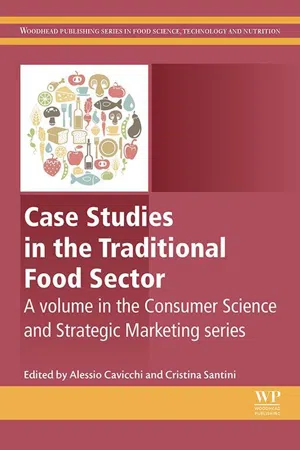
Case Studies in the Traditional Food Sector
A volume in the Consumer Science and Strategic Marketing series
- 376 pages
- English
- ePUB (mobile friendly)
- Available on iOS & Android
eBook - ePub
Case Studies in the Traditional Food Sector
A volume in the Consumer Science and Strategic Marketing series
About this book
Consumer Science and Strategic Marketing: Case Studies in the Traditional Food Sector aims to close the gap between academic researchers and industry professionals through real world scenarios and field-based research. The book explores how consumer and sensory science has been implemented in the food industry for achieving the following strategic aims: rejuvenating product image, shaping new market places, achieving market differentiation and geographical diffusion, achieving customer loyalty, promoting traditional features of the product and defining product positioning in competitive environment.
There is an emerging demand from food industry professionals and undergraduate and postgraduate students who attend business and agricultural studies courses who want to gain practical information through real cases and field-based research. This book aims to answer the following questions, amongst others: How research in the field of consumer science became relevant for marketing strategies?, Which tangible economic and financial outcomes have been obtained by the joint work of sensory scientists, researchers in marketing field and food business professionals?, and which communication methods and practices have been relevant to make the most of R&D in the food industry?
Through case studies, successful examples and practices are provided, with newer inputs for further theoretical investigation given. Both current and future professionals in the food industry will gain insights that can be used in their business environment.
- Bridges the gap between scholars and practitioners in understanding consumers in the traditional food sector
- Allows scientists and professionals to make the most of R&D outcomes
- Advances consumer science research to address business problems in the food industry
Information
Subtopic
Scienze dell'alimentazionePart I
Traditional Foods: Definitions, Challenges and Consumer Trends
Outline
Chapter 1
Traditional Food
Definitions and Nuances
Francesca Galli, University of Pisa, Pisa, Italy
Abstract
Traditional food products (TFPs) represent an important element of culture, identity, and heritage and are characterized by both historical and geographical dimensions. The increasing attention shown in the past 25 years by academics, politicians, and food system actors, and their recognition through Geographical Indications, stems from their implications on economic, juridical, political and social grounds.
This introductory chapter addresses definitions and nuances of TFPs with reference to the three main rationales behind legal recognition and protection of origin products. By drawing on available literature, and addressing the interests of actors across the food system, we emphasize a set of critical issues in relation to the supply of credible information to consumers, the remuneration of farmers and processors, and the provision of public goods and rural development.
Keywords
Traditional food products; Geographical Indications; origin; asymmetric information; competitiveness; rural development; quality
Introduction
Traditional food products (TFPs) constitute food products elaborated according to tradition, a “long established custom that has been passed from generation to generation” (Tradition here defined as in the Oxford dictionary, https://en.oxforddictionaries.com/definition/tradition (accessed on 31/10/2016)). The European Parliament and the Council of the European Union (2012) defines TFPs as products with “proven usage on the domestic market for a period that allows transmission between generations; this period is to be at least 30 years.” As such, they represent an important element of culture, identity, and heritage (Committee of the Regions, 1996). The quality and identity of such products reflect the link between the specificities of a place (i.e., the origin) and the people living there, and they represent the result of a long-standing effort of enterprises localized in the specific area that manage and communicate the quality of their products, defending and increasing their reputation. From these general definitions it descends that TFPs are characterized by both historical and geographical dimensions.
Food culture is extremely heterogeneous, since noticeable differences exist not only at a global level but also from national, regional and local points of view in food preferences, habits, food-related behavior, and attitudes (Askegaard and Madsen, 1998). Moreover, the range of foods continually evolves over time and traditional foods are being re-invented and re-adapted according to new needs and requirements. A variety of terms—local, original, typical, specialty, etc.—are used to convey the concept inherent to traditional food (Verbeke et al., 2016). The challenge to providing a clearcut definition is thus linked to the complex set of meanings associated to a concept that is inevitably relative, and shaped according to different points of observation and interests.
TFPs may or may not possess some form of origin labeling, although they are often sold under different collective trademarks, i.e., quality labels. Geographical Indications (GIs) is used as a generic term for names or signs used on food products that correspond to a specific geographical location. Protected Designations of Origin (PDO) and Protected Geographical Indications (PGIs) (Protected Designations of Origin (PDO) and Protected Geographical Indications (PGIs) for the identification of specialty food products are labeling schemes that grant producer groups the right to label the geographical origin of their products, in order to make them recognizable to consumers. Based on the definition provided by EC Reg. 1151/2012, for a PDO product the link with the territory of origin is related both to the provenance of the raw materials and to the area where the processing stage takes place, according to a particular processing technique that has been developed locally, by means of tradition over time. For a PGI product, the link to the territory relates to the area where the processing stage takes place, allowing for the raw material to be provided from outside the officially identified processing area.) are specific forms of GIs, among the instruments of the European food quality policy, that not only convey the geographical origin of the product but make a direct link between geographical origin and the quality of the product. The main justification behind GI protection is that for some products there is a strong relationship between either the nature of the product, its reputation, and/or identity, and its place of production and that this relationship is important to consumers (or at least to some of them). Naming a product after the place of origin conveys information on its very nature and—as it happens for PDOs and PGIs—a legal framework for protecting product and place names and for assigning rights to their use can be established. The geographical boundaries allowed for producing these products are defined and traditional production rules are set (e.g., varieties/races and transformation rules, calendar of operations, etc.) and the role of a compulsory third-party control body is affirmed (Balogh et al., 2016; Carbone et al., 2014).
The increasing attention shown in the past 25 years by academics, politicians, and food system actors stems from the relevance of traditional foods and GIs—both in terms of opportunities and controversies—on the economic, juridical, political and social grounds (Quiñones-Ruiz et al., 2016; Belletti et al., 2015; Rangnekar, 2010; Herrmann and Marauhn, 2009; Bramley and Kirsten, 2007). GIs have a worldwide resonance, well beyond European borders, as indicated by recent academic contributions on their impacts and effectiveness in developed and developing countries (Biénabe and Marie-Vivien, 2015; Zhao et al., 2014; Mancini, 2013; Galtier et al., 2013). Their introduction has sparked a debate both at the European and at the international level on the degree to which these policy schemes represent legitimate instruments to protect consumers from the risk of being misled in their purchase decisions and, at the same time, to protect and foster the distinctive reputation of some producers being usurped by unfair competitors. On the opposite side, some strongly held views claim that these are instruments of granting producers higher rents deriving from the possibility of excluding new entrants on the market and therefore an obstacle to fair competition (Josling, 2006).
The three rationales behind legal recognitions of origin products address specific interests across the food system: to consumers, they aim at providing credible information on different attributes (especially credence attributes) of food products; to farmers and processors, they should allow a fair remuneration for efforts in building individual and collective reputation; to collectivities, they preserve and foster cultural heritage related to the production and promotion of specialty products linked to a specific geographical territory, desirably in economically marginal areas.
This introductory chapter addresses definitions and nuances of “traditional food products,” by drawing on available literature. In the following sections I outline the main rationales of TFPs protection through GIs, by highlight the different perspectives across the food system. In the first section, the way TFPs are perceived and valued by consumers is addressed. The second section focuses on the opportunities for farmers and food processors, in terms of competitiveness and innovation. The third section addresses TFPs in relation to collectivities, local territories, and policies.
Traditional Food and Consumers
Consumer Drive for TFPs
Increasing academic literature in recent years indicates a renewed interest by consumers in traditional foods (Verbeke et al., 2016; Balogh et al., 2016; Almli et al., 2011; Pieniak et al., 2009; Guerrero et al., 2009). Different conceptions of what traditional food is contribute to explaining consumers’ motivations to purchase traditional foods (Verbeke et al., 2016). Guerrero et al. (2009) conducted a study across six European countries and defined traditional food from the European consumer’s perspective as “a product frequently consumed or associated with specific celebrations and/or seasons, normally transmitted from one generation to another, made accurately in a specific way according to the gastronomic heritage, with little or no processing/manipulation, distinguished and known because of its sensory properties and associated with a certain local area, region or country” (The authors focus on the meaning that the word “traditional” has in consumers’ minds and what values they relate to this concept, by adopting a free word association method. The different word associations obtained were classified in classes and then grouped in principal dimensions by triangulation. Four main dimensions were identified for the concept of TFP: habit-natural, orig...
Table of contents
- Cover image
- Title page
- Table of Contents
- Copyright
- List of Contributors
- About the Editors
- Foreword
- Preface
- “In Tradition We Trust”: The Emerging (?) Trends of Authenticity in the Food Sector and the Role of Consumer Science to Support SMEs
- Part I: Traditional Foods: Definitions, Challenges and Consumer Trends
- Part II: Sensory and Consumer Research Between Theory and Practice
- Part III: Adopting Innovative Marketing Strategies Based on Market Research Insights and Consumer Studies
- Part IV: Mature Products in a Mature Business? Challenges and Opportunities for Traditional Food Products
- Conclusions
- Index
Trusted by 375,005 students
Access to over 1.5 million titles for a fair monthly price.
Study more efficiently using our study tools.
Frequently asked questions
Yes, you can cancel anytime from the Subscription tab in your account settings on the Perlego website. Your subscription will stay active until the end of your current billing period. Learn how to cancel your subscription
No, books cannot be downloaded as external files, such as PDFs, for use outside of Perlego. However, you can download books within the Perlego app for offline reading on mobile or tablet. Learn how to download books offline
Perlego offers two plans: Essential and Complete
- Essential is ideal for learners and professionals who enjoy exploring a wide range of subjects. Access the Essential Library with 800,000+ trusted titles and best-sellers across business, personal growth, and the humanities. Includes unlimited reading time and Standard Read Aloud voice.
- Complete: Perfect for advanced learners and researchers needing full, unrestricted access. Unlock 1.5M+ books across hundreds of subjects, including academic and specialized titles. The Complete Plan also includes advanced features like Premium Read Aloud and Research Assistant.
We are an online textbook subscription service, where you can get access to an entire online library for less than the price of a single book per month. With over 1.5 million books across 990+ topics, we’ve got you covered! Learn about our mission
Look out for the read-aloud symbol on your next book to see if you can listen to it. The read-aloud tool reads text aloud for you, highlighting the text as it is being read. You can pause it, speed it up and slow it down. Learn more about Read Aloud
Yes! You can use the Perlego app on both iOS and Android devices to read anytime, anywhere — even offline. Perfect for commutes or when you’re on the go.
Please note we cannot support devices running on iOS 13 and Android 7 or earlier. Learn more about using the app
Please note we cannot support devices running on iOS 13 and Android 7 or earlier. Learn more about using the app
Yes, you can access Case Studies in the Traditional Food Sector by Alessio Cavicchi,Cristina Santini in PDF and/or ePUB format, as well as other popular books in Tecnologia e ingegneria & Scienze dell'alimentazione. We have over 1.5 million books available in our catalogue for you to explore.