- 520 pages
- English
- ePUB (mobile friendly)
- Available on iOS & Android
eBook - ePub
About this book
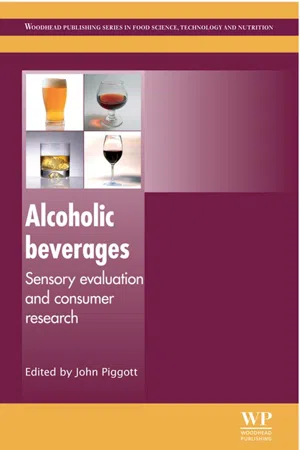
Sensory evaluation methods are extensively used in the wine, beer and distilled spirits industries for product development and quality control, while consumer research methods also offer useful insights as the product is being developed. This book introduces sensory evaluation and consumer research methods and provides a detailed analysis of their applications to a variety of different alcoholic beverages.Chapters in part one look at the principles of sensory evaluation and how these can be applied to alcoholic beverages, covering topics such as shelf life evaluation and gas chromatography – olfactometry. Part two concentrates on fermented beverages such as beer and wine, while distilled products including brandies, whiskies and many others are discussed in part three. Finally, part four examines how consumer research methods can be employed in product development in the alcoholic beverage industry.With its distinguished editor and international team of contributors, Alcoholic beverages is an invaluable reference for those in the brewing, winemaking and distilling industries responsible for product development and quality control, as well as for consultants in sensory and consumer science and academic researchers in the field.
- Comprehensively analyses the application of sensory evaluation and consumer research methods in the alcoholic beverage industry
- Considers shelf life evaluation, product development and gas chromatography
- Chapters examine beer, wine, and distilled products, and the application of consumer research in their production
Information
Subtopic
Food SciencePart I
Sensory evaluation: principles and application to alcoholic beverages
1
Overview of sensory perception
W.L.P. Bredie and P. Møller, The University of Copenhagen, Denmark
Abstract:
Perception of foods and beverages is mediated by the human senses, of which the five common senses play an important role. Sensory function at physiological and genetic levels is now understood in detail. This chapter provides details about the chemical senses, important for the perception of flavour. Chemical receptors for taste, smell and pain are widespread in the human body and are believed to have other functions, as in homeostasis and food intake regulation. Food perception is intertwined with the way humans select foods, food intake and learning of new food preferences. Sensory physiology undergoes changes and food preferences vary through life; perception of the sensory quality of foods is stable from early adolescence to old age.
Key words
food perception
common senses
sensory physiology
food interoception
preferences
1.1 Introduction
The appreciation of foods and beverages is strongly influenced by the sensory properties of the appearance, smell, flavour and texture. The sensory properties of foods are mediated through all our senses including the common senses of sight, touch, hearing, taste, and smell, as well as pain and temperature. Many of the perceptions humans have with foods become more familiar and liked upon repeated exposure and are thus learned throughout their lifespan. The sound of opening a can of beer will create expectations regarding the freshness of the product, and even such a perception that is less central to our awareness is not trivial for the total sensory quality experienced with the product. Although the common senses are quite central to the understanding of the perceived sensory quality, the sensations and feelings related to the desires to eat and satisfaction with the consumption of food should not be neglected. These feelings occur in the alimentary tract and are important drivers for food intake and termination of eating and drinking. As with perception of foods, which deals with the interaction of the senses with the environment, feelings in the body can be referred to as interoception.
Our senses of sight and touch can set up expectations of the overall flavour of food which can be very hard to ignore. For example, the presentation of a prestigious cognac in a cheap polystyrene container would ruin not only the expected quality, but also the perceived sensory quality. The interplay of the presentation, expectation and situation in which the food is made available plays an important role in the experienced sensory quality. Equally, the colour of food can affect our perception of the flavour both by enhancing the magnitude of perception, for example the fruity and strawberry flavours in red drinks (e.g. Small and Prescott, 2005).
Between all the senses, the most significant for our appreciation of foods and drinks remain the chemical senses, which encompass taste, smell and chemesthesis (pain, touch and temperature). Taste or gustation detects compounds dissolved in liquids using delicately organized chemosensors, mostly in the mouth. Smell or olfaction detects air borne compounds, both from the ambient air, but also from those emitted from the food in the oral cavity and throat to the nose. Chemesthesis mediates information about irritants through nerve endings in the skin as well as other borders between us and the environment, including the epithelia in the nose, mouth, eyes and in the alimentary tract.
In this chapter we will give a closer look at how our senses interact with foods and beverages. Special attention will be given to the role and function of the senses, especially the chemical senses, which are central in the perception of flavour. Furthermore, the chapter describes what happens in the mouth when drinking a beverage and how the sensory signals that arise are transduced and integrated in the human brain. Several mechanisms of human perception will be explained and described with the aim to give a better understanding about why sensory properties and preferences are so different for different foods and beverages.
1.2 The common senses
Humans are endowed with many senses which make it possible to obtain information about ‘what’ is ‘where’ in the environment. A fair number of these different senses, or sensory modalities, are of crucial importance for perception and affective evaluation of foods and drinks, as well as for choice behaviour, which have been demonstrated to rely far more on the sensory properties than upon any other parameters.
In English, and many other languages, the overall sensory impression of food and drink is usually described by the word ‘taste’. When we use the word in this sense it will be written in quotation marks, ‘taste’; without quotes we refer to the separate sense of taste. Besides helping us to choose and create expectations, visual perception also contributes to preparing the gastrointestinal system for digestion via a number of so-called cephalic reflexes, such as increasing the flow of saliva in the mouth. This aids the chewing process and facilitates transport of tastants to taste cells, increasing release of insulin in the pancreas and increasing release of acid in the stomach (Giduck et al., 1987; Mattes, 1997). Perception of food smells has also been demonstrated to have cephalic consequences. These effects take place via so-called orthonasal olfaction, or olfaction obtained by sniffing behaviour. This is different from the way the sense of smell contributes to the ‘taste’ of food and drink, which is referred to as retronasal olfaction. Recent work has suggested that retronasal and orthonasal olfaction might be distinct in many ways (Small et al., 2005), possibly reflecting the different functional roles they play in food and other behaviours.
Finally, interoception, the sensation of the internal physiological state of the body, plays a large role in food behaviour, probably in particular with respect to how preferences and habits change, seemingly outside our conscious control (Craig, 2002; Capaldi, 2001).
1.2.1 General definitions of taste and flavour
It is customary to talk of five basic tastes: sweet, salty, sour, bitter and umami. The last one, umami, is less well known than the other four. It is often described as the taste of bouillon or glutamate. Umami was discovered by Japanese scientists and the name is meant to indicate ‘pleasurable taste’, and is associated with seaweed, fermented soy and fish products. The concept of basic tastes comprises the idea that sweet, salty, sour, bitter and umami tastes are basic, in the sense that no one of them can be obtained by any combination of the other four, and that any taste sensation possible can be created by an appropriate mixture of the five basic tastes. The basic tastes are usually defined in terms of sucrose (sweet), quinine (bitter), sodium chloride (salty), citric acid (sour) and monosodium glutamate (umami).
As already mentioned, the five basic tastes are not sufficient to create all of the thousands of different ‘tastes’ available to us from different foods. Smelling a food or drink gives an impression of its so-called aroma. The sense of smell would therefore seem to be an important sense for the perception of foods and drinks. Think about how food tastes when you have a common cold; or how wine tastes if you block your nose when drinking it. If smell was not important for the ‘taste’ of food and drinks it should be possible to ‘create’ the ‘taste’ of, e.g., an orange, by a particular mixture of the basic tastes. The sensation of smell produces an almost infinite number of possible ‘tastes’ when combined with the other senses important for food and drink perception. The dimensionality of the space describing the different possible tastes increases enormously from the five dimensions that the sense of taste provides on its own. In the scientific literature the central (i.e. in the brain) integration of taste, smell and trigeminality is often referred to as flavour. For the total experience of a food or a drink, it would make sense to also include tactile sensation (touch, mouth-feel) and hearing among the senses that contribute to the flavour of a food or drink. In common language, taste is often confused with flavour, as the tastes that people describe are merely derived from olfactory inputs or other sensations, such as touch and temperature.
Despite the fact that we only rarely doubt whether we have added too much salt to a dish or too much tonic in our gin and tonic, or if our coffee is too bitter, the underlying neurophysiological processes that immediately allow us to evaluate these questions are very complicated, as will be elaborated upon later in this chapter. Suffice it to mention here that the sensation of a taste starts with stimulation of taste cells in the mouth. Different neurophysiological mechanisms have been identified to code the different b...
Table of contents
- Cover image
- Title page
- Table of Contents
- Copyright
- Contributor contact details
- Woodhead Publishing Series in Food Science, Technology and Nutrition
- Preface
- Part I: Sensory evaluation: principles and application to alcoholic beverages
- Part II: Fermented products
- Part III: Distilled products
- Part IV: Consumer research methods: principles and application to alcoholic beverages
- Index
Trusted by 375,005 students
Access to over 1.5 million titles for a fair monthly price.
Study more efficiently using our study tools.
Frequently asked questions
Yes, you can cancel anytime from the Subscription tab in your account settings on the Perlego website. Your subscription will stay active until the end of your current billing period. Learn how to cancel your subscription
No, books cannot be downloaded as external files, such as PDFs, for use outside of Perlego. However, you can download books within the Perlego app for offline reading on mobile or tablet. Learn how to download books offline
Perlego offers two plans: Essential and Complete
- Essential is ideal for learners and professionals who enjoy exploring a wide range of subjects. Access the Essential Library with 800,000+ trusted titles and best-sellers across business, personal growth, and the humanities. Includes unlimited reading time and Standard Read Aloud voice.
- Complete: Perfect for advanced learners and researchers needing full, unrestricted access. Unlock 1.5M+ books across hundreds of subjects, including academic and specialized titles. The Complete Plan also includes advanced features like Premium Read Aloud and Research Assistant.
We are an online textbook subscription service, where you can get access to an entire online library for less than the price of a single book per month. With over 1.5 million books across 990+ topics, we’ve got you covered! Learn about our mission
Look out for the read-aloud symbol on your next book to see if you can listen to it. The read-aloud tool reads text aloud for you, highlighting the text as it is being read. You can pause it, speed it up and slow it down. Learn more about Read Aloud
Yes! You can use the Perlego app on both iOS and Android devices to read anytime, anywhere — even offline. Perfect for commutes or when you’re on the go.
Please note we cannot support devices running on iOS 13 and Android 7 or earlier. Learn more about using the app
Please note we cannot support devices running on iOS 13 and Android 7 or earlier. Learn more about using the app
Yes, you can access Alcoholic Beverages by John Piggott in PDF and/or ePUB format, as well as other popular books in Technology & Engineering & Food Science. We have over 1.5 million books available in our catalogue for you to explore.