- 474 pages
- English
- ePUB (mobile friendly)
- Available on iOS & Android
eBook - ePub
Food Hygiene and Toxicology in Ready-to-Eat Foods
About this book
Food Hygiene and Toxicology in Ready-to-Eat Foods is a solid reference for anyone in the food industry needing to understand the complex issues and mechanisms of biological control and chemical hazards to ensure food safety. infectious and non-infectious contaminants in raw, minimally processed, and prepared foods are covered in detail, as well as effective measures to avoid foodborne infections and intoxications. The book is written by an international team of experts presenting the most up-to-date research in the field, and provides current applications and guidance to enhance food safety in the food industry. Strategies and recommendations for each food category include, among others, how to avoid cross-contamination of pathogens, the proper uses of antimicrobial coatings and spray cleanings of fresh produce, and acrylamide reduction during processing. leafy vegetables, fruit juices, nuts, meat and dairy products are some of the ready-to-eat foods covered.
- Provides the latest on research and development in the field of food safety incorporatingpractical real life examples for microbiological risk assessment and reduction in the foodindustry
- Includes specific aspects of potential contamination and the importance of various risksassociated with ready-to-eat foods
- Describes potential harmful agents that may arise in foods during processing and packaging
- Presents information on psychrotropic pathogens and food poisoning strains, effect oftemperature, Salmonella, Listeria, Escherichia coli, Bacillus cereus, Norovirus, parasites, fungalmicrobiota, enterotoxins, and more
Information
Part I
Trends in food habits
Outline
Chapter 1
Food habits and the increase in ready-to-eat and easy-to-prepare products
Caterina Contini, Caterina Romano, Gabriele Scozzafava and Leonardo Casini, Department of Agricultural, Food and Forestry Systems, University of Florence, Florence, Italy
Abstract
This chapter analyses the inclination to consume ready-to-eat and easy-to-prepare (RTE and ETP) foods by means of a literature review of the studies conducted on consumer behavior. The review highlights several key elements associated with the sphere of values and beliefs of individuals, such as curiosity to try new ways of eating, individualist food behavior, and time pressure, which act as a catalyst in the process of choosing RTE and ETP foods. From the perspective of supply emerges the importance of the qualitative characteristics of products and their market penetration, which contribute to loosening the normative barriers associated with consumption. The final section proposes a discussion on the explicative elements of the role that RTE and ETP foods assume in the scenario of consumptions in view of possible evolutions in demand.
Keywords
Convenience foods; food habits; theory of planned behavior; food-related lifestyles
Introduction
Ready-to-eat and easy-to-prepare (RTE and ETP) meals include a wide range of foods whose composition, importance, and image have transformed over the decades, reflecting the technological developments and changes in uses and customs that have characterized different epochs (Scholliers, 2015). In this regard, the precursors of RTE and ETP meals can be traced back to the products that long ago were made to confront long journeys, such as dried or smoked products, which were easy to preserve and required no particular preparation. With the introduction of glass containers in the 1800s, food preservation took a step forward. It was only 50 years later, however, that food preservation on an industrial scale received a boost from the use of tin, which facilitated food transport and its diffusion over increasingly vaster areas. With the development of industrialized processes, in the 1900s we witnessed the supply of more complex products in tins, which made for a greater variability of assortments, as in the case of sardines in tomato sauce. The preparation of a complete dish was achieved in the early 1950s with TV dinners, made up of a main course, always accompanied by a dressing and a side dish, and packaged in a container that could be heated directly in the oven. The evolution of RTE and ETP meals further developed in the late 1980s with the diffusion of microwave ovens, and the use of these products was no longer limited to particular or emergency situations but instead officially entered the dietary habits of families (Scholliers, 2015). We are currently witnessing yet another transformation of these products in the sense of an expansion of their ranges, accompanied by a strong increase in demand (Scholderer and Grunert, 2005).
To get a better grasp of these phenomena, studies on consumer behavior have analyzed the characteristics of RTE and ETP meals in relation to the preferences of individuals and the evolution of these preferences. This chapter intends to confront these themes by analyzing the studies reported in the literature, and answering three key questions: “Is there a common denominator that characterizes the different RTE and ETP meals?,” “What are the motives behind their growing demand?,” and “Is there a typical profile of individuals who choose to consume these types of products?” These three questions will be developed in the following sections and constitute the paper’s framework. In the conclusions section we shall discuss the principal arguments in light of possible future scenarios for RTE and ETP meals.
Is There a Common Denominator in RTE and ETP Meals?
The answer to the first question is yes: despite their multifaced nature, it is possible to qualify RTE and ETP meals on the basis of several traits common to all the products belonging to this category. The literature underlines, in particular, that their definition involves two key dimensions. The first concerns those activities for which RTE and ETP meals can determine a benefit for the consumer, while the second concerns the type of benefit associated with the product. Regarding the former aspect, the authors propose to consider all the phases tied to the consumption of food, which include purchase, preparation, and cleaning up, inasmuch as RTE and ETP meals influence, though in different ways, each of these activities (Brown and McEnally, 1993; Darian and Cohen, 1995). As for the type of benefit, the advantages of these foods are to be sought in their convenience in terms of time, physical energy, and mental effort (Brunner et al., 2010).
These considerations permit us to extrapolate the common denominator of RTE and ETP meals, and thus arrive at the following definition: “RTE and ETP meals are food products that help save time, physical energy, and mental effort in all food activities compared to what is required for meals prepared from raw materials.” This characteristic represents an answer to the demands of an increasingly more time-constrained society in which fewer opportunities to prepare meals lead to a progressive substitution of the homemade with the more convenient (Ryan et al., 2002). In this context, convenience becomes a decisive attribute of the consumer’s preferences and a determining factor in food choice on a par with other product attributes such as taste, price, or health traits (Candel, 2001; Grunert, 2006).
What are the Motives Behind the Growing Demand for RTE and ETP Meals?
Numerous studies have observed a growing demand for convenience foods in various countries (Casini et al., 2015; Rischke et al., 2015; Smith et al., 2013). On the macroeconomic level, the reasons for the success of RTE and ETP meals are traced to the growth and technological progress that have increased the consumers’ assets and facilitated the conservation and transformation of foods (Jabs and Devine, 2006). Other factors can be identified in family structure and organization. These include the woman’s participation in the world of work, the extension of work hours (Buckley et al., 2007; Senauer et al., 1991; Traill, 1997), and the growth of single-member units, which have played a decisive role in increasing the demand for quickly prepared foods (Khan, 2000; Swoboda and Morschett, 2001; Verlegh and Candel, 1999).
While the aforementioned elements may constitute some of the most macroscopic factors that can be correlated to the increase in convenience food consumption, for a proper understanding of the phenomenon we must shift our attention from the objective characteristics of consumers and available resources to the subjective aspects. In this ambit, the literature points out two major fields of analysis. The first concerns beliefs, intended as the individual’s perception of the outcomes of a certain behavior, the expectations of the “others” and the capability to perform a particular behavior (Ajzen, 1991, 2011). The other field concerns the value system and the ways individuals pursue personal values (de Boer et al., 2004; Brunsø et al., 1996; Schwartz, 1992).
The answer to the initial question as to the success of convenience foods therefore requires a closer examination of these concepts. The two following sections will describe the behaviors of consumers that emerge from the studies conducted by applying theories based on beliefs and values, in view of reaching an answer capable of explaining the growing demand for RTE and ETP meals.
Beliefs, Attitudes, and Behavior
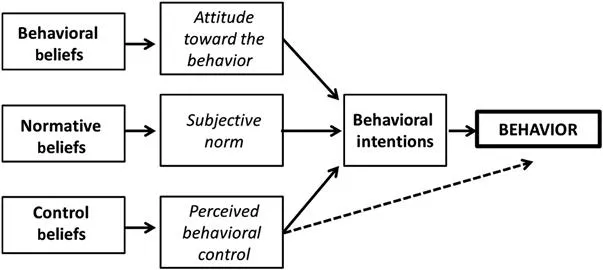
In the field that analyses the connection between behavior and beliefs, the study of convenience orientation has been confronted using the cognitive model known as the theory of planned behavior (TPB), which proposes a structured approach to explain the behavior of individuals (Ajzen, 1991, 2011).
At the basis of the model are the beliefs, shaped into behavioral, normative, and control beliefs (Ajzen, 1985). The first are defined as the expected outcomes of a particular behavior. They are weighed on the basis of a personal evaluation of these outcomes, generating the attitude towards the behavior, which can be positive or negative.
Normative beliefs concern the perception of the expectations of family members, friends, and other important referents. Along with personal motivations in satisfying the expectations of others, they are responsible for the social pressure to adopt (or not to adopt) a particular behavior.
Finally, control beliefs express the perception the individual has of his/her own assets in terms of resources, skills, and opportunities to adopt a particular behavior. The individual’s evaluation of the power of the aforesaid resources to facilitate or oppose the behavior determines the perceived behavioral control. According to the TPB, the connection between beliefs and behavior is represented by intention, defined as the individual’s inclination to adopt a particular behavior. The consequences of intention on behavior are moderated by the perceptions of behavioral control, in the sense that a favorable intention produces the behavior only if the perceived behavioral controls favor the behavior (Fig. 1.1).
The studies conducted in the ambit of RTE and ETP meals have analyzed the factors that can influence purchase behaviors; these factors can be traced to all three categories of beliefs, though the behavioral beliefs and therefo...
Table of contents
- Cover image
- Title page
- Table of Contents
- Copyright
- List of Contributors
- Preface
- Part I: Trends in food habits
- Part II: Microbiological hazards
- Part III: Toxicological hazards
- Index
Trusted by 375,005 students
Access to over 1.5 million titles for a fair monthly price.
Study more efficiently using our study tools.
Frequently asked questions
Yes, you can cancel anytime from the Subscription tab in your account settings on the Perlego website. Your subscription will stay active until the end of your current billing period. Learn how to cancel your subscription
No, books cannot be downloaded as external files, such as PDFs, for use outside of Perlego. However, you can download books within the Perlego app for offline reading on mobile or tablet. Learn how to download books offline
Perlego offers two plans: Essential and Complete
- Essential is ideal for learners and professionals who enjoy exploring a wide range of subjects. Access the Essential Library with 800,000+ trusted titles and best-sellers across business, personal growth, and the humanities. Includes unlimited reading time and Standard Read Aloud voice.
- Complete: Perfect for advanced learners and researchers needing full, unrestricted access. Unlock 1.5M+ books across hundreds of subjects, including academic and specialized titles. The Complete Plan also includes advanced features like Premium Read Aloud and Research Assistant.
We are an online textbook subscription service, where you can get access to an entire online library for less than the price of a single book per month. With over 1.5 million books across 990+ topics, we’ve got you covered! Learn about our mission
Look out for the read-aloud symbol on your next book to see if you can listen to it. The read-aloud tool reads text aloud for you, highlighting the text as it is being read. You can pause it, speed it up and slow it down. Learn more about Read Aloud
Yes! You can use the Perlego app on both iOS and Android devices to read anytime, anywhere — even offline. Perfect for commutes or when you’re on the go.
Please note we cannot support devices running on iOS 13 and Android 7 or earlier. Learn more about using the app
Please note we cannot support devices running on iOS 13 and Android 7 or earlier. Learn more about using the app
Yes, you can access Food Hygiene and Toxicology in Ready-to-Eat Foods by Parthena Kotzekidou in PDF and/or ePUB format, as well as other popular books in Technology & Engineering & Food Science. We have over 1.5 million books available in our catalogue for you to explore.