- 184 pages
- English
- ePUB (mobile friendly)
- Available on iOS & Android
eBook - ePub
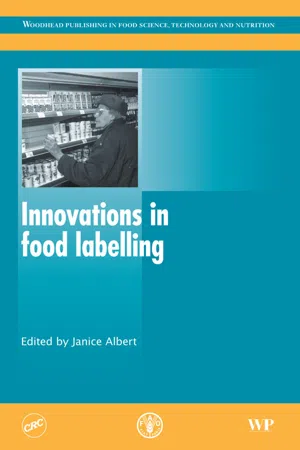
Innovations in Food Labelling
About this book
Increasingly, consumers desire information about the health, safety, environmental and socioeconomic characteristics of food products. These traits often cannot be detected by sight, smell or taste. Therefore, consumers must use food labels to select products that meet their needs and preferences. The growing consumer and industry interest in food labels presents challenges for governments, which must ensure that the product information is accurate, truthful and not misleading to consumers. Governments must decide whether provision of information should be mandatory or voluntary. With the increase in global trade in food, there is a need to harmonize food labels so that product information is understood and relevant to foreign markets.Innovations in food labelling provides information about the principles and requirements of food labelling and reviews the latest trends in this important area. Following an introduction on the evolution of food labelling, further chapters cover the Codex Alimentarius and food labelling, international trade agreements, nutrition labelling, allergies and food labels and environmental and social labels, among other topics.An essential reference for food regulatory agencies, food law experts and professionals in the food industry responsible for labelling as well as consumer and environmental associations with an interest in labelling.
- Provides important information about the principles and requirements of food labelling and reviews the trends in this area
- Documents label evolution and considers standards and legal issues, as well as protection of the environment and sustainable food production
- Features labels for a variety of different markets, including organic foods, and addresses social issues such as association of food quality with location
Information
1
Introduction to innovations in food labelling
Janice Albert Food and Agricultural Organization of the United Nations (FAO), Italy
Abstract
National labelling laws, international norms and guidelines as well as private standards aim to protect consumers from deception and businesses from unfair competition. Food labelling is also becoming a policy tool for motivating change in consumer behaviour and shifts in food production practices. In this process of developing labels, the interactions between private actors and public institutions are dynamic and complex, especially given the need to harmonize labels to facilitate trade. This book provides information about the rights and responsibilities that are the foundation for food labelling, and illustrates how labelling policies are developed. Labelling topics include the Codex Committee on Food Labelling, international trade agreements and human rights, nutrition, allergens, organic, eco-labelling for fish, fair trade, geographic indication and genetically modified foods.
Key words
labelling principles
international food standards
labelling and health
labelling and environment
labelling and socioeconomic conditions
1.1 Introduction: the evolution of food labelling
In their broadest and most conventional application, food labelling policies have a dual purpose: to protect consumers and to ensure fair marketing. National laws, international norms and guidelines as well as private standards prohibit labelling that misrepresents the quality of a product and deceives consumers. Prevention of false claims protects businesses from unfair competition. These basic principles were established long ago and they are still highly relevant.
All consumers need to be able to rely upon the truthfulness of information on a package, which helps them to distinguish among products and to make proper use of the products. At best, labels are part of the environment that enables consumers to make food choices according to their needs and desires. For labels to serve their intended purposes they should be accompanied by education and information. Yet, all too often, these resources are not available. This is why it is essential that labels are easy to understand and that those responsible for food package information do not take advantage of vulnerabilities.
For some, food labelling is seen as more than a form of minimal protection; it is a policy tool for motivating change in consumer behaviour and different food production practices. Increasingly, labelling relates specific products to consumers’ interests in health, the environment, culture and social well-being. As labelling policies encompass a larger number of topics, there are more interactions between private actors and public institutions. Each decision reflects a particular regulatory approach and state of knowledge, with the influences of different actors, agencies and events varying greatly. This leads to inconsistent approaches regarding labels and differences of opinion, even among experts. Within the same country or organization, one can find labelling policies that are very restrictive and others that are very permissive in terms of the type of information that may be placed on a package.
When considering international standards, the situation becomes even more intricate as each national organization brings its labelling ideas into the international arena and the process of harmonization begins. As more food is traded and labelling must meet the needs of consumers in different countries, the process for establishing specific labelling standards has become very challenging. The implications of every detail of a label are scrutinized before governments reach consensus on a standard, and the label gains acceptance of stakeholders. There is large scope for interpretation of the basic principles for specific foods and markets and a trend towards expansion of the principles, which can lead to contentious, lengthy and costly debates.
To facilitate the development and use of food labelling, more understanding of good labelling practices is needed among governments, industry, civil society organizations and consumers. This book aims to contribute to this goal by providing essential information about the rights and responsibilities that are the foundation for food labelling, and providing case studies of labels that are currently at different stages of development. Collectively, the chapters in this book provide a rich picture of the dynamic and multi-faceted topic of food labelling. While the subject of each chapter is different, there are common features and processes that can be discerned.
1.2 Standards and legal issues
Every food label must comply with food laws and standards. Because of the increased importance of the food trade, national authorities often pay close attention to harmonizing their laws with international standards. The Codex Alimentarius Commission is the recognized international authority for food standards setting. Since the Food and Agriculture Organization and the World Health Organization established the programme in 1962, labelling has been a fundamental aspect of the work. In fact, the first Codex food standard was a labelling standard. In Chapter 2, Randell explains the major labelling standards developed by Codex and how the work of the Codex Committee on Food Labelling is evolving. The Codex standards are increasingly relevant, particularly because they are recognized in international trade agreements of the World Trade Organization. In Chapter 3, Vidar explains the key international trade agreements and relates them to the international commitments and treaties to protect the rights of consumers. She notes that consumers have a right to affordable foods, thus it is important to consider the costs as well as the benefits of labelling.
1.3 Labelling to protect and promote health
In the 21st century, the information that is considered to be necessary or desirable for consumers to protect their health is changing dramatically. With the accumulation of scientific evidence linking food and health, there is a trend towards voluntary and mandatory food labelling as a tool to address nutrition-related problems. The latest trends in nutrition labelling are discussed by Hawkes in Chapter 4. As new foods become available in different markets, additional measures are being taken to protect consumers who may be allergic to certain foods, yet unaware that the foods are ingredients in unfamiliar products. These consumers need labels to warn them since they cannot detect which products contain ingredients that cause allergic reactions on their own. In Chapter 5, Hattersley and Chun-Han explain how food authorities ensure that the necessary information is available, without causing unnecessary dietary restrictions.
1.4 Labelling to protect the environment and promote sustainable food production
Labelling contributes to the efficient functioning of the market by enabling consumers to express their preferences, which may be based on values and interest as well as tastes, budgets and health. Public concern about the impact of food production on the environment has stimulated interest in labelling of organic foods and eco-labelling. Environmental organizations have promoted the use of food labels as a strategy of providing market incentives to encourage more sustainable production practices. The aims of the organic food industry and public and private procedures for protecting the integrity of their product labels are discussed by Compagnoni in Chapter 6. In Chapter 7, Willmann, Cochrane and Emerson explain the need for sustainable marine fishing practices and how eco-labelling may motivate better practices. The latest information on an international code within this industry is described and the process of developing the code is reviewed.
1.5 Labelling to promote social well-being and protect culture
Consumers may express their interest in preservation of traditional cultures and specific foods through their purchasing decisions. Others wish to support food producers in developing countries and food production that provides decent economic and social conditions. Labelling is a means for food producers to inform consumers about their ways of producing foods. With markets for products being thousands of miles from the place of production, consumers cannot determine whether the claims about production practices are true without certification by independent sources. Through certification, consumers gain confidence in the truthfulness of a specific label. In Chapter 7, Liu describes the business case for certification in relation to fair trade products. In Chapter 8, Vandecandelaere raises our awareness of the social dimension in food labelling in discussing geographic indicators (GI). GI labels have been used for centuries to distinguish foods with unique qualities; today they are being used to raise esteem and earnings for local producers. GI labels are intended to recognize and protect producer’s rights and protect culture and traditions.
1.6 Labelling in relation to new technologies
Governments and food producers need to stimulate economic growth and innovation, which may occur with new technologies for food production. At the same time, they must respect the views of citizens who may not be in favour of particular technological changes. Labelling is often preferred as a policy tool in such situations because it does not restrict a product from being marketed but it allows consumers to express their views through their purchases. In theory, the market will determine whether a technology will succeed since labelling provides information to buyers and their actions give a signal to sellers about consumer preferences. As shown in the examples above, the food producer expects to be rewarded for practices that are desired by consumers. Labelling can also enable consumers to reject a product, with the loss in sales causing the producer to remove the product from the market.
In the case of genetically modified foods, labelling has been proposed as a way to allow consumers to demonstrate their views about the technology. In Chapter 10, Albert reports on the seven major labelling options for GM foods found among the countries that belong to the Codex Alimentarius Commission. She provides information about two of the most controversial approaches, the voluntary ap- proach of the United States of America and the mandatory approach of the European Union.
2
The Codex Alimentarius and Food Labelling: delivering consumer protection
Alan W. Randell former Secretary of the Codex Alimentarius Commission, Italy
Abstract
The Codex General Standard for the Labelling of Prepackaged Foods and other Codex texts dealing with claims in general and health and nutrition claims in particular are described in a historical context. It is possible to demonstrate a transition from trade-based standards to consumer-based standards and guidelines – a process that is still underway. The main shift is from a strict ‘prevention of fraud’ scenario (1960s) to a scenario of providing consumer information (1990s) and, finally, to a scenario of delivering health policy through labelling.
Key words
Codex Alimentarius
food labelling
consumer protection
fraudulent claims
nutrition
health claims
‘organic’ food
irradiated food
‘Halal’ food
biotechnology
allergens
diet
non-communicable disease
2.1 Introduction
The Codex General Standard for the Labelling of Pre-Packaged Foods was adopted in 1969: the first international standard to be approved by the newly-formed Codex Alimentarius Commission (CAC, 1969). The fact that the Standard bears the number “Codex-Stan 1” reflects its central importance as the principal Codex standard for consumer protection and for ensuring fair practices in the food trade. The General Standard was extensively revised and enlarged in 1985 and, since then, numerous amendments and additions have ensured that the Standard remains the key Codex instrument for delivering information about food to the consumer.
The General Standard is accompani...
Table of contents
- Cover image
- Title page
- Table of Contents
- Copyright page
- Foreword
- 1: Introduction to innovations in food labelling
- 2: The Codex Alimentarius and Food Labelling: delivering consumer protection
- 3: International legal frameworks for food labelling and consumer rights
- 4: Government and voluntary policies on nutrition labelling: a global overview
- 5: Labelling of allergenic foods of concern in Europe
- 6: Organic food labels: history and latest trends
- 7: FAO’s ecolabelling guidelines for marine capture fisheries: an international standard
- 8: Voluntary environmental and social labels in the food sector
- 9: Geographic origin and identification labels: associating food quality with location
- 10: New technologies and food labelling: the controversy over labelling of foods derived from genetically modified crops
- Index
Trusted by 375,005 students
Access to over 1.5 million titles for a fair monthly price.
Study more efficiently using our study tools.
Frequently asked questions
Yes, you can cancel anytime from the Subscription tab in your account settings on the Perlego website. Your subscription will stay active until the end of your current billing period. Learn how to cancel your subscription
No, books cannot be downloaded as external files, such as PDFs, for use outside of Perlego. However, you can download books within the Perlego app for offline reading on mobile or tablet. Learn how to download books offline
Perlego offers two plans: Essential and Complete
- Essential is ideal for learners and professionals who enjoy exploring a wide range of subjects. Access the Essential Library with 800,000+ trusted titles and best-sellers across business, personal growth, and the humanities. Includes unlimited reading time and Standard Read Aloud voice.
- Complete: Perfect for advanced learners and researchers needing full, unrestricted access. Unlock 1.5M+ books across hundreds of subjects, including academic and specialized titles. The Complete Plan also includes advanced features like Premium Read Aloud and Research Assistant.
We are an online textbook subscription service, where you can get access to an entire online library for less than the price of a single book per month. With over 1.5 million books across 990+ topics, we’ve got you covered! Learn about our mission
Look out for the read-aloud symbol on your next book to see if you can listen to it. The read-aloud tool reads text aloud for you, highlighting the text as it is being read. You can pause it, speed it up and slow it down. Learn more about Read Aloud
Yes! You can use the Perlego app on both iOS and Android devices to read anytime, anywhere — even offline. Perfect for commutes or when you’re on the go.
Please note we cannot support devices running on iOS 13 and Android 7 or earlier. Learn more about using the app
Please note we cannot support devices running on iOS 13 and Android 7 or earlier. Learn more about using the app
Yes, you can access Innovations in Food Labelling by J Albert in PDF and/or ePUB format, as well as other popular books in Technology & Engineering & Marketing. We have over 1.5 million books available in our catalogue for you to explore.