- 448 pages
- English
- ePUB (mobile friendly)
- Available on iOS & Android
eBook - ePub
Understanding and Measuring the Shelf-Life of Food
About this book
The shelf-life of a product is critical in determining both its quality and profitability. This important collection reviews the key factors in determining shelf-life and how it can be measured.Part one examines the factors affecting shelf-life and spoilage, including individual chapters on the major types of food spoilage, the role of moisture and temperature, spoilage yeasts, the Maillard reaction and the factors underlying lipid oxidation. Part two addresses the best ways of measuring the shelf-life of foods, with chapters on modelling food spoilage, measuring and modelling glass transition, detecting spoilage yeasts, measuring lipid oxidation, the design and validation of shelf-life tests and the use of accelerated shelf-life tests.Understanding and measuring the shelf-life of food is an important reference for all those concerned with extending the shelf-life of food.
- Reviews the key factors in determining shelf-life and how they can be measured
- Examines the importance of the shelf-life of a product in determining its quality and profitability
- Brings together the leading international experts in the field
Information
Part I
Factors affecting shelf-life and spoilage
1
The major types of food spoilage: an overview
R.P. Singh; B.A. anderson University of California, USA
1.1 Introduction
All food products are composed of biological raw materials. Biological products inherently spoil and deteriorate over time. This spoilage and deterioration cannot be completely stopped; however, it is the desire of food processors to slow this rate of deterioration as much as possible through formulation, processing, packaging, storage and handling. To properly address this problem of spoilage it is first important to understand what is meant by food spoilage and by what various modes can it take place.
Food spoilage can be defined in several different ways. Generally, a food is considered spoiled when it is no longer acceptable to the consumer. The worst case of spoilage is when it becomes a food safety issue, where the food product may cause the consumer illness or even death. However, less serious cases of food spoilage can simply be that the color, flavor, texture, or aroma of the food has deteriorated to the point that it is no longer acceptable. Another case of spoilage could be that the nutrients (e.g. vitamin content) in the food have deteriorated to the point that the food product no longer meets its declared nutritional value. The time it takes for a food product to reach one of these spoilage conditions is generally termed the product's shelf-life.
Many food products have some variation of open shelf-life dating marked on their containers. Open shelf-life dating varies widely by product, region, and manufacturer. Common open shelf-life dates include a ‘sell-by-date’, a ‘best-if-used-by-date’, or a ‘better-if-used-by-date’. These dates help the consumer to decide how long the product may be stored prior to consumption and also help with stock rotation in grocery stores. Hopefully the food manufacturer conducted studies to properly determine the shelf-life of their product; however, often the date given assumes proper storage conditions of the product prior to consumption. It is important to understand what types of spoilage may occur in a product, how to best reduce the rate of deterioration of the product, and how to properly measure or detect its occurrence.
The three main categories of food spoilage that can occur are physical spoilage, chemical spoilage, and microbiological spoilage. There are some overlaps between the three categories, and often spoilage in one category can help to promote spoilage in another category. Table 1.1 lists the major mechanisms for spoilage or deterioration of various food categories. There are several main factors that influence most types of spoilage. These factors include temperature, pH, water activity, exposure to oxygen and light, and nutrients or chemicals available in the food product. Figure 1.1 shows graphically how one of these factors, water activity, affects various chemical and microbiological changes in typical food products. Each of the three main categories of spoilage is briefly reviewed in this chapter.
Table 1.1
Deterioration/spoilage mechanisms and critical variables for various food products (Kilcast and Subramaniam, 2000; Labuza and Szybist, 2001)
| Food product/category | Type of spoilage/deterioration | Critical storage variables |
| Milk | Oxidation, hydrolytic rancidity, bacterial growth | Oxygen, temperature |
| Milk powder | Oxidation, browning, caking | Oxygen, humidity, temperature |
| Dairy products | Oxidation, rancidity, lactose crystallization | Oxygen, temperature |
| Ice cream | Ice crystal or lactose crystal formation, oxidation | Temperature (freeze/thaw), oxygen |
| Fresh beef | Microbial (bacterial) growth, oxidation, moisture loss | Temperature, oxygen, light, humidity |
| Fresh poultry | Microbial growth | Temperature, oxygen |
| Fresh fish and seafood | Microbial growth, oxidation | Temperature, oxygen |
| Fruit | Enzymatic softening, microbial growth, bruising, moisture loss | Temperature, light, oxygen, handling, humidity |
| Leafy vegetables | Enzymatic activity, moisture loss/wilting, microbial growth | Temperature, light, oxygen, humidity |
| Crisp vegetables | Enzymatic softening, microbial growth, bruising, moisture loss | Temperature, light, oxygen, handling, humidity |
| Bread | Moisture migration (staling), starch retrogradation, microbial (mold) growth | Humidity, temperature, oxygen |
| Cereals | Moisture migration (softening), starch retrogradation, oxidation, breakage | Humidity, temperature, oxidation, handling |
| Soft bakery products | Moisture migration (staling), microbial (mold) growth, starch retrogradation | Humidity, temperature, oxygen |
| Crisp bakery/fried products (cracker, etc.) | Moisture migration (softening), oxidation, breakage | Humidity, temperature, oxygen, handling, light |
| Chocolate | Sugar crystallization (sugar bloom), fat crystallization (fat bloom), oxidation | Humidity, temperature, oxidation |
| Candy | Moisture migration (stickiness), sugar crystallization | Temperature, humidity |
| Beer | Oxidation, microbial growth | Oxygen, light, temperature |
| Coffee/tea | Oxidation, volatile loss | Oxygen, light, moisture |
| Frozen meats | Oxidation, freezer burn (drying) | Oxygen, temperature, humidity |
| Other frozen foods | Oxidation, ice crystal formation, texture change | Oxygen, temperature |
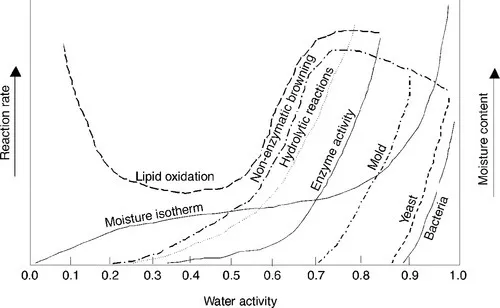
Fig. 1.1 Relative water activity stability map (from Labuza et al., 1970).
1.2 Physical instability
The first type of spoilage that can occur is due to physical changes or instability. This can include physical damage such as bruising of fresh fruits and vegetables or breaking of dry, brittle products such as potato chips and breakfast cereals. Bruising of fruits and vegetables can occur during transportation and distribution or by dropping the products. If the physical damage is severe, the product may become unacceptable to the consumer. There can be color changes due to enzymatic browning as cells are ruptured and there is often loss of water content at the bruise. In addition, bruising causes damage to cells and allows microbial growth to occur more readily. Breaking of dry, brittle products can make many products such as crackers, potato chips, ready-to-eat cereals, piecrusts, and many frozen foods unacceptable. The use of well-designed packaging systems that protect the products from vibrations and mechanical damage during distribution and handling can minimize the effects of bruising and breakage.
Most other physical changes or instabilities involve moisture or mass transfer of components in the food. A frequent cause of degradation of food products is a change in their water content (water loss, gain, or migration). The change in moisture alone may cause the product to become unacceptable, though frequently it also leads to other problems such as microbial or chemical degradation, which will be discussed in later sections. Moisture transfer occurs in foods due to gradients in chemical potential, which is directly related to the food's water activity (aw). Water activity is defined as the equilibrium relative humidity for a produ...
Table of contents
- Cover image
- Title page
- Table of Contents
- Copyright page
- Contributor contact details
- Part I: Factors affecting shelf-life and spoilage
- Part II: Measuring shelf-life and spoilage
- Index
Trusted by 375,005 students
Access to over 1.5 million titles for a fair monthly price.
Study more efficiently using our study tools.
Frequently asked questions
Yes, you can cancel anytime from the Subscription tab in your account settings on the Perlego website. Your subscription will stay active until the end of your current billing period. Learn how to cancel your subscription
No, books cannot be downloaded as external files, such as PDFs, for use outside of Perlego. However, you can download books within the Perlego app for offline reading on mobile or tablet. Learn how to download books offline
Perlego offers two plans: Essential and Complete
- Essential is ideal for learners and professionals who enjoy exploring a wide range of subjects. Access the Essential Library with 800,000+ trusted titles and best-sellers across business, personal growth, and the humanities. Includes unlimited reading time and Standard Read Aloud voice.
- Complete: Perfect for advanced learners and researchers needing full, unrestricted access. Unlock 1.5M+ books across hundreds of subjects, including academic and specialized titles. The Complete Plan also includes advanced features like Premium Read Aloud and Research Assistant.
We are an online textbook subscription service, where you can get access to an entire online library for less than the price of a single book per month. With over 1.5 million books across 990+ topics, we’ve got you covered! Learn about our mission
Look out for the read-aloud symbol on your next book to see if you can listen to it. The read-aloud tool reads text aloud for you, highlighting the text as it is being read. You can pause it, speed it up and slow it down. Learn more about Read Aloud
Yes! You can use the Perlego app on both iOS and Android devices to read anytime, anywhere — even offline. Perfect for commutes or when you’re on the go.
Please note we cannot support devices running on iOS 13 and Android 7 or earlier. Learn more about using the app
Please note we cannot support devices running on iOS 13 and Android 7 or earlier. Learn more about using the app
Yes, you can access Understanding and Measuring the Shelf-Life of Food by R. Steele in PDF and/or ePUB format, as well as other popular books in Technology & Engineering & Food Science. We have over 1.5 million books available in our catalogue for you to explore.