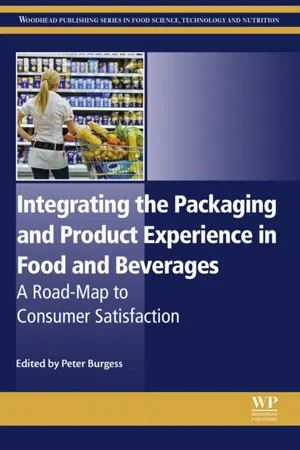
eBook - ePub
Integrating the Packaging and Product Experience in Food and Beverages
A Road-Map to Consumer Satisfaction
- 220 pages
- English
- ePUB (mobile friendly)
- Available on iOS & Android
eBook - ePub
Integrating the Packaging and Product Experience in Food and Beverages
A Road-Map to Consumer Satisfaction
About this book
Integrating the Packaging and Product Experience in Food and Beverages: A Road-Map to Consumer Satisfaction focuses on the interrelationship between packaging and the product experience. In both industry and academia there has been a growing interest in investigating approaches that capture consumer responses to products that go beyond traditional sensory and liking measures. These approaches include assessing consumers' emotional responses, obtaining temporal measures of liking, as well as numerous published articles considering the effect of situation and context in the evaluation of food and beverage products.
For fast-moving consumer goods (FMCG) products in particular, packaging can be considered as a contributor to consumer satisfaction. Recent cross-modal research illustrated consumers' dissatisfaction or delight with a product can be evoked when there is dissonance between the packaging and the product experience.
The book includes an extensive overview of an adapted satisfaction scale that has been tailored for the food and beverage sector and which identifies varying satisfaction response modes such as contentment, pleasure, and delight with a product. This is an important development as it provides insights about products that can be used to market specific categories and brands of foods and beverages.
The book demonstrates the value of this approach by bringing together case studies that consider the interrelationships between packaging design, shape, on-pack sensory messages, expectations, and consumer satisfaction with the product.
- Focuses on the inter-relationship between packaging and the product experience, specifically in the context of the food and beverage sector
- Presents the expectancy disconfirmation model of satisfaction, which is well developed within the social sciences, to the food and beverage sector
- Contains case studies demonstrating how these practices can be used in industry to better enhance customer's responses to products
- Includes an extensive overview of an adapted satisfaction scale that has been tailored for the food and beverage sector and which identifies varying satisfaction response modes such as contentment, pleasure, and delight with a product
Information
Subtopic
Comportamiento del consumidor1
Multisensory Packaging Design
Color, Shape, Texture, Sound, and Smell
C. Spence Oxford University, Oxford, United Kingdom
Abstract
The visual aspects of packaging design (think here of color and form, or image mold) are critical to the success or failure of many of the products on the supermarket shelf. While a large body of research has detailed the meaning and impact of packaging color, the haptic (or tactile), auditory, and olfactory attributes of packaging design have to date received far less attention from researchers. In this review, the literature on multisensory food and beverage packaging is critically evaluated, with a focus on the contributions of the various senses to the consumer's overall multisensory product experience. Evidence is reviewed concerning how the color (not to mention the other sensory cues) associated with product packaging can capture the shopper's attention on shelf, while at the same time signaling the likely flavor of the contents. What is more, the multisensory attributes of the packaging can influence the consumer's perception of the taste/flavor of the contents. Given the lower costs of production/development, together with the growing awareness of its importance, interest in the multisensory attributes of product packaging is only likely to increase in the years to come.
Keywords
Color; Haptics; Image mold; Multisensory; Packaging; Shape; Smell; Sound; Texture1.1. Introduction
The multisensory attributes of the packaging undoubtedly constitute a key element in the success of many, if not all, mass market food and beverage products (eg, Klimchuk and Krasovec, 2013; Moskowitz et al., 2009; Paine and Paine, 1992). In recent years, the function of food and beverage packaging has certainly gone far beyond its original role in portion control and product preservation (see Hine, 1995 for a historical overview). In fact, as the decades have passed by, the key role(s) played by the packaging in marketing has become increasingly clear (see Calder, 1983; Day, 1985; Lannon, 1986; Masten, 1988; Pilditch, 1973; Sacharow, 1982; Schlossberg, 1990; Simms and Trott, 2010; Underwood and Ozanne, 1998; Vartan and Rosenfeld, 1987); Nowadays, then, packaging really is the fifth “P” in the marketing mix (eg, Nickels and Jolsen, 1976). Here at the outset, though, it is perhaps worth bearing in mind that the cost of the packaging far exceeds that of the contents in many product categories (see Spence and Piqueras-Fiszman, 2012). No wonder, then, that getting the packaging “right” has become such a key element of the marketing strategy for many companies when it comes to trying to ensure the long-term success of their products in the increasingly competitive marketplace. At the same time, however, many companies are having to deal with a growing consumer and governmental backlash against what is perceived (by many) to be an excess of packaging (eg, see Anon, 2006; Finch and Smithers, 2006; Usborne, 2012).
In this review, I will focus on the multisensory aspects of packaging design for food and beverage products, an area of growing interest in recent years (eg, Anon, 2010b; Day, 1985; Hruby and Sorensen, 1999; Spence and Piqueras-Fiszman, 2012). Food and beverage packaging is a particularly intriguing category because it is one in which the packaging has to serve multiple functions. On the one hand, it obviously needs to stand out on the shelf (just as for other product categories). However, given that it has been estimated that we consume as much as a third of the food products we buy direct from the packaging, which certainly needs to be optimized for the consumption experience as well. In fact, a growing body of both anecdotal and empirical research now shows that changing the multisensory design of the packaging can significantly affect people’s judgments of the contents (eg, Mohan, 2013; Raine, 2007). No surprise, then, that over the last few years it has been estimated that a third of the world’s largest brands have been working on “sensory branding” strategies (Johnson, 2007). Indeed, time and again, it would seem that consumers have a hard time when it comes to trying to report solely on the sensory/hedonic properties of products themselves. That is, they are often influenced in their evaluations by the extrinsic (Underwood, 1993) sensory properties of, and meanings attached to, the product packaging (see Spence and Piqueras-Fiszman, 2012). More often than not, what one sees, at least in the setting of the laboratory, is that people’s feelings about the packaging tend to carry over and influence what they say about the contents (that is, the product itself) when they come to taste/evaluate them. Such effects have been described in terms of the notion of “sensation transference” (Cheskin, 1957; Spence and Piqueras-Fiszman, 2012) or “affective ventriloquism” (Spence and Gallace, 2011).
The fact that our perception of a product can be so radically affected by the multisensory design of the packaging obviously raises troubling questions concerning the utility of so much blind food and beverage testing, where products are evaluated away from any of their packaging (Davis, 1987). How can one ever hope to predict the ultimate success of a product under such conditions, one might well ask (Spence, 2009)?
The focus in this review will be on the various sensory aspects of the packaging. I want to start by looking at those attributes of the packaging that can be ascertained visually, namely the color, shape, and texture—though, of course, the latter two can also be experienced haptically in the consumer’s hands (eg, Piqueras-Fiszman and Spence, 2012a; Spence and Piqueras-Fiszman, 2012). The sound made by the packaging when a product is picked up from off of the shelf, or when it is opened, also constitutes a potentially important, if often overlooked, aspect of the consumer’s overall multisensory product experience (see Byron, 2012; Spence and Piqueras-Fiszman, 2012; Spence and Wang, 2015). Finally, there has been a recent growth of interest in scent-enabled packaging; and, as we will see later, some innovative souls are even considering the possible market for edible packaging (just think of the analogy with the skin of the grape; see http://www.wikipearl.com/).
1.2. Neuroscience-Inspired Packaging Design
Part of the recent growth of interest in multisensory packaging design undoubtedly stems from the potential utilization of some of the latest research techniques from the field of experimental psychology and cognitive neuroscience. Increasingly, such methods are being used to help packaging designers discriminate between the different design alternatives that they might be considering. Techniques such as the implicit association test (see Parise and Spence, 2012; Piqueras-Fiszman and Spence, 2011; see also Maison et al., 2004) and eye-tracking (Clement, 2007), especially when combined with other techniques such as word analysis (eg, Piqueras-Fiszman et al., 2013; see also Ares and Deliza, 2010) or the analysis of a consumer’s grasping behavior (Juravle et al., 2015; see also Desanghere and Marotta, 2011), would seem especially promising here. That said, not all of the innovative techniques that have been tried in the area of multisensory packaging design have proved successful (eg, see Durgee and O’Connor, 1996).
Another area of rapidly growing research interest relates to the use of online testing platforms such as Mechanical Turk and Prolific Academic (see Woods et al., 2015 for a recent review). These online resources are increasingly enabling researchers to evaluate the relative merits of various different packaging designs in diverse markets at surprisingly low cost (and in a time frame that is likely to keep the marketing manager happy). In our own work in this area, for instance, we have often been able to collect data from more than 300 participants in less than an hour (eg, Velasco et al., 2015b). While the spread in terms of the participant base is still not ideal when it comes to answering many marketing questions, the explosion of online testing resources is definitely one emerging approach to packaging research to watch closely in the coming years.
In recent years, a growing number of research practitioners have become increasingly excited by the possibilities associated with the use of cognitive neuroscience techniques such as functional magnetic resonance imaging and event-related potentials. The suggestion from the neuromarketers is that such research methods can be used to evaluate the design of product packaging more directly, that is, without having to rely on what the consumer says that they are going to do, or which of a range of packaging design alternatives they indicate that they prefer (eg, Basso et al., 2014; Pradeep, 2010; Stoll et al., 2008). My suspicion, though, is that such enthusiasm for the neuromarketing approach is currently misplaced, especially when it comes to the evaluation of multisensory packag...
Table of contents
- Cover image
- Title page
- Table of Contents
- Related titles
- Copyright
- List of Contributors
- Woodhead Publishing Series in Food Science, Technology and Nutrition
- Preface & Acknowledgments
- 1. Multisensory Packaging Design: Color, Shape, Texture, Sound, and Smell
- 2. Consumer Reactions to On-Pack Educational Messages
- 3. Designing Inclusive Packaging
- 4. Omni-Channel Retail—Challenges and Opportunities for Packaging Innovation
- 5. Emotion Measurements and Application to Product and Packaging Development
- 6. Neurosense and Packaging: Understanding Consumer Evaluations Using Implicit Technology
- 7. Explicit Methods to Capture Consumers’ Responses to Packaging
- 8. Consumers’ Mindset: Expectations, Experience, and Satisfaction
- Looking Forward
- Index
Trusted by 375,005 students
Access to over 1.5 million titles for a fair monthly price.
Study more efficiently using our study tools.
Frequently asked questions
Yes, you can cancel anytime from the Subscription tab in your account settings on the Perlego website. Your subscription will stay active until the end of your current billing period. Learn how to cancel your subscription
No, books cannot be downloaded as external files, such as PDFs, for use outside of Perlego. However, you can download books within the Perlego app for offline reading on mobile or tablet. Learn how to download books offline
Perlego offers two plans: Essential and Complete
- Essential is ideal for learners and professionals who enjoy exploring a wide range of subjects. Access the Essential Library with 800,000+ trusted titles and best-sellers across business, personal growth, and the humanities. Includes unlimited reading time and Standard Read Aloud voice.
- Complete: Perfect for advanced learners and researchers needing full, unrestricted access. Unlock 1.5M+ books across hundreds of subjects, including academic and specialized titles. The Complete Plan also includes advanced features like Premium Read Aloud and Research Assistant.
We are an online textbook subscription service, where you can get access to an entire online library for less than the price of a single book per month. With over 1.5 million books across 990+ topics, we’ve got you covered! Learn about our mission
Look out for the read-aloud symbol on your next book to see if you can listen to it. The read-aloud tool reads text aloud for you, highlighting the text as it is being read. You can pause it, speed it up and slow it down. Learn more about Read Aloud
Yes! You can use the Perlego app on both iOS and Android devices to read anytime, anywhere — even offline. Perfect for commutes or when you’re on the go.
Please note we cannot support devices running on iOS 13 and Android 7 or earlier. Learn more about using the app
Please note we cannot support devices running on iOS 13 and Android 7 or earlier. Learn more about using the app
Yes, you can access Integrating the Packaging and Product Experience in Food and Beverages by Peter Burgess in PDF and/or ePUB format, as well as other popular books in Tecnología e ingeniería & Comportamiento del consumidor. We have over 1.5 million books available in our catalogue for you to explore.